US ’mother of all bombs’ killed 36 Daesh militants in Afghanistan

1 / 4
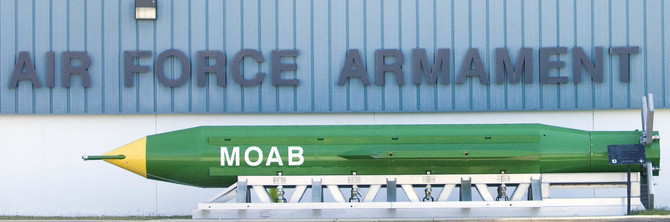
A group gathers around a GBU-43B, or massive ordnance air blast (MOAB) weapon, on display at the Air Force Armament Museum on Eglin Air Force Base. (AP)
2 / 4
A GBU-43B, or massive ordnance air blast (MOAB) weapon, on display at the Air Force Armament Museum on Eglin Air Force Base. (AP)
3 / 4
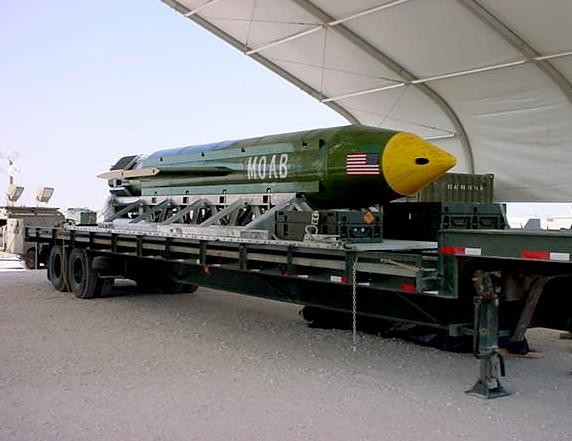
The US military dropped what is considered to be the largest non-nuclear bomb on an Daesh complex in Afghanistan, the Pentagon said. The GBU-43/B Massive Ordnance Air Blast bomb hit a “tunnel complex” in Achin district in Nangarhar province, US Forces Afghanistan said in a statement. ( AFP PHOTO/US AIR FORCE)
4 / 4
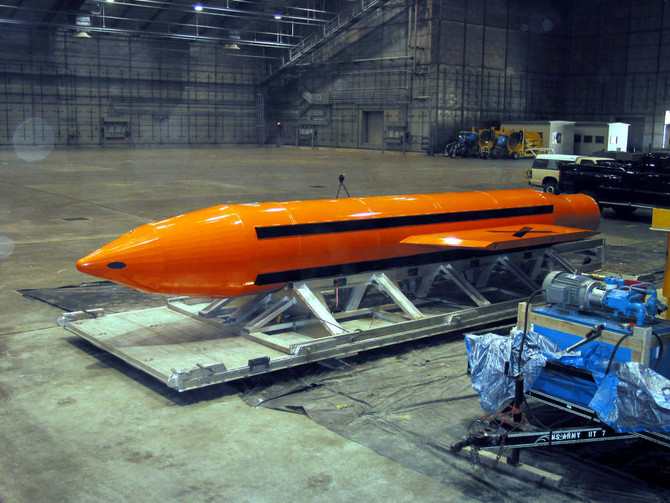
A Massive Ordnance Air Blast (MOAB) weapon is prepared for testing at the Eglin Air Force Armament Center. (REUTERS)
Updated 14 April 2017
Follow

US ’mother of all bombs’ killed 36 Daesh militants in Afghanistan

KABUL: As many as 36 suspected Daesh militants were killed in Afghanistan when the United States dropped “the mother of all bombs,” its largest non-nuclear device ever unleashed in combat, the Afghan Defense Ministry said on Friday.
The claims have not been independently verified, but ministry spokesman Dawlat Waziri said no civilians were harmed in Thursday’s massive blast that targeted a network of caves and tunnels.
“No civilian has been hurt and only the base which Daesh used to launch attacks in other parts of the province, was destroyed,” Waziri said in a statement, using an Arabic term for Islamic State, which has established a small stronghold in eastern Afghanistan and launched deadly attacks on the capital, Kabul. 


Germany’s Merz and Ukraine’s Zelensky praise truce efforts

Updated 30 January 2026
Follow

Germany’s Merz and Ukraine’s Zelensky praise truce efforts

  • Donald Trump said Vladimir Putin had agreed to a week-long halt on attacks

BERLIN: German Chancellor Friedrich Merz and President Volodymyr Zelensky on Thursday welcomed “efforts in favor of a truce,” Berlin said, after Donald Trump said Vladimir Putin had agreed to a week-long halt on attacks on Ukraine’s power grid.
Merz at the same time stressed that “the systematic and brutal destruction of Ukraine’s civilian infrastructure by Russian attacks” was “still ongoing,” which he condemned “in the strongest terms,” his spokesman, Stefan Kornelius, said.