US drops 'Mother Of All Bombs' in Afghanistan

1 / 5
2 / 5
In this photograph taken on April 11, 2017, smoke rises after an air strike by US aircraft on positions during an ongoing an operation against Daesh militants in the Achin district of Afghanistan's Nangarhar province. An American special forces soldier has been killed while conducting operations against the Daesh group in Afghanistan, the US military said. The US-backed Afghan military has vowed to wipe out the group in its strongholds in the eastern province of Nangarhar as Daesh challenges the more powerful Taliban on its own turf. (AFP)
3 / 5
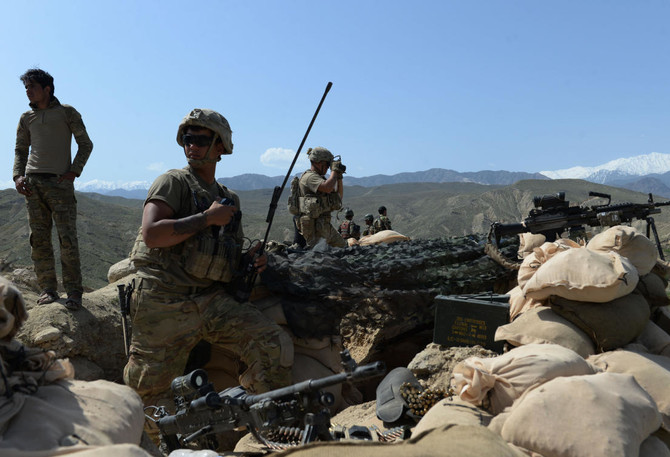
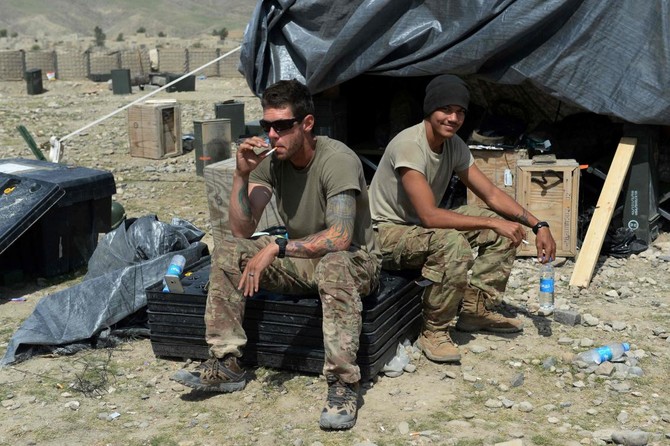
In this photograph taken on April 11, 2017, US soldiers take up positions during an ongoing an operation against Daesh militants in Achin district of Nangarhar province. An American special forces soldier has been killed while conducting operations against the Daesh group in Afghanistan, the US military said. The US-backed Afghan military has vowed to wipe out the group in its strongholds in the eastern province of Nangarhar as Daesh challenges the more powerful Taliban on its own turf. (AFP)
4 / 5
April 11, 2017, an Afghan security force personnel fires during an ongoing an operation against Daesh militants in the Achin district of Nangarhar province. An American special forces soldier has been killed while conducting operations against the Daesh group in Afghanistan, the US military said. The US-backed Afghan military has vowed to wipe out the group in its strongholds in the eastern province of Nangarhar as Daesh challenges the more powerful Taliban on its own turf. (AFP)
5 / 5
In this photograph taken on April 11, 2017, US soldiers look on during an ongoing an operation against Daesh militants in the Achin district of Nangarhar province. An American special forces soldier has been killed while conducting operations against the Daesh group in Afghanistan, the US military said. The US-backed Afghan military has vowed to wipe out the group in its strongholds in the eastern province of Nangarhar as Daesh challenges the more powerful Taliban on its own turf. (AFP)
Updated 14 April 2017
Follow

US drops 'Mother Of All Bombs' in Afghanistan

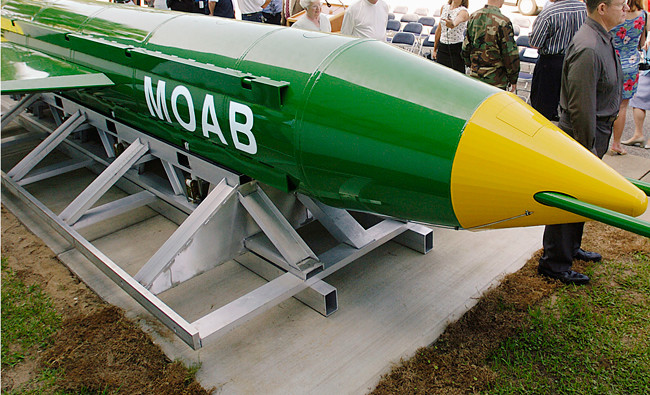
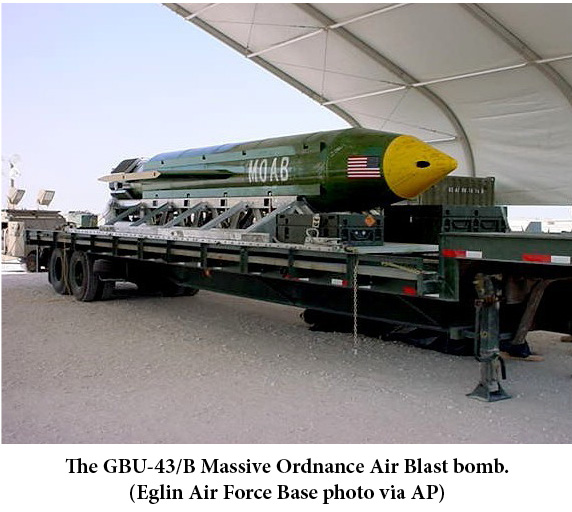
WASHINGTON: US forces in Afghanistan on Thursday struck a Daesh (Islamic State) tunnel complex in eastern Afghanistan with “the mother of all bombs,” the largest non-nuclear weapon every used in combat by the US military, Pentagon officials said.
The bomb, known officially as a GBU-43B, or massive ordnance air blast weapon, unleashes 11 tons of explosives. When it was developed in the early 2000s the Pentagon did a formal review of legal justification for its combat use.
The US military headquarters in Kabul said in a statement that the bomb was dropped at 7:32 p.m. local time Thursday on a tunnel complex in Achin district of Nangarhar province, where the Afghan affiliate of the Daesh group has been operating.
The target was close to the Pakistani border.
Adam Stump, a Pentagon spokesman, said the bomb was dropped from a US Air Force MC-130 transport, which he said had been brought to Afghanistan “some time ago” for potential use.
Army Gen. John W. Nicholson, commander of US forces in Afghanistan, said in a written statement that the strike was designed to minimize the risk to Afghan and US forces conducting clearing operations in the Achin area “while maximizing the destruction” of Daesh fighters and facilities. He said Daesh has been using improvised explosive devices, bunkers and tunnels to strengthen its defenses.
“This is the right munition to reduce these obstacles and maintain the momentum of our offensive against ISIS-K,” he added, using the US military’s acronym for the Daesh affiliate.
India, Arab League target $500bn in trade by 2030

Updated 01 February 2026
Follow

India, Arab League target $500bn in trade by 2030

  • It was the first such gathering of India–Arab FMs since the forum’s inauguration in 2016
  • India and Arab states agree to link their startup ecosystems, cooperate in the space sector

NEW DELHI: India and the Arab League have committed to doubling bilateral trade to $500 billion by 2030, as their top diplomats met in New Delhi for the India–Arab Foreign Ministers’ Meeting. 

The foreign ministers’ forum is the highest mechanism guiding India’s partnership with the Arab world. It was established in March 2002, with an agreement to institutionalize dialogue between India and the League of Arab States, a regional bloc of 22 Arab countries from the Middle East and North Africa.

The New Delhi meeting on Saturday was the first gathering in a decade, following the inaugural forum in Bahrain in 2016.

India’s Foreign Minister S. Jaishankar said in his opening remarks that the forum was taking place amid a transformation in the global order.

“Nowhere is this more apparent than in West Asia or the Middle East, where the landscape itself has undergone a dramatic change in the last year,” he said. “This obviously impacts all of us, and India as a proximate region. To a considerable degree, its implications are relevant for India’s relationship with Arab nations as well.”

Jaishankar and his UAE counterpart co-chaired the talks, which aimed at producing a cooperation agenda for 2026-28.

“It currently covers energy, environment, agriculture, tourism, human resource development, culture and education, amongst others,” Jaishankar said.

“India looks forward to more contemporary dimensions of cooperation being included, such as digital, space, start-ups, innovation, etc.”

According to the “executive program” released by India’s Ministry of External Affairs, the roadmap agreed by India and the League outlined their planned collaboration, which included the target “to double trade between India and LAS to US$500 billion by 2030, from the current trade of US$240 billion.”

Under the roadmap, they also agreed to link their startup ecosystems by facilitating market access, joint projects, and investment opportunities — especially health tech, fintech, agritech, and green technologies — and strengthen cooperation in space with the establishment of an India–Arab Space Cooperation Working Group, of which the first meeting is scheduled for next year.

Over the past few years, there has been a growing momentum in Indo-Arab relations focused on economic, business, trade and investment ties between the regions that have some of the world’s youngest demographics, resulting in a “commonality of circumstances, visions and goals,” according to Muddassir Quamar, associate professor at the School of International Studies, Jawaharlal Nehru University.

“The focus of the summit meeting was on capitalizing on the economic opportunities … including in the field of energy security, sustainability, renewables, food and water security, environmental security, trade, investments, entrepreneurship, start-ups, technological innovations, educational cooperation, cultural cooperation, youth engagement, etc.,” Quamar told Arab News.

“A number of critical decisions have been taken for furthering future cooperation in this regard. In terms of opportunities, there is immense potential.”