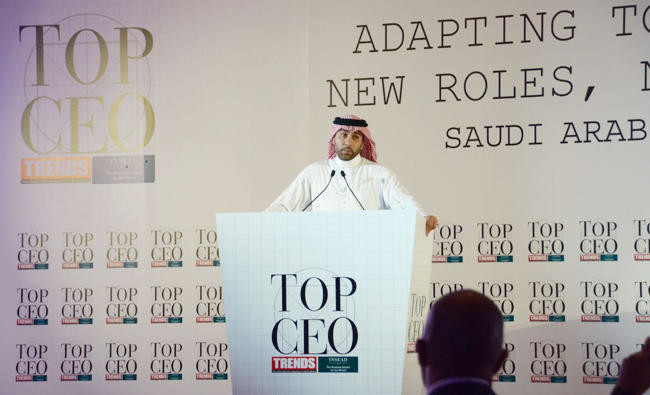
KING ABDULLAH ECONOMIC CITY: Fahd Al-Rasheed, chief executive of King Abdullah Economic City (KAEC), believes that the Saudi business community is in for a challenging time.
But he said it has no alternative but to adapt to the transformation underway in the Kingdom’s economy and society.
Speaking at the opening plenary session of the Top CEO Conference in KAEC, Al-Rasheed told delegates: “The next three or four years will be challenging for all of us but there is only one way.”
He added: “We will have to change and adapt to the two big shifts that have taken place: the change that has overtaken the oil economy as a result of the decline in energy prices; and the economic restructuring and transformation that is taking place.
“No government in the world has successfully attempted such an ambitious thing. I know some people are in despair, and are hoping that the government will change its mind, or that the oil price will recover. But the Vision 2030 strategy is the blueprint for the next 15 years,” he added.
Al-Rasheed, who since 2007 has led the KAEC development in partnership with the Dubai real estate giant Emaar Properties, gave a realistic assessment of the impact the transformation would have on many businesses in Saudi Arabia as the government pushes through the National Transformation Program 2020 to reduce dependence on oil and increase the contribution of the private sector in what he called “Saudi Inc.”
“As subsidies are reduced, your costs will increase, for labour, electricity and land. All will be changed. And small to medium enterprises (SMEs) will be challenged too. But infrastructure investment and privatization will produce growth across the entire economy.
Privatization has increased growth in most countries where it has been introduced, especially in certain sectors, like telecoms and airlines.”
He said that KAEC was “proof of concept” that the formula would work. “We have come through two crises, in 2008 and in 2014. Now our port is among the top 100 in the world, the industrial zone is expanding, and foreign businesses are coming to KAEC.”
He added: “I think Vision 2030 is going to be hard to implement, both for the government side and for the private sector. But it unifies economic development in Saudi Arabia, and it also inspires. It is not just a government job to see it through, but for all of us,” he added.
A panel on the subject of “challenges of slow growth” heard from Dr. Irene Mia, global editorial director for thought leadership at The Economist group, that the economy was expected to grow at 2.4 percent this year, based on an assumed oil price of $58 per barrel.
Dr. Lama Al-Sulaiman, vice chair of the Jeddah Chamber of Commerce, said that lower growth would have an impact on all of the Saudi economy, but that SMEs would face a big challenge.
Dr. Fahad Al-Turki, chief economist at Jadwa Investment, said the transformation program was designed to protect Saudi financial reserves, and the exchange rate of the dollar-pegged currency regime of the country.


![]()
Saudi businesses face ‘challenging’ few years
Saudi businesses face ‘challenging’ few years

Latest updates


© 2026 SAUDI RESEARCH & PUBLISHING COMPANY, All Rights Reserved And subject to Terms of Use Agreement.