KING ABDULLAH ECONOMIC CITY: A proposed 1 percent tax on the wealthiest citizens of the Gulf would fix the region’s budget deficits and stave off the possibility of social unrest, a prominent financial expert said.
Regional economies including Saudi Arabia have been hit hard by the drop in oil prices, boosting the need for reforms such as subsidy cuts and the introduction of a value-added tax (VAT).
But one seasoned financial expert said another measure would be even more effective: A tax on the rich.
Khalid Abdulla-Janahi, group chief executive of Dar Al Mal Al Islami Trust (DMI Trust), said that there is “a much better way” to close the budget gap than the existing reforms.
He proposes an annual 1 percent “wealth tax” on people with $5 million or more in assets — something that would allow governments to funnel more money into education.
“Imagine how much money you would raise,” he told Arab News.
“That would clean up your deficit for the next 10 years, easily. That would give you more income, to really invest in the right direction, after all the wrong investments that we’ve done in the past.
“So much wealth has been created in this part of the world. So people should pay.”
Janahi, who has over 30 years of experience in banking and financial services, said that this could also help avert possible social unrest in the region.
“I’m worried about social disruption,” he said. “In order that you don’t create social unrest, you need to manage this, I think, in a much better way that has been done with the VAT and everything else. So the wealth tax is one solution.”
Janahi, who is also an Arab News columnist, said that he had raised this idea in high-level meetings. “Of course, it falls on deaf ears because the majority of people who come to these meetings are the so-called elite,” he said.
The expert was speaking on the sidelines of the Top CEO Conference in King Abdullah Economic City. He took part in a panel discussion on public-private partnerships (PPP) at the event, which was moderated by Frank Kane, Arab News' senior business columnist.
Janahi said he was involved in the region’s first real-estate PPP — but would not work on future PPPs with regional governments under current circumstances, due to a “lack of transparency in implementation, and because of the wrong people in the right places.”
Other members of the panel discussion were however more positive on the potential of PPPs.
Naif Al-Rasheed, CEO of Investment and Real Estate Development (NRDC) at Saudi Arabia's Ministry of Housing, and adviser to the minister, said that the financial structure was key to the Kingdom’s ambitious house-building plans. Saudi Arabia has a five-year plan to build some 800,000 housing units.
“(With) housing in Saudi historically, the government has been playing this Big Brother role of providing the unit for each beneficiary, and they did that by directly developing the units,” Al-Rasheed told the Top CEO panel. “This could never be sustainable model for the future.”
The Saudi government is looking to boost home ownership in the Kingdom to 52 per cent by 2020, from around 47 or 48 percent today.
“To do that, you cannot just rely on government funding. And that’s why PPP is extremely necessary.”
Danish Faruqui, managing director in the Parthenon-EY practice of Ernst & Young in India, said the PPP model also worked well in the education sector.
“PPP in education is actually not just a reality, it’s the need of the hour,” he said. “It is the way forward for most of the world, specifically the region and Saudi Arabia.”


![]()
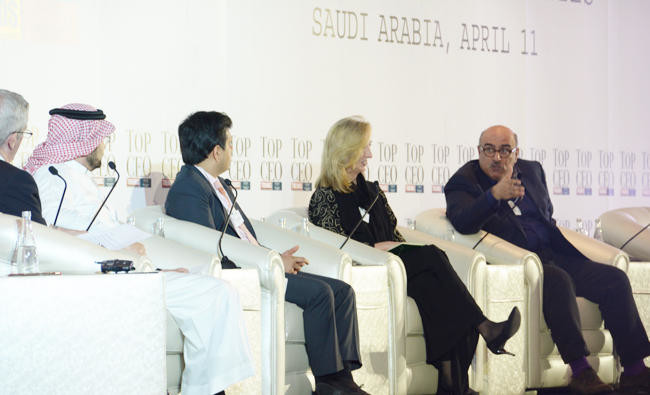
1% wealth tax ‘would fix Gulf budget shortfalls, avert social unrest’
1% wealth tax ‘would fix Gulf budget shortfalls, avert social unrest’

Latest updates


© 2026 SAUDI RESEARCH & PUBLISHING COMPANY, All Rights Reserved And subject to Terms of Use Agreement.