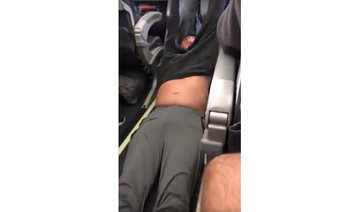
CHICAGO: Several minutes after a passenger recorded a video watched around the world that showed security officers dragging another passenger off an overbooked United Express flight at Chicago’s O’Hare International Airport, a smaller snippet of video showed an even more troubling scene.
There stood the passenger who had been dragged on his back to the front of the plane, appearing dazed as he spoke through bloody lips and blood that had spilled onto his chin.
“I want to go home, I want to go home,” he said.
The treatment of the passenger on Sunday night prompted outrage and scorn on social media, and anger among some of the passengers on the flight as the unidentified man was evicted.
The incident risks a backlash against United from passengers who could boycott the airline as the busy summer travel season is about to begin. For Chicago, it is another public relations nightmare, adding to its reputation as a city unable to curb a crime wave in some neighborhoods, which President Donald Trump has highlighted with critical tweets.
The embarrassing incident spiraled out of control from a common air travel issue — an overbooked flight. United was trying to make room for four employees of a partner airline, meaning four people had to get off the flight to Louisville.
At first, the airline asked for volunteers, offering $400 and then when that didn’t work, $800 per passenger to relinquish a seat. When no one voluntarily came forward, United selected four passengers at random.
Three men, identified later as city aviation department security officers, got on the plane. Two officers tried to reason with the man before a third came aboard and pointed at the man “basically saying, ‘Sir, you have to get off the plane,’” said Tyler Bridges, a passenger whose wife, Audra D. Bridges, posted a video on Facebook.
One of the security officers could be seen grabbing the screaming man from his window seat, across the armrest and dragging him down the aisle by his arms.
Other passengers on Flight 3411 are heard saying, “Please, my God,” “What are you doing?” “This is wrong,” “Look at what you did to him” and “Busted his lip.”
“We almost felt like we were being taken hostage,” said Tyler Bridges. “We were stuck there. You can’t do anything as a traveler. You’re relying on the airline.”
United Airlines’ parent company CEO Oscar Munoz late Monday issued a letter defending his employees, saying the passenger was being “disruptive and belligerent.”
While Munoz said he was “upset” to see and hear what happened, “our employees followed established procedures for dealing with situations like this.”
Chicago’s aviation department said the security officer who grabbed the passenger had been placed on leave.
“The incidence on United Flight 3411 was not in accordance with our standard operating procedure and the actions of the aviation security officer are obviously not condoned by the Department,’ the department said in a statement.
After a three-hour delay, United Express Flight 3411 took off without the man aboard.
Airlines are allowed to sell more tickets than seats on the plane, and they routinely overbook flights because some people do not show up.
It’s not unusual for airlines to offer travel vouchers to encourage people to give up their seats, and there are no rules for the process. When an airline demands that a passenger give up a seat, the airline is required to pay double the passenger’s one-way fare, up to $675 provided the passenger is put on a flight that arrives within one to two hours of the original. The compensation rises to four times the ticket price, up to $1,350, for longer delays.
When they bump passengers, airlines are required to give those passengers a written description of their compensation rights.
Last year, United forced 3,765 people off oversold flights and another 62,895 United passengers volunteered to give up their seats, probably in exchange for travel vouchers. That’s out of more than 86 million people who boarded a United flight in 2016, according to government figures. United ranks in the middle of US carriers when it comes to bumping passengers.
ExpressJet, which operates flights under the United Express, American Eagle and Delta Connection names, had the highest rate of bumping passengers last year. Among the largest carriers, Southwest Airlines had the highest rate, followed by JetBlue Airways.
___
Associated Press David Koenig contributed to this report.