

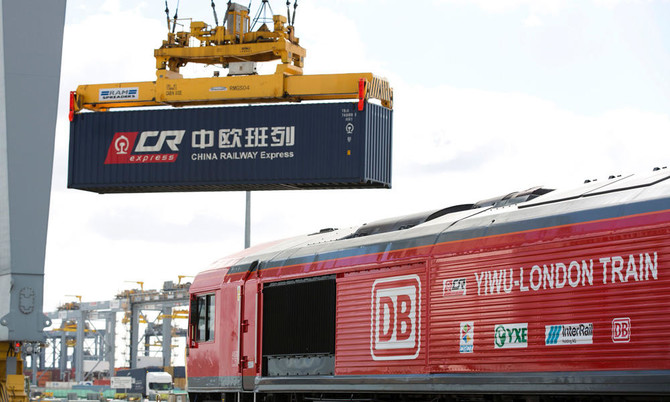
Freight train begins 7,500-mile UK-China journey

1 / 6
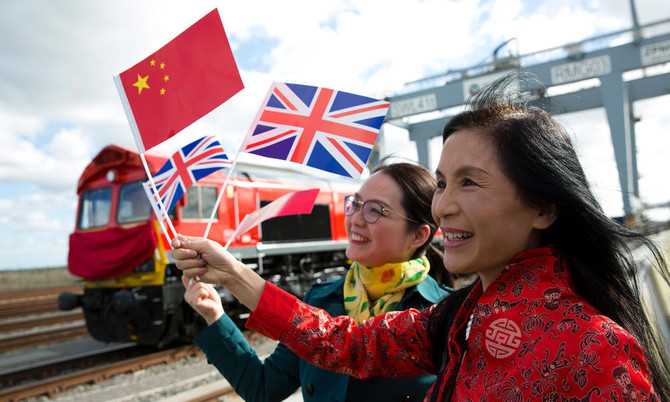
People wave a Chinese and a Union flags as they pose for photographs during a photcall to witness the departure of a freight train transporting containers laden with goods from the UK, from DP World London Gateway's rail freight depot in Corringham, east of London, on Monday, enroute to Yiwu in the eastern Chinese province of Zhejiang. (AFP / Isabel Infantes)
2 / 6
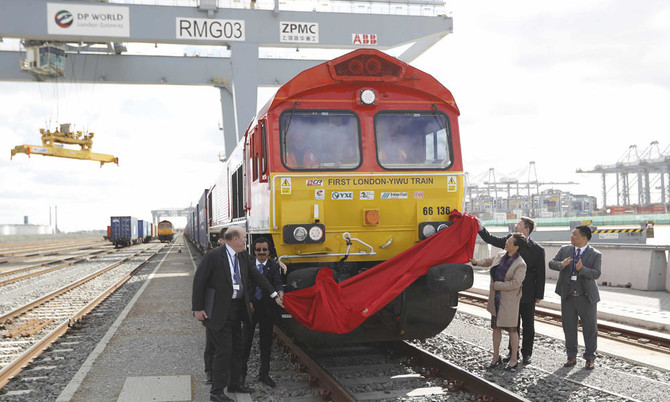
Officials unveil the first UK to China export train, laden with containers of British goods, during the official ceremony to mark its departure from the DP World London Gateway, Stanford-le-Hope, Britain, on Monday. (REUTERS/Peter Nicholls)
3 / 6
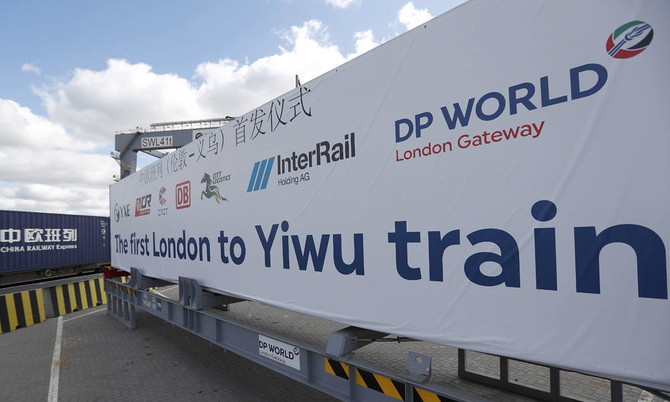
A banner promotes the first UK to China export train, laden with containers of British goods, during the official ceremony to mark its departure from the DP World London Gateway, Stanford-le-Hope, Britain, on Monday. (REUTERS/Peter Nicholls)
4 / 6
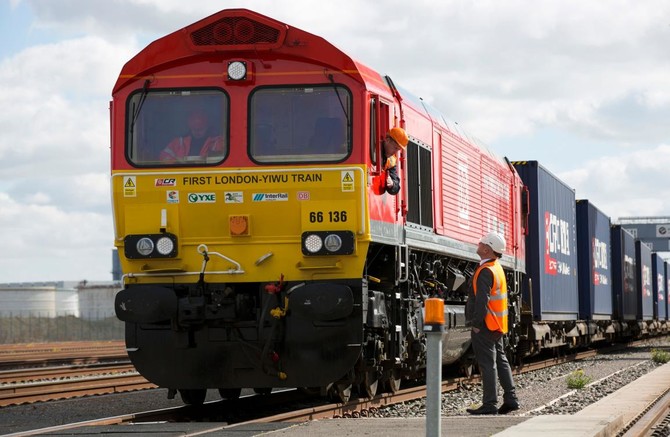
A freight train transporting containers laden with goods from the UK, is prepared ahead of departure from DP World London Gateway's rail freight depot in Corringham, east of London, on Monday, enroute to Yiwu in the eastern Chinese province of Zhejiang. (AFP / Isabel Infantes)
5 / 6
China Railway Express containers are loaded onto a freight train as it is prepared ahead of departure from DP World London Gateway's rail freight depot in Corringham, east of London, on Monday, enroute to Yiwu in the eastern Chinese province of Zhejiang. (AFP / Isabel Infantes)
6 / 6
A freight train transporting containers laden with goods from the UK, is prepared ahead of departure from DP World London Gateway's rail freight depot in Corringham, east of London, on Monday, enroute to Yiwu in the eastern Chinese province of Zhejiang. (AFP / Isabel Infantes)
Updated 10 April 2017
Follow

Freight train begins 7,500-mile UK-China journey

STANFORD-LE-HOPE, England: The first freight train to run from Britain to China was due to depart on Monday, carrying vitamins, baby products and other goods as Britain seeks to burnish its global trading credentials for when it leaves the European Union.
The 7,500-mile journey from eastern England to eastern China will take three weeks, around half the time needed for the equivalent journey by boat. The first freight train from China arrived in Britain in January.
The train will leave a depot at Stanford-Le-Hope in Essex for Barking in east London, before passing through the Channel Tunnel into France and on to Belgium, Germany, Poland, Belarus, Russia and Kazakhstan.
Britain is seeking to enhance its trade links with the rest of the world as it prepares to leave the EU in two years’ time.
“This new rail link with China is another boost for global Britain, following the ancient Silk Road trade route to carry British products around the world,” said Greg Hands, a British trade minister.
Run by Yiwu Timex Industrial Investment, the Yiwu-London freight service makes London the 15th European city to have a direct rail link with China after the 2013 unveiling of the “One Belt, One Road” initiative by Chinese premier Xi Jinping.
Among the goods being transported to China are soft drinks, vitamins, pharmaceuticals and baby products.
“This is the first export train and just the start of a regular direct service between the UK and China,” Xubin Feng, chairman of Yiwu Timex Industrial Investment Co., said.
“We have great faith in the UK as an export nation and rail provides an excellent alternative for moving large volumes of goods over long distances faster.” (Reporting by Peter Nicholls)

Bangladesh readies for polls, worry among Hasina supporters

Updated 6 sec ago
Follow

Bangladesh readies for polls, worry among Hasina supporters

  • The Muslim-majority nation of 170 million people will hold elections on February 12, its first since the uprising
  • Hasina was sentenced to death for crimes against humanity in Nov. and her former ruling party has been outlawed

Gopalganj: Bangladesh is preparing for the first election since the overthrow of Sheikh Hasina, but supporters of her banned Awami League (AL) are struggling to decide whether to shift their allegiance.

In Gopalganj, south of the capital Dhaka and a strong bastion of Hasina’s iron-grip rule, residents are grappling with an election without the party that shaped their political lives for decades.

“Sheikh Hasina may have done wrong — she and her friends and allies — but what did the millions of Awami League supporters do?” said tricycle delivery driver Mohammad Shahjahan Fakir, 68, adding that he would not vote.

“Why won’t the ‘boat’ symbol be there on the ballot paper?” he said, referring to AL’s former election icon.

The Muslim-majority nation of 170 million people will hold elections on February 12, its first since the uprising.

Hasina, who crushed opposition parties during her rule, won landslide victories in Gopalganj in every election since 1991.

After a failed attempt to cling to power and a brutal crackdown on protesters, she was ousted as prime minister in August 2024 and fled to India.

She was sentenced to death in absentia for crimes against humanity by a court in Dhaka in November, and her former ruling party, once the country’s most popular, has been outlawed.

Human Rights Watch has condemned the AL ban as “draconian.”

“There’s so much confusion right now,” said Mohammad Shafayet Biswas, 46, a banana and betel leaf seller in Gopalganj.

“A couple of candidates are running from this constituency — I don’t even know who they are.”

As a crowd gathered in the district, one man shouted: “Who is going to the polling centers? We don’t even have our candidates this time.”

‘DEHUMANISE’

Hasina’s father, Sheikh Mujibur Rahman, the founding president of Bangladesh, hailed from Gopalganj and is buried in the town.

Statues of Rahman have been torn down nationwide, but in Gopalganj, murals and statues are well-maintained.

Since Hasina’s downfall, clashes have broken out during campaigning by other parties, including one between police and AL supporters in July 2025, after which authorities filed more than 8,000 cases against residents.

Sazzad Siddiqui, a professor at Dhaka University, believes voter turnout in Gopalganj could be the lowest in the country.

“Many people here are still in denial that Sheikh Hasina did something very wrong,” said Siddiqui, who sat on a government commission formed after the 2025 unrest.

“At the same time, the government has constantly tried to dehumanize them.”

This time, frontrunners include candidates from the Bangladesh Nationalist Party (BNP) and Jamaat-e-Islami, the country’s largest religious party.

Both are from Hasina’s arch-rivals, now eyeing power.

“I am going door to door,” BNP candidate S.M Zilany, 57, told AFP, saying many would-be voters had never had a candidate canvass for their backing.

“I promise them I will stand by them.”

Zilany said he had run twice against Hasina — and was struck down by 34 legal cases he claimed had been politically motivated.

This time, he said that there was “a campaign to discourage voters from turning up.”

Jamaat candidate M.M Rezaul Karim, 53, said that under Hasina, the party had been driven underground.

“People want a change in leadership,” Karim told AFP, saying he was open to all voters, whatever their previous loyalties.

“We believe in coexistence; those involved in crimes should be punished; others must be spared,” Karim said.

Those once loyal to Hasina appear disillusioned. Some say they had abandoned the AL, but remain unsure whom to support.

“I am not going to vote,” said one woman, who asked not to be named.

“Who should I vote for except Hasina? She is like a sister.”