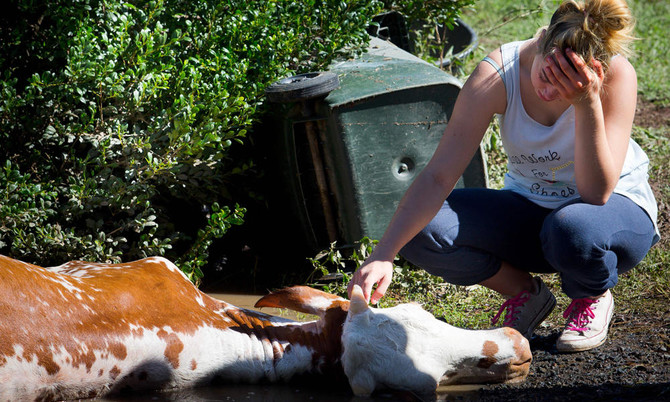
BEENLEIGH, Australia: Flooded rivers were still rising Saturday in two Australian states with two women dead and four people missing after torrential rains in the wake of a powerful tropical cyclone.
Queensland police warned that the Logan River, which runs through Beenleigh south of Brisbane, would only hit peak flood levels during the afternoon while further north the city of Rockhampton was also facing a serious threat.
Commissioner Ian Stewart warned there was “still a major risk to the community around Logan and further south caused by that flooding situation.”
Rockhampton, with a population of over 80,000 on the Fitzroy River, was expected to suffer flood levels not seen for a century and Stewart urged residents in low-lying areas to leave.
“By Wednesday, we will be at peak flooding in Rockhampton,” he said.
“It will be a gradual rise, so I encourage people to move now.”
Queensland police tweeted “we currently have four people missing... that we have serious concerns about,” including a 77-year-old man.
Tens of thousands of people have been evacuated from a string of towns in Queensland and New South Wales as the floods move south toward Ballina, cutting roads.
Others have tried to stick it out to save their properties.
The scene was grim along the Logan river.
Casey Bently, a 47-year-old mechanic from North Maclean appeared visibly upset as she looked at her house, submerged to the roof.
“We got as much out as we could in the short time that we had,” she told AFP.
“People have lost everything. I’d only just finished renovating the house, and it is all gone again now.”
Nearby a calf was stuck in a tree as a man in a kayak paddled out to see if it was alive. Dozens gathered to watch but by the time two people on jet skis arrived to help the calf only to discover it was dead.
Prime Minister Malcolm Turnbull called on residents in affected areas to exercise caution.
“In many parts of the country you will see floodwaters continuing to rise over the next days,” he told reporters.
“This is a very dangerous time in these flooded areas.
“I want to say to everybody who is affected by these floods — do not go into flooded waters. Do not cross flooded roads.”
Category four Cyclone Debbie hit northeastern Australia on Tuesday between Bowen and Airlie Beach ripping up trees and causing widespread damage that is still being assessed.
It was downgraded to a tropical low as it tracked southeast still packing high winds and dumping huge amounts of rain all down the east coast to Sydney and beyond before blowing out over the Tasman Sea.
Police on Friday found the body of a woman who disappeared in floodwaters near Murwillumbah just south of the Queensland border.
And a 64-year-old woman, whose vehicle was swept off a causeway on a property in Gungal, in the Hunter Valley south of Sydney was also found dead Friday.
Lismore, south of Murwillumbah was among the worst flooded towns on Friday with Tweed Heads, Kingscliff and Murwillumbah also subject to evacuation orders.
In areas further north where the cyclone made landfall, water and power were still being restored.
Bowen, Mackay and the Whitsunday islands bore the brunt of the cyclone and nearly 40,000 homes were waiting to be re-connected on Saturday.
The military has mobilized 1,300 soldiers for the clean-up with helicopters and planes deploying to restore infrastructure and supply emergency food, water and fuel.
The Insurance Council of Australia declared the Queensland and northern NSW regions disaster zones, adding that the damage bill could top Aus$1 billion (US $770 million).

Australia floods still rising with two dead, four missing
UK veterans are ‘ticking time bomb’ after Iraq war chemical exposure
- Fifteen former RAF personnel were deployed to the Qarmat Ali water plant in 2003, which was contaminated with sodium dichromate
- Veterans say they were not screened or protected, and are now living with serious health conditions
LONDON: Fifteen British servicemen who worked on a carcinogen-contaminated water treatment site during the Iraq war say they were not offered biological screening despite official guidance saying they should have been.
The former Royal Air Force members, who have suffered from ailments including cancer, tumors and nosebleeds, told Sky News they were offered no medical assistance or subsequent treatment after having been exposed to toxic sodium dichromate at the Qarmat Ali water treatment plant in 2003.
The channel said it had seen a letter from the RAF’s medical authority stating that senior officers knew of the dangers posed by the substance.
Peter Lewis, 53, was one of 88 personnel deployed to guard the site, which was deemed vital for getting Iraq’s oil industry up and running. He told Sky: “I’ve had eight or nine operations to remove cancer.
“I’ve had so many lumps taken out of my neck, one on my face. This is something I’m literally fighting every year now. It’s constant.”
Qarmat Ali, the former troops say, was covered in ripped bags of bright orange sodium dichromate.
“We were never warned what the bags of chemicals were,” Jon Caunt, another former serviceman, said. “We were breathing this stuff in.”
His former comrade Tony Watters added: “I never thought about what it was. We were told the site is safe.”
Several months after deployment to the site, however, the servicemen were joined by two workers wearing protective gear who placed signs around it reading: “Warning. Chemical hazard. Full protective equipment and chemical respirator required. Sodium dichromate exposure.”
Watters said: “When you left the site, your uniform was contaminated, your webbing was contaminated.
“You went in your sleeping bag, and that was contaminated. And you were contaminating other people with it back at camp.”
Andy Tosh, who has led the group of veterans as they sought answers from the Ministry of Defence, said: “Even with the warning signs going up … they kept us there. They knowingly kept us exposed.”
The RAF gave some of the men a leaflet on their return to the UK, warning of the dangers of the substance, but not all were told.
The letter seen by Sky acknowledging the dangers posed to the veterans made a “strong” link to “increased risk of lung and nose cancer” as well as numerous other issues. It suggested personnel sent to Qarmat Ali should have their medical records altered to mention their exposure to sodium dichromate.
“Offer biological screening. This cannot be detailed until the numbers exposed are confirmed,” the letter also said.
An inquiry into US personnel deployed to Qarmat Ali found that 830 people were “unintentionally exposed” to sodium dichromate, giving them access to support from the US Department of Veterans Affairs. This came after the death of Lt. Col. James Gentry from cancer in 2009, which the US Army determined came “in line of duty for exposure to sodium dichromate.”
There has been no such inquiry by UK authorities despite British personnel being deployed at the site for longer than their American counterparts.
Thirteen of them have suffered from cancer and similar symptoms, including one who developed a brain tumor.
Jim Garth told Sky: “My skin cancer will never go away … It’s treatable, but when the treatment is finished, it comes back, so I’ve got that for life really.”
Lewis added: “I’m actually getting to the point now where I don’t care anymore … sooner or later, it’s going to do me.”
Caunt described his former colleagues’ conditions as a “ticking time bomb.”
He added: “We do not know what’s going to happen in the future."
The MoD insists medical screening was offered to personnel at the time, despite the men stating that it was not. In 2024, several met with Labour MPs about the issue. One, John Healey, who is now the UK defence secretary, said at the time the veterans should have “answers to their important questions.”
In a statement, the MoD said: “We take very seriously the concerns raised by veterans who were deployed to guard the Qarmat Ali Water Treatment Plant in 2003.
“As soon as we were alerted to the possible exposure of Sodium Dichromate, an environmental survey was conducted to evaluate typical exposure at Qarmat Ali. Results showed that the levels at the time were significantly below UK government guidance levels.”
A 2004 letter seen by Sky News suggested, however, that the MoD knew the levels of sodium dichromate were higher.
“Anyone who requires medical treatment can receive it through the Defence Medical Services and other appropriate services,” the MoD said.
“Veterans who believe they have suffered ill health due to service can apply for no-fault compensation under the War Pensions Scheme.”
Watters called on the government to hold an investigation into what happened at Qarmat Ali.
“We are the working class, we are ex-soldiers who have put our lives on the line and you’re turning a blind eye to us,” he said.
Garth added: “We felt let down at Qarmat Ali all those years ago, and we still feel let down now.”