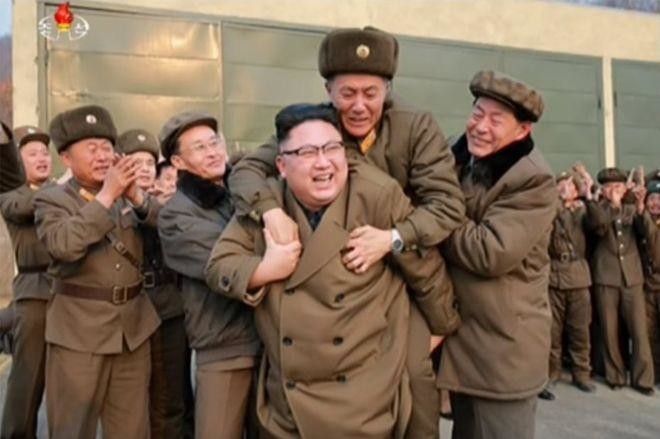
Why did this man piggy-back North Korea’s Supreme Leader Kim Jong-un?

North Korea this week released a flurry of photos to accompany news that a rocket engine was launched. (Photo courtesy: KCNA)
Updated 24 March 2017
Follow

Why did this man piggy-back North Korea’s Supreme Leader Kim Jong-un?

DUBAI: North Korea this week released a flurry of photos to accompany news that a rocket engine was launched by the state.
However, one image stood out in particular – North Korean ruler Kim Jong-un being piggy-backed by an older man.
In pictures released by state news agency KCNA, the rule - known as the supreme leader - was seen shaking hands with officers and laughing, but the bizarre photo led the BBC to ask what exactly was going on, in a report published Friday.
Observers told the BBC that the man is not a well-known figure in North Korean political spheres but added that his uniform's insignias show he is most likely an officer of the KPA Strategic Force.
North Korean expert Michael Madden told the BBC the image was most likely stage-managed but "it wasn't completely machinated or fabricated."
Madden, who is with the US-Korea Institute at Johns Hopkins University, added: "It was more a signal of allowance and encouragement than something completely machinated by an image maker."
Meanwhile, the UN Security Council on Thursday "strongly condemned" the North Korean missile and ballistic missile engine tests, denouncing Pyongyang's "increasingly destabilizing behavior" on Thursday.
The condemnation came as the US military said on Thursday that it has observed activity in North Korea that suggests Pyongyang may be gearing up for another nuclear test.
"The launch and engine test are in grave violation of the Democratic People's Republic of Korea's international obligations," the council said in a statement.
"The members of the Security Council expressed serious concern over the Democratic People's Republic of Korea's increasingly destabilizing behavior and flagrant and provocative defiance of the Security Council," it added.
North Korea is on a quest to develop a long-range missile capable of hitting the US mainland with a nuclear warhead, and staged two nuclear tests and multiple missile launches last year.
(With AFP)


Thai coffee chains cut default sugar content in coffee and tea drinks in a new health push

Updated 11 February 2026
Follow

Thai coffee chains cut default sugar content in coffee and tea drinks in a new health push

  • The Health Department says Thais consume 21 teaspoons of sugar daily, far exceeding the World Health Organization’s recommended six teaspoons
  • Officials warn this increases obesity and diabetes risks. A survey found iced coffee and bubble tea contain high sugar levels

BANGKOK: For many Thais, a meal doesn’t feel complete without an iced coffee or tea so sugary it could pass for dessert. The government, concerned about the health consequences, wants them to dial it back.
Starting Wednesday, nine major coffee chains across the country have pledged to cut the default sugar content in some of their drinks by half in a government initiative aimed at tackling excessive sugar consumption.
According to the Health Department, Thais consume an average of 21 teaspoons of sugar per day, more than three times the World Health Organization’s recommended limit of six teaspoons. Health officials warn that such high intake increases the risk of obesity, diabetes and other diseases.
The initiative is the first significant step to change consumers’ sugar consumption behavior, said Amporn Benjaponpitak, the director general of the department.
Pakorn Tungkasereerak, the department’s deputy, said 2025 data show that about 45 percent of Thais aged 15 and older are obese, while 10 percent of the population has diabetes.
A survey by the Bureau of Nutrition found that a 22-ounce (650-milliliter) iced coffee contains an average of nine teaspoons of sugar, while a 10-ounce (300-milliliter) serving of bubble milk tea — an iced milk tea with tapioca pearls known as boba — can contain as much as 12 teaspoons.
Sirinya Kuiklang, an office worker, said she approves of the changes. She already orders her drinks at just 25 percent of the standard sugar level, but she is aware that many others consume too much sugar.
“It’s good for Thai people,” she said.
Another office worker, Porwares Tantikanpanit, said he has enjoyed his non-coffee beverages at their current sugar levels but is willing to adjust if shops reduce the sweetness.
However, putting the policy into practice may prove challenging. Officials have said each brand can apply the initiative as they see fit.
Some customers have expressed confusion in response to social media posts promoting the initiative, asking how to order drinks with the level of sweetness that they prefer. Several brands said that the reduction applies only to certain menu items.