North Korea tests newly developed high-thrust rocket engine

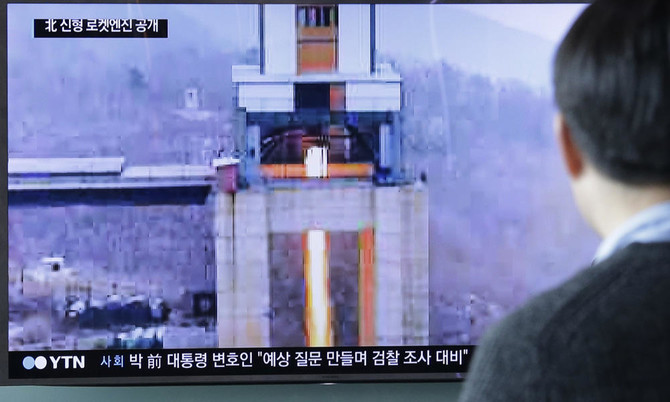
A man watches a TV news program showing an image that North Korea's Rodong Sinmun newspaper reports of a ground test of a new type of high-thrust rocket engine at Seoul Railway station in Seoul, South Korea, on Sunday. (AP Photo/Ahn Young-joon)
Updated 19 March 2017
Follow

North Korea tests newly developed high-thrust rocket engine

TOKYO: North Korea has conducted a ground test of a new type of high-thrust rocket engine that leader Kim Jong Un is calling a revolutionary breakthrough for the country’s space program.
Kim attended the test at the Sohae launch site, according to a report Sunday by the Korean Central News Agency, which said the test was intended to confirm the “new type” engine’s thrust power and gauge the reliability of its control system and structural safety.
The KCNA report said Kim called the test “a great event of historic significance” for the country’s indigenous rocket industry.
He also said the “whole world will soon witness what eventful significance the great victory won today carries” and claimed the test marks what will be known as the “March 18 revolution” in the development of the country’s rocket industry.
The report indicated the engine is to be used for North Korea’s space and satellite-launching program.
North Korea is banned by the United Nations from conducting long-range missile tests, but it claims its satellite program is for peaceful use, a claim many in the US and elsewhere believe is questionable.
North Korean officials have said that under a five-year plan they intend to launch more Earth observation satellites and what would be the country’s first geostationary communications satellite — which would be a major technological advance.
Getting that kind of satellite into place would likely require a more powerful engine than its previous ones. The North also claims it is trying to build a viable space program that would include a moon launch within the next 10 years.
The test was conducted as US Secretary of State Rex Tillerson is in China on a swing through Asia that has been closely focused on concerns over how to deal with Pyongyang’s nuclear and missile programs.
It’s hard to know whether this test was deliberately timed to coincide with Tillerson’s visit, but Pyongyang has been highly critical of ongoing US-South Korea wargames just south of the Demilitarized Zone and often conducts some sort of high-profile operation of its own in protest.
Earlier this month, it fired off four ballistic missiles into the Sea of Japan, reportedly reaching within 200 kilometers (120 miles) of Japan’s shoreline.
Japan, which was Tillerson’s first stop before traveling to South Korea and China, hosts tens of thousands of US troops.
While building ever better long-range missiles and smaller nuclear warheads to pair with them, North Korea has marked a number of successes in its space program.
It launched its latest satellite — the Kwangmyongsong 4, or Brilliant Star 4 — into orbit on Feb. 7 last year, just one month after conducting what it claims was its first hydrogen-bomb test.
It put its first satellite in orbit in 2012, a feat few other countries have achieved. Rival South Korea, for example, has yet to do so.


Former South Korea leader Yoon gets life in prison for insurrection

Updated 5 sec ago
Follow

Former South Korea leader Yoon gets life in prison for insurrection

  • Yoon Suk Yeol abruptly declared martial law in a televised address in December 2024
  • Hardline conservative was later impeached, arrested and charged with a litany of crimes
SEOUL: A South Korean court sentenced ex-president Yoon Suk Yeol to life in prison on Thursday after finding him guilty of leading an insurrection with his martial law declaration in 2024.
Yoon abruptly declared martial law in a televised address in December 2024, saying drastic measures were needed to root out “anti-state forces” in South Korea’s National Assembly.
The 65-year-old hardline conservative was later impeached, arrested and charged with a litany of crimes ranging from insurrection to obstruction of justice.
Presiding judge Ji Gwi-yeon said Yoon sent troops to the assembly building in an effort to silence political opponents who had frustrated his attempts to govern.
“The court finds that the intention was to paralyze the assembly for a considerable period,” Ji told the Seoul Central District Court.
“The declaration of martial law resulted in enormous social costs, and it is difficult to find any indication that the defendant has expressed remorse for that,” the judge said.
“We sentence Yoon to life imprisonment.”
Former defense minister Kim Yong-hyun was sentenced to 30 years in prison for his role in the crisis.
Prosecutors had sought the harshest penalty for Yoon’s insurrection charges, urging the court during hearings in January to sentence him to death.
South Korea has an unofficial moratorium on capital punishment — the last prisoners were executed in 1997 — with a death sentence effectively banishing Yoon to life behind bars.
Unpleasant memories
Thousands of supporters gathered outside the court ahead of the verdict, toting placards that read “Yoon Great Again” or “Drop the charge against President Yoon.”
There were loud cries as a blue prison bus believed to be transporting the former president made its way into the court complex.
Police clad in neon-colored jackets gathered in force outside the courthouse to quell any unrest triggered by the verdict.
They formed a makeshift barricade with police buses parked nose-to-tail around the courthouse.
South Korea has long been seen as a shining light of stable democracy in Asia, but Yoon’s failed bid to seize power stirred unpleasant memories of the military coups that jolted the nation between 1960 and 1980.
Yoon has been held in solitary confinement while fighting multiple criminal trials.
He has consistently denied wrongdoing, arguing he acted to “safeguard freedom” and restore constitutional order against what he called an opposition-led “legislative dictatorship.”
Prosecutors accused him of leading an “insurrection” driven by a “lust for power aimed at dictatorship and long-term rule.”
Martial law
Under South Korean law, only two sentences are fit for insurrection: life imprisonment or death.
Yoon has already been sentenced to five years in prison on lesser charges, while a host of senior officials also face hefty prison terms.
Yoon broke into late-night TV on December 3, 2024, to deliver a shock address to the nation.
Pointing to vague threats of North Korean influence and dangerous “anti-state forces,” he declared the suspension of civilian government and the start of military rule.
Martial law was lifted six hours later after lawmakers raced to the assembly building to hold an emergency vote.
Staffers barricaded the doors with office furniture to keep armed troops at bay.
The declaration triggered flash protests, sent the stock market into panic and caught key military allies such as the United States off guard.
Yoon’s wife Kim Keon Hee was sentenced to 20 months’ jail earlier in January on unrelated charges stemming from bribes she took while first lady.