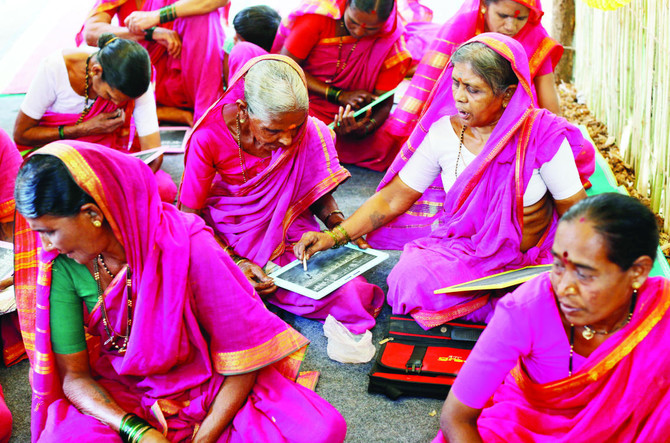
PHANGANE, India: A little before 2 p.m. each day, when residents of Phangane village in India’s Maharashtra state usually take a quick nap in the heat of the day, elderly women in bright pink sarees head towards a colorful hut, clutching satchels and plastic bags.
Inside the hut, festooned with streamers and flowers, the women gingerly sit cross-legged on cotton rugs on the mud floor, and pull out slates, notebooks, chalk and pencils. Minutes later, a younger woman leads them in a prayer song before they begin reciting the Marathi alphabet after her.
The Aajibaichi Shala, or grandmothers’ school, is perhaps the only one in India for uneducated, elderly women. Set up by a charitable trust and Yogendra Bangar, a teacher at the village’s primary school, the school teaches the women to read and write, and basic arithmetic.
“These women did not have the opportunity to study when they were young,” said Bangar.
“It’s not as if they want to go to college or work in an office now. But they do want to be able to read and write, and sign their names, like everyone else in their families.”
Literacy levels in India have steadily risen over the past decades as the economy expanded and greater emphasis was placed on education. But women still lag behind men, particularly in rural areas, where girls are often not sent to class or are pulled out after primary school so they can work at home or in the fields.
While 79 percent of India’s rural men are literate, the rate for women is only 59 percent, according to official data.
Aajibaichi Shala was set up last year for women over 60 to mark the International Women’s Day on March 8. It was first run out of the home of the woman who was the sole teacher, 30-year-old Sheetal More.
The opening day was celebrated like a festival, with entire families accompanying the women to their first day of school, More said. Since then, classes have been moved to a purpose-built hut in her backyard, in the shade of a large mango tree.
“At first I was a bit nervous about teaching such elderly women. Even my mother-in-law comes to class,” said More, who has finished high school.
“But they are all so eager, and behave just like little children in class. Every other teacher teaches children; only I have the opportunity to teach elderly women,” she said.
There is little to distinguish Phangane from other villages in the western state, one of India’s wealthiest.
About 120 km (75 miles) from the bustling financial hub of Mumbai, the village of 70 families is a tidy enclave, with clean mud roads and brick homes divided by fences and gardens.
During the day, women go about their chores, cleaning, cooking and tending to the livestock and young grandchildren.
About 30 women aged 60 to 90 years attend classes for two hours in the afternoon, six days a week. In the past year, they have learned the Marathi alphabet, numbers and can write their names, Bangar said.
The women, including More, wear fuchsia sarees to class to replicate the experience of wearing a school uniform, he said.
“I like going to the school — I have learned to write my name and I have learned the alphabet,” said Kamal Keshav Tupange, 68, as she washed clothes on a slab of stone.
“My knees hurt, so I can’t sit on the floor for long; that’s the only problem. But I still go every day,” said Tupange, who was married at the age of 12 and had never been to school.
It is a similar story with most other elderly women in the village. Most did not go to school as children, and were married at a young age.
While the legal age for marriage for women in India is 18 years, nearly half the women are married earlier even now, according to the U.N.’s children’s agency, Unicef.

Never too late: Elderly Indian women go to school for first time

Myanmar, Afghan hopeful scholars mourn UK study visa ban
- Myanmar, Afghanistan, Sudan and Cameroon citizens will be barred from obtaining university visas
- Britain’s travel block is “really painful” for Afghan women hoping to escape to an education abroad, said one female
YANGON, Myanmar: Aspiring students are lamenting Britain’s ban on education visas for their war-weary countries — dashing dreams of bettering themselves and their home nations.
Myanmar, Afghanistan, Sudan and Cameroon citizens will be barred from obtaining university visas, London announced this week, saying asylum applications by visiting students had “rocketed” nearly 500 percent from 2021 to 2025.
“It’s like the country is punishing the weak, the most vulnerable people,” said one woman from Myanmar.
She was preparing for a scholarship interview for a master’s in climate change finance when her plans were upended by Downing Street’s decree on Wednesday.
“I could not focus the whole morning,” the 28-year-old told AFP from Yangon, speaking on condition of anonymity for security reasons in a country riven by civil war since a 2021 military coup.
“I can’t picture my future.”
Like in much of the developed world, immigration has become a divisive issue in Britain.
Efforts to beat back arrivals mirror the sweeping travel bans issued by US President Donald Trump which have shut out citizens of Myanmar, Sudan and Afghanistan.
Since the chaotic military withdrawal of Britain, the United States and other NATO nations in 2021, Afghanistan has been ruled by a resurgent Taliban government which has banned women over age 12 from attending school.
Britain’s travel block is “really painful” for Afghan women hoping to escape to an education abroad, said one female child social worker in Ghazni province, who asked to remain anonymous for security reasons.
She has now canceled her plans to study for a master’s in both the US and the UK.
“Now I am trying to be hopeful, but I think it would also be a mistake,” said the 27-year-old.
In the summer of 2024, Arefa Mohammadi fled to neighboring Pakistan, living in limbo as she applied to universities.
She got an offer to study public health in England but now cannot accept it.
“It was truly shocking for me,” said the 24-year-old.
“This situation put me in a place where I haven’t any goals, because all my goals and all my futures are unpredictable.”
- ‘Cruel and short-sighted’ -
In Kabul, a 39-year-old man faces similar heartbreak.
He was accepted to study specialist subjects related to water management at three universities in England and Scotland.
“When I was a child I witnessed several challenges like flash floods, water scarcity, environmental neglect, inefficient irrigation systems,” he said, asking to remain anonymous for security reasons. “To address these challenges I made my application.”
“I hoped to acquire modern knowledge. It’s impossible to acquire in Afghanistan,” he added.
Some 33 million people in the country face severe water shortages, aid agencies say, a result of compounding multi-year droughts, climate change and infrastructure battered by decades of war.
Britain’s Labour government made the decision to curb visas as the right-wing Reform UK party surges in opinion polls with its hard-line stance against immigration.
The UK Home Office said almost 135,000 asylum seekers had entered the country through legal routes since 2021.
Activist organization Burma Campaign UK called the visa ban “exceptionally cruel and shortsighted.”
“The opportunity to come to the UK to study is life-changing for the individual student but also an investment in the future of Myanmar,” said program director Zoya Phan in a statement.
One exiled Myanmar journalist has been living over the border in Thailand after escaping the military rule which has clamped down on press freedoms.
“When the military coup happened I was just 22, so I had a lot of dreams,” she said. “But over the past five years there have been a lot of struggles — I couldn’t complete my dreams.”
Every year since the junta takeover she applied for further education to buoy her spirits.
But she received an email Thursday morning canceling her place to study for a master’s at a London university.
“Everything is gone,” she said. “My UK dream is all disappeared.”