MOSCOW: In offices across Russia, the countdown to International Women’s Day is a whirl of last-minute meetings and dashes for gifts as men race to prepare festivities for their female colleagues.
“We’ve sent out loads of emails, we’ve analyzed the market, we’ve pooled ideas, and we’ve just got one more meeting ahead of the launch of Operation Women’s Day today,” confided Sergei Krakhmalyev, who works at Rosbank, a major Russian bank.
“This year we’ve decided not to spend money on gifts that are useless, shall we say, but to organize a buffet,” he said.
Krakhmalyev, who is in his 40s, works in a team of eight men and 35 women. He calculates that this year’s celebration will cost about 25,000 rubles ($430).
“It’s expensive,” he says, “but it’s a Soviet tradition that I think it’s important to keep up.”
A public holiday in the Soviet Union since 1965, March 8 is an opportunity for Russian men to “remember the importance of women” in society, he says.
International Women’s Day is also a public holiday, so office celebrations are held the day before.
This year’s events are expected to be relatively low-key in comparison to the oil-boom years, when many companies spared no expense.
“The company used to allocate a big budget for this holiday and took as many as 500 women out to a restaurant,” recalled Irina, who works in human resources at a major Russian company.
“That was before the 2008 economic crisis,” said Irina, 40, who asked not to disclose her surname. “Now the men have a whip-round to buy us flowers and chocolates.”
Nevertheless the holiday “cheers up the atmosphere in the team,” she said.
In Russia, it is also widely seen as a counterpart to the Day of the Defender of the Fatherland, on Feb. 23, which is nominally for those who served in the army but is considered the male equivalent.
In offices, this holiday is often an occasion for celebrations that take an unreconstructed approach to gender roles.
“This year we organized a fake army recruitment drive” for the defender holiday, Irina said. “We gave our colleagues a medical and some of us were dressed up as sexy nurses.”
“Now the men are under pressure. They have to try to do better than us, even if we know that’s impossible,” she added with a smile.
Some men, however, including Vitaly Konyayev, a project manager in the southern Russian city of Saratov, find it hard to get into the holiday spirit.
“This year my colleagues didn’t give me anything for Feb. 23, so they can whistle for a gift on March 8,” he said.
The March 8 holiday “only means something if you give flowers to a woman you love and respect — not those you are forced to rub along with at work,” he said.
He complained that he had to pay almost 1,000 rubles for a bunch of flowers for the holiday, which brings a bonanza for florists.
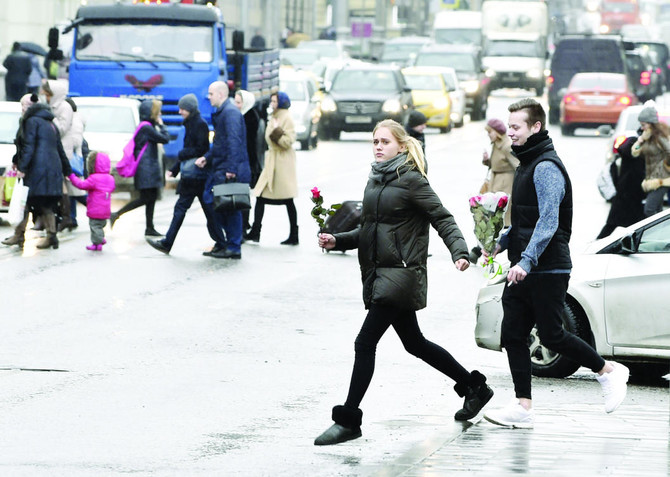
Flower prices often double ahead of the March 8 holiday — and orders double as well, said Florence Gervais d’Aldin, a French flower grower and importer who has worked in Russia for more than 20 years.
Her business, which specializes in scented roses, sells more than 8,000 roses on March 7 and 8, compared with her usual sales of 600 per day.
“It’s a day for mothers, for sweethearts, for colleagues, all together,” Gervais d’Aldin said, with its popularity “far higher” than that of St Valentine’s Day, on Feb. 14.
The stress of organizing a celebration for female counterparts starts early, with boys in elementary school expected to throw celebrations for the girls in their class.
Sasha Kuznetsov, 11, has put together a program of cakes, balloons, greeting cards and even a concert.
“I think this holiday should exist, but it shouldn’t be celebrated in such a pompous way,” he said.
“In any case, soon it will be pointless because women’s rights will be respected,” he added.
For foreigners working in Russia, the full-on approach is a culture shock, said Samuel, a French national working for Sberbank, the country’s biggest lender.
“Russians get used to this holiday from childhood, but for us, it’s always a bit strange,” he said.
He found himself designated a “volunteer” to organize this year’s celebrations, a role that he said requires “endless meetings and spreadsheets.” Last year, the party ended up costing more than 150,000 rubles.
“For my Russian colleagues, it’s a time to make a gesture,” he said. “Even if it is often corny and some things would make a French woman scream.”


![]()
In Russia, Women’s Day piles on the pressure for men
In Russia, Women’s Day piles on the pressure for men


Latest updates


Recommended


© 2026 SAUDI RESEARCH & PUBLISHING COMPANY, All Rights Reserved And subject to Terms of Use Agreement.