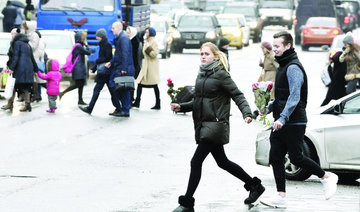
PARIS: No self-congratulations but calls to action will mark many celebrations of the 40th International Women’s Day on Wednesday, as the fight for equality faces new threats.
Murders of women in Latin America, anti-abortion movements in Europe, and machismo talk from men in power are among the growing concerns that have brought millions of women into the streets of world capitals these past few months to defend their rights.
“March 8 is not only to commemorate suffragettes and to celebrate successes from the past, but more to reflect on the present situation,” said Barbara Nowacka, a Polish politician and representative of the committee “Save Women.”
“There is still a lot to do concerning women’s role in the labor market, society, politics,” she told AFP ahead of the global day highlighting women’s rights started by the UN in 1977.
Some recent developments have feminists worried about such key issues as abortion rights, pay equity and gender-based violence.
In Nowacka’s own country, the ruling conservative party is trying to curtail laws on abortion rights, already among the most restrictive in Europe — one of several signs of rising anti-abortion movements across the continent.
These groups “are uniting, are very present on social media and have political weight,” said Christine Mauget, in charge of international matters at France’s Family Planning agency.
“In 2017, there is still a major problem of machismo,” Mauget added. “It is difficult to move things forward, but we try to prevent them from going backward.”
The worries about women’s rights in the face of sexist male attitudes were on display in the huge women’s marches following the inauguration of US President Donald Trump in late January.
Two million women took to the streets in cities around the globe, especially in Washington, where protesters in pink “pussy hats” voiced their opposition to Trump’s policies and his sometimes sexist and vulgar comments about women seen on videotape during the campaign.
Two days after those marches, Trump acted on his anti-abortion stance when, surrounded by male advisors, he signed a decree banning the financing of international charities that support abortions.
“The problem isn’t abortion but unwanted pregnancies,” said Mauget, calling for more extensive sex education to help prevent such circumstances.
When it comes to women’s pocketbooks, the long-running struggle for equal pay still has a way to go.
Worldwide, women earn on average 23 percent less than men. At that pace it would take 70 years to close the gap, according to the International Labor Organization (ILO).
The statistics are also dire regarding violence against women.
According to the UN, about 35 percent of women around the world have been victims of physical or sexual violence. Some 200 million women and girls have been subjected to a form of genital mutilation and 700 million have been married before the age of 18.
All over Latin America in October the movement #NiUnaMenos (“Not one less”) rose up against “femicide” and abuse of women after the brutal murder in Argentina of a teenage girl who was drugged and gang raped.
Ariadna Estevez, a university researcher in Mexico, described the mass women’s movement as “a wake-up call” in the region.
For activists such as Nowacka, the message for women standing up for their rights is: “We feel anger, but we know we are not powerless.”

World marks Women’s Day with rights under attack

US and Ukraine ‘a lot closer’ on peace deal, Trump says after meeting with Zelensky
- Zelensky sees agreement on security guarantees for Ukraine
- Hurdles to a comprehensive peace deal remain
- Trump spoke with Putin ahead of meeting on Sunday
PALM BEACH, Florida: US President Donald Trump said on Sunday that he and Ukrainian President Volodymyr Zelensky were “getting a lot closer, maybe very close” to an agreement to end the war in Ukraine, though both leaders acknowledged that some of the thorniest details remain unresolved.
The two leaders spoke at a joint press conference late Sunday afternoon after meeting at Trump’s Mar-a-Lago resort in Florida. Trump said it will be clear “in a few weeks” whether negotiations to end the war will succeed.
Zelensky said an agreement on security guarantees for Ukraine has been reached. Trump was slightly more cautious, saying that they were 95 percent of the way to such an agreement, and that he expected European countries to “take over a big part” of that effort with US backing.
Zelensky has said previously that he hopes to soften a US proposal for Ukrainian forces to withdraw completely from the Donbas region of eastern Ukraine, a Russian demand that would mean ceding some territory held by Ukrainian forces.
Both Trump and Zelensky said on Sunday the future of the Donbas had not been settled. “It’s unresolved, but it’s getting a lot closer. That’s a very tough issue,” Trump said.
Just before Zelensky and his delegation arrived at Trump’s Florida residence, Trump and Russian President Vladimir Putin spoke in a call described as “productive” by the US president and “friendly” by Kremlin foreign policy aide Yuri Ushakov.
Ushakov, in Moscow, said Putin told Trump a 60-day ceasefire proposed by the European Union and Ukraine would prolong the war. The Kremlin aide also said Ukraine needs to make a decision regarding the Donbas “without further delay.” And he said the Russian government had agreed to establish working groups to resolve the conflict that will focus on economic and security concerns.
Meeting follows Russian attacks on Kyiv
Zelensky arrived at Mar-a-Lago early Sunday afternoon, as Russian air raids pile pressure on Kyiv. Russia hit the capital and other parts of Ukraine with hundreds of missiles and drones on Saturday, knocking out power and heat in parts of Kyiv. Zelensky has described the weekend attacks as Russia’s response to the US-brokered peace efforts, but Trump on Sunday said he believes Putin and Zelensky are serious about peace.
The US president said he will call Putin again after meeting with Zelensky. Zelensky had previously told journalists he plans to discuss the fate of the contested Donbas region with Trump, as well as the future of the Zaporizhzhia nuclear power plant and other topics.
Russia claims more battlefield advances
Putin said on Saturday Moscow would continue waging its war if Kyiv did not seek a quick peace. Russia has steadily advanced on the battlefield in recent months, claiming control over several more settlements on Sunday.
While Kyiv and Washington have agreed on many issues, the issue of what territory, if any, will be ceded to Russia remains unresolved. While Moscow insists on getting all of the Donbas, Kyiv wants the map frozen at current battle lines.
The US, seeking a compromise, has proposed a free economic zone if Ukraine leaves the area, although it remains unclear how that zone would function in practical terms.
US negotiators have also proposed shared control over the Zaporizhzhia nuclear plant. Power line repairs have begun there after another local ceasefire brokered by the International Atomic Energy Agency, the agency said on Sunday.
Russia controls all of Crimea, which it annexed in 2014, and since its invasion of Ukraine nearly four years ago has taken control of about 12 percent of its territory, including about 90 percent of the Donbas, 75 percent of the Zaporizhzhia and Kherson regions, and slivers of the Kharkiv, Sumy, Mykolaiv and Dnipropetrovsk regions, according to Russian estimates.
Putin said on December 19 that a peace deal should be based on conditions he set out in 2024: Ukraine withdrawing from all of the Donbas, Zaporizhzhia and Kherson regions, and Kyiv officially renouncing its aim to join NATO. Zelensky’s past encounters with Trump have not always gone smoothly, but Sunday’s meeting follows weeks of diplomatic efforts. European allies, while at times cut out of the loop, have stepped up efforts to sketch out the contours of a post-war security guarantee for Kyiv that the United States would support.
On Sunday, ahead of the Mar-a-Lago visit, Zelensky said he held a detailed phone call with British Prime Minister Keir Starmer. Trump and Zelensky will hold a phone call with European leaders at some point during the Florida meeting, Trump said. The 20-point plan was spun off from a Russian-led 28-point plan, which emerged from talks between US special envoy Steve Witkoff, Trump’s son-in-law Jared Kushner and Russian special envoy Kirill Dmitriev, and which became public in November.
Subsequent talks between Ukrainian officials and US negotiators have produced the more Kyiv-friendly 20-point plan.