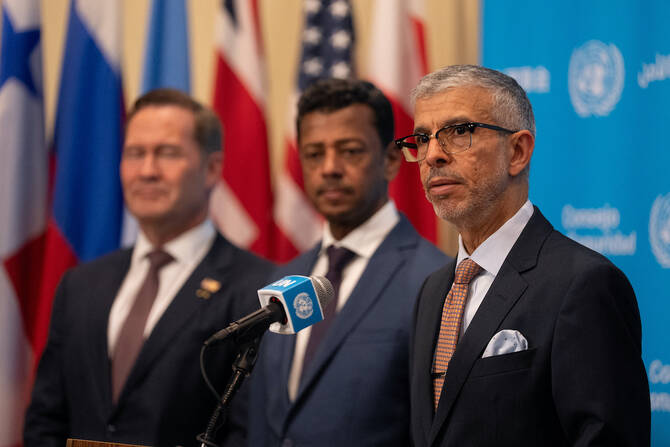


NEW YORK: Saudi Arabia’s permanent representative to the UN said there was an urgent need to "safeguard the stability and security” of the Strait of Hormuz as Gulf nations and the United States pressed the UN on Thursday to demand Iran end its blockage of the vital waterway.
Abdulaziz Alwasil made his comments alongside Gulf allies and the US at the UN as they urged countries to support a resolution demanding Iran halt attacks and mining of the strait.
The Saudi envoy said the draft resolution calls for immediate international action to “de-escalate tensions, ensure the free and safe flow of trade and humanitarian assistance, restore stability to global markets, and protect affected populations.”
“The Strait of Hormuz remains a vital artery of global trade and any disruption to its security is a matter of serious international concern,” Alwasil said.
“Disruptions to marine transit are affecting global energy markets and hindering the delivery of essential goods, including food, medical supplies, and humanitarian assistance with particular severe consequences for vulnerable and import dependent countries,” he added.
Alwasil was joined by US ambassador Mike Waltz and his counterparts from Bahrain, the UAE, Qatar and Kuwait.
Waltz said: “We believe in some basic fundamental principles, namely the freedom of navigation for the entire world's economies. That's what's at stake here, nothing less than a cornerstone of worldwide stability and commerce.”
Diplomatic sources said veto-holding Russia, a key ally of Iran, had warned on Wednesday it was prepared to block the UN Security Council resolution, AFP reported.
The United States and Bahrain recently presented the Security Council with a draft resolution calling on Iran to free up the Strait of Hormuz, refrain from charging tolls, specify where it has placed mines, and allow the creation of a humanitarian corridor for shipments of fertilizer, amid fears of global food shortages.
A fifth of the world's oil supplies and a third of the global fertilizers normally pass through the Strait of Hormuz, but shipping has been largely cut off since the war broke out on February 28 with US and Israeli attacks on Iran.
In mid-March the council passed a strongly worded resolution urging Iran to stop attacking its Gulf neighbors and condemning its chokehold on the Strait of Hormuz.
Russia and China abstained in that vote. But in early April they vetoed a text urging countries to coordinate their efforts in a "defensive" way to ensure free navigation through the strait.
* With AFP