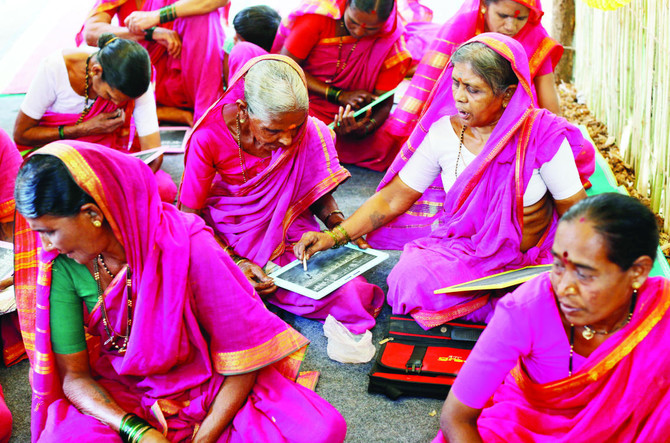
PHANGANE, India: A little before 2 p.m. each day, when residents of Phangane village in India’s Maharashtra state usually take a quick nap in the heat of the day, elderly women in bright pink sarees head towards a colorful hut, clutching satchels and plastic bags.
Inside the hut, festooned with streamers and flowers, the women gingerly sit cross-legged on cotton rugs on the mud floor, and pull out slates, notebooks, chalk and pencils. Minutes later, a younger woman leads them in a prayer song before they begin reciting the Marathi alphabet after her.
The Aajibaichi Shala, or grandmothers’ school, is perhaps the only one in India for uneducated, elderly women. Set up by a charitable trust and Yogendra Bangar, a teacher at the village’s primary school, the school teaches the women to read and write, and basic arithmetic.
“These women did not have the opportunity to study when they were young,” said Bangar.
“It’s not as if they want to go to college or work in an office now. But they do want to be able to read and write, and sign their names, like everyone else in their families.”
Literacy levels in India have steadily risen over the past decades as the economy expanded and greater emphasis was placed on education. But women still lag behind men, particularly in rural areas, where girls are often not sent to class or are pulled out after primary school so they can work at home or in the fields.
While 79 percent of India’s rural men are literate, the rate for women is only 59 percent, according to official data.
Aajibaichi Shala was set up last year for women over 60 to mark the International Women’s Day on March 8. It was first run out of the home of the woman who was the sole teacher, 30-year-old Sheetal More.
The opening day was celebrated like a festival, with entire families accompanying the women to their first day of school, More said. Since then, classes have been moved to a purpose-built hut in her backyard, in the shade of a large mango tree.
“At first I was a bit nervous about teaching such elderly women. Even my mother-in-law comes to class,” said More, who has finished high school.
“But they are all so eager, and behave just like little children in class. Every other teacher teaches children; only I have the opportunity to teach elderly women,” she said.
There is little to distinguish Phangane from other villages in the western state, one of India’s wealthiest.
About 120 km (75 miles) from the bustling financial hub of Mumbai, the village of 70 families is a tidy enclave, with clean mud roads and brick homes divided by fences and gardens.
During the day, women go about their chores, cleaning, cooking and tending to the livestock and young grandchildren.
About 30 women aged 60 to 90 years attend classes for two hours in the afternoon, six days a week. In the past year, they have learned the Marathi alphabet, numbers and can write their names, Bangar said.
The women, including More, wear fuchsia sarees to class to replicate the experience of wearing a school uniform, he said.
“I like going to the school — I have learned to write my name and I have learned the alphabet,” said Kamal Keshav Tupange, 68, as she washed clothes on a slab of stone.
“My knees hurt, so I can’t sit on the floor for long; that’s the only problem. But I still go every day,” said Tupange, who was married at the age of 12 and had never been to school.
It is a similar story with most other elderly women in the village. Most did not go to school as children, and were married at a young age.
While the legal age for marriage for women in India is 18 years, nearly half the women are married earlier even now, according to the U.N.’s children’s agency, Unicef.

Never too late: Elderly Indian women go to school for first time

Afghanistan says it thwarted Pakistani airstrike on Bagram Air Base as fighting enters fourth day
- The fighting has been the most severe between the neighbors for years
- Pakistan accuses Taliban government of harboring militant groups that stage attacks against it
KABUL: Afghanistan thwarted attempted airstrikes on Bagram Air Base, the former US military base north of Kabul, authorities said Sunday, while cross-border fighting between Pakistan and Afghanistan stretched into a fourth day.
The fighting has been the most severe between the neighbors for years, with Pakistan declaring that it’s in “open war” with Afghanistan.
The conflict has alarmed the international community, particularly as the area is one where other militant organizations, including Al-Qaeda and the Daesh group, still have a presence and have been trying to resurface.
Pakistan accuses Afghanistan’s Taliban government of harboring militant groups that stage attacks against it and also of allying with its archrival India.
Border clashes in October killed dozens of soldiers, civilians and suspected militants until a Qatari-mediated ceasefire ended the intense fighting. But several rounds of peace talks in Turkiye in November failed to produce a lasting agreement, and the two sides have occasionally traded fire since then.
On Sunday, the police headquarters of Parwan province, where Bagram is located, said in a statement that several Pakistani military jets had entered Afghan airspace “and attempted to bomb Bagram Air Base” at around 5 a.m.
The statement said Afghan forces responded with “anti-aircraft and missile defense systems” and had managed to thwart the attack.
There was no immediate response from Pakistan’s military or government regarding Kabul’s claim of attempted airstrikes on Bagram or the ongoing fighting.
Bagram was the United States’ largest military base in Afghanistan. It was taken over by the Taliban as they swept across the country and took control in the wake of the chaotic US withdrawal from the country in 2021. Last year, US President Donald Trump suggested he wanted to reestablish a US presence at the base.
The current fighting began when Afghanistan launched a broad cross-border attack on Thursday night, saying it was in retaliation for Pakistani airstrikes the previous Sunday.
Pakistan had said its airstrike had targeted the outlawed Pakistani Taliban, also known as Tehreek-e-Taliban Pakistan, or TTP. Afghanistan had said only civilians were killed.
The TTP militant group, which is separate but closely allied with Afghanistan’s ruling Taliban, operates inside Pakistan, where it has been blamed for hundreds of deaths in bombings and other attacks over the years.
Pakistan accuses Afghanistan’s Taliban government of providing a safe haven within Afghanistan for the TTP, an accusation that Afghanistan denies.
After Thursday’s Afghan attack, Pakistani Defense Minister Khawaja Mohammad Asif declared that “our patience has now run out. Now it is open war between us.”
In the ongoing fighting, each side claims to have killed hundreds of the other side’s forces — and both governments put their own casualties at drastically lower numbers.
Two Pakistani security officials said that Pakistani ground forces were still in control on Sunday of a key Afghan post and a 32-square-kilometer area in the southern Zhob sector near Kandahar province, after having seized it during fighting Friday. The captured post and surrounding area remain under Pakistani control, they added. The officials spoke on condition of anonymity, because they weren’t authorized to speak publicly.
In Kabul, the Afghan government rejected Pakistan’s claims. Deputy government spokesman Hamdullah Fitrat called the reports “baseless.”
Afghan officials said that fighting had continued overnight and into Sunday in the border areas.
The police command spokesman for Nangarhar province, Said Tayyeb Hammad, said that anti-aircraft missiles were used from the provincial capital, Jalalabad, and surrounding areas on Pakistani fighter jets flying overhead Sunday morning.
Defense Ministry spokesman Enayatulah Khowarazmi said that Afghan forces had launched counterattacks with snipers across the border from Nangarhar, Paktia, Khost and Kandahar provinces overnight. He said that two Pakistani drones had been shot down and dozens of Pakistani soldiers had been killed.
Fitrat said that Pakistani drone attacks hit civilian homes in Nangarhar province late Saturday, killing a woman and a child, while mortar fire killed another civilian when it hit a home in Paktia province.
There was no immediate response to the claims from Pakistani officials.