BEIRUT: At least 11 civilians were killed and dozens more wounded on Saturday in airstrikes on a central Syrian village that a monitor said were likely carried out by Russia.
“The raids targeted a livestock market in the village of Oqayrabat, held by the Daesh group in Hama province,” said Rami Abdel Rahman, head of the Syrian Observatory for Human Rights.
“They are probably Russian airstrikes,” he said, adding that 45 people were also wounded,
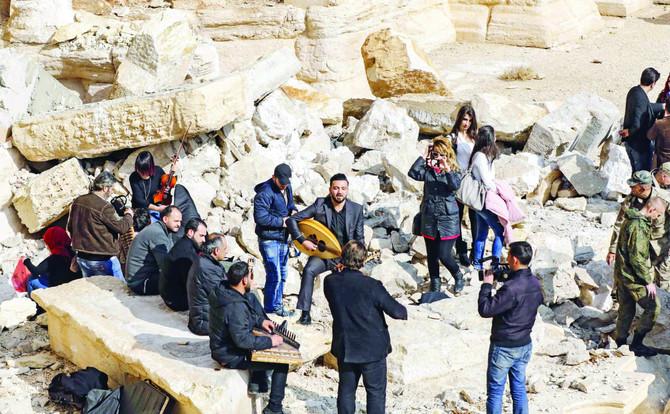
Oqayrabat lies northwest of Palmyra, the ancient desert city that was recaptured by Russian-backed regime forces from Daesh on Wednesday.
The road between the two had been often used by radical militants to travel between the provinces of Hama and Homs, where Palmyra lies.
Abdel Rahman said the raids on the village were part of “new military operations by the Syrian regime and its Russian ally targeting terrorist positions in Hama province.”
Syrian and Russian warplanes on Saturday were heavily bombing Daesh extremists north and east of Palmyra, which has changed hands several times in Syria’s nearly six-year war.
The Organization for the Prohibition of Chemical Weapons (OPCW) also raised fears at the time that chemical weapons may have been used in airstrikes on Oqayrabat.
The Observatory, which relies on a network of sources inside Syria for its information, says it determines whose planes carry out raids according to type, location, flight patterns and munitions used.
Tens of thousands of Syrian civilians have fled ferocious fighting between Russian-backed regime forces and Daesh militants over the past week in the country’s ravaged north.
Supported by Russian air power and artillery, regime forces have seized around 90 villages from the terrorists since mid-January.
Their aim is Daesh-held Khafsah, the main station pumping water into Aleppo.
Residents of Syria’s second city have been without water for 47 days after the terrorists cut the supply.
The fighting over the past week has sparked an exodus of “more than 30,000 civilians, most of them women and children,” Abdel Rahman said.
Most of the displaced went to areas around Manbij, under the control of the Syrian Democratic Forces (SDF), an alliance of Kurdish and Arab fighters backed by the US that is also fighting Daesh, the monitor said.
An AFP correspondent in Manbij saw dozens of displaced families speeding toward the relative safety of the town on motorcycles and in small buses and cars.
Many of them looked exhausted as they lined up at a checkpoint manned by the Manbij Military Council, the SDF unit that controls the town, to be searched and get permission to enter.
Ibrahim Al-Quftan, co-chair of Manbij’s civil administration, told AFP that as many as 40,000 displaced people had arrived in the town in recent days.
“The numbers of displaced people here are still rising because of the clashes between the Syrian regime and Daesh,” Al-Quftan said.
“These people are suffering very difficult circumstances.”
Manbij is already hosting “tens of thousands of displaced people that fled previous clashes in the area and are living in difficult circumstances,” according to Abdel Rahman.
In another development, Syria’s chief negotiator in Geneva said that the “only thing” achieved at 10-day talks was an agreed agenda and that the regime wanted a unified opposition delegation as its negotiating partner.
In his first remarks since talks ended on Friday, Syria’s ambassador to the UN Bashar Al-Jaafari said the agenda agreed through UN mediator Staffan de Mistura gave equal weight to four subjects, including the regime’s own priority of fighting terrorism.
“Nothing has been adopted so far, there is nothing final at all except for the agreement on an agenda. This is the only final thing that we achieved in this round,” Al-Jaafari told reporters in Geneva.
Damascus sought a unified Syrian opposition, “not a Saudi partner nor a Qatari, Turkish or French partner.” “What is asked is to have a partner,” he said.
The main Syrian opposition at the talks is the High Negotiations Committee (HNC) but there are also two smaller dissident groups which have no military muscle but enjoy Moscow’s blessing as opposition voices.
Jaafari said a “first condition” was to have a Syrian national opposition that did not seek help from other parties.
The second condition was to have a unified opposition that agreed on a common agenda, he said.
Jaafari said the government was studying whether to return for the next round of Geneva talks later in March. De Mistura says he plans to continue separate talks with the two sides on substantive issues after reporting to the UN Security Council next week.
“The train is ready, is in the station, is warming up its engine, everything is ready and it just needs an accelerator,” de Mistura told reporters on Friday night. “And the accelerator is in the hands of those who were attending this round.”


![]()
Strikes kill 11 civilians in Syria as tens of thousands flee clashes with Daesh
Strikes kill 11 civilians in Syria as tens of thousands flee clashes with Daesh


Latest updates


© 2026 SAUDI RESEARCH & PUBLISHING COMPANY, All Rights Reserved And subject to Terms of Use Agreement.