

Germany arrests suspected Syrian war criminal

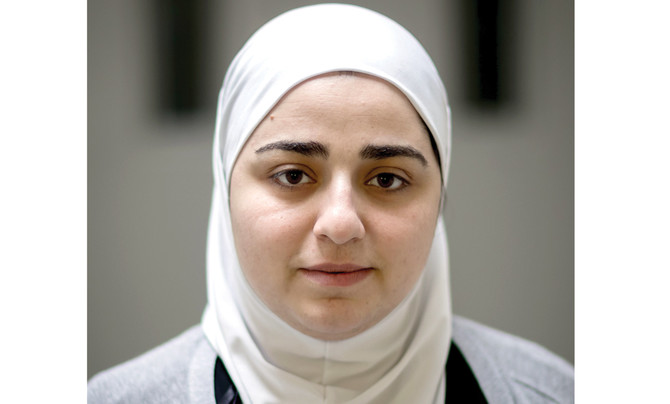
Syrian Abier Farhud, a victim of torture and abuse in Syrian regime cells. (Reuters)
Updated 03 March 2017
Follow

Germany arrests suspected Syrian war criminal

BERLIN: German police have arrested two Syrian men, one of whom is suspected of involvement in the killing of 36 Syrian regime’s employees in Syria in March 2013 and committing war crimes, prosecutors said on Thursday.

Abdalfatah H. A., 35, is suspected of being a member of the Al-Qaeda-linked Nusra Front and of carrying out a death sentence.

With other members of his unit, he is believed to have killed 36 employees of the Syrian regime who were protected under international law, said the prosecutors.

He was arrested in Duesseldorf in northwestern Germany.

Spiegel Online reported that he was an asylum seeker but the prosecutor’s office refused to confirm that.

The second man, Abdulrahman A.A., 26, is also suspected of being a member of the Nusra Front and of dealing with money and transport for his unit. He was arrested in the western German town of Giessen.

Both men are believed to have been equipped with Kalashnikovs, and to have helped seize a big arms depot in November 2013 near Mahin, south of the Syrian city of Homs.

In Germany, suspects are identified only by their first names and initials.

Prosecutors separately confirmed they had received a complaint filed by a group of people who said they had been tortured in Syrian intelligence service prisons.

The European Center for Constitutional and Human Rights, seven Syrians and two Syrian lawyers said they had submitted the first such complaint against six senior officials in the Syrian Military Intelligence Service known by name.

The aim of the complaint was to secure international arrest warrants and to start investigations by the prosecutors’ office against those responsible for crimes, said the complainants in a statement.

“This complaint is very welcome because it may lead us to an investigation,” said a spokeswoman for prosecutors in Karlsruhe, adding that German authorities had since 2011 been involved in looking at possible investigations of crime committed in Syria. 

The new complaint alleges crimes against humanity and war crimes committed in three Damascus prisons between October 2011 and July 2015, based on the testimonies of 12 witnesses, seven of whom are complainants.

The Syrian ex-detainees, men and women aged 26 to 57, are joined by Syrian lawyers Anwar Al-Bunni and Mazen Darwish, who have both themselves been victims of torture and abuse in Syrian regime cells.

“In Syria there is total impunity, which produces further violence. Without justice there will be no political solution to the conflict,” said Darwish.

Al-Bunni added: “Massive human rights violations must not remain unanswered. This is clear since the Nuremberg trials. Torture is absolutely forbidden.”

The complaint was launched under the principle of universal jurisdiction, which allows the German judiciary to become active in cases where neither the victims nor the perpetrators are German citizens.


Thousands of Libyans gather for the funeral of Qaddafi’s son who was shot and killed this week

Updated 4 sec ago
Follow

Thousands of Libyans gather for the funeral of Qaddafi’s son who was shot and killed this week

  • As the funeral procession got underway and the crowds swelled, a small group of supporters took Seif Al-Islam’s coffin away and later performed the funeral prayers and buried him
  • Authorities said an initial investigation found that he was shot to death but did not provide further details

BANI WALID, Libya: Thousands converged on Friday in northwestern Libya for the funeral of Seif Al-Islam Qaddafi, the son and one-time heir apparent of Libya’s late leader Muammar Qaddafi, who was killed earlier this week when four masked assailants stormed into his home and fatally shot him.
Mourners carried his coffin in the town of Bani Walid, 146 kilometers (91 miles) southeast of the capital, Tripoli, as well as large photographs of both Seif Al-Islam, who was known mostly by his first name, and his father.
The crowd also waved plain green flags, Libya’s official flag from 1977 to 2011 under Qaddafi, who ruled the country for more than 40 years before being toppled in a NATO-backed popular uprising in 2011. Qaddafi was killed later that year in his hometown of Sirte as fighting in Libya escalated into a full-blown civil war.
As the funeral procession got underway and the crowds swelled, a small group of supporters took Seif Al-Islam’s coffin away and later performed the funeral prayers and buried him.
Attackers at his home
Seif Al-Islam, 53, was killed on Tuesday inside his home in the town of Zintan, 136 kilometers (85 miles) southwest of the capital, Tripoli, according to Libyan’s chief prosecutor’s office.
Authorities said an initial investigation found that he was shot to death but did not provide further details. Seif Al-Islam’s political team later released a statement saying “four masked men” had stormed his house and killed him in a “cowardly and treacherous assassination,” after disabling security cameras.
Seif Al-Islam was captured by fighters in Zintan late in 2011 while trying to flee to neighboring Niger. The fighters released him in June 2017, after one of Libya’s rival governments granted him amnesty.
“The pain of loss weighs heavily on my heart, and it intensifies because I can’t bid him farewell from within my homeland — a pain that words can’t ease,” Seif Al-Islam’s brother Mohamed Qaddafi, who lives in exile outside Libya though his current whereabouts are unknown, wrote on Facebook on Friday.
“But my solace lies in the fact that the loyal sons of the nation are fulfilling their duty and will give him a farewell befitting his stature,” the brother wrote.
Since the uprising that toppled Qaddafi, Libya plunged into chaos during which the oil-rich North African country split, with rival administrations now in the east and west, backed by various armed groups and foreign governments.
Qaddafi’s heir-apparent
Seif Al-Islam was Qaddafi’s second-born son and was seen as the reformist face of the Qaddafi regime — someone with diplomatic outreach who had worked to improve Libya’s relations with Western countries up until the 2011 uprising.
The United Nations imposed sanctions on Seif Al-Islam that included a travel ban and an assets freeze for his inflammatory public statements encouraging violence against anti-Qaddafi protesters during the 2011 uprising. The International Criminal Court later charged him with crimes against humanity related to the 2011 uprising.
In July 2021, Seif Al-Islam told the New York Times that he’s considering returning to Libya’s political scene after a decade of absence during which he observed Middle East politics and reportedly reorganized his father’s political supporters.
He condemned the country’s new leaders. “There’s no life here. Go to the gas station — there’s no diesel,″ Seif Al-Islam told the Times.
In November 2021, he announced his candidacy in the country’s presidential election in a controversial move that was met with outcry from anti-Qaddafi political forces in western and eastern Libya.
The country’s High National Elections Committee disqualified him, but the election wasn’t held over disputes between rival administrations and armed groups.