


JEDDAH/WASHINGTON: A damning report by Amnesty International detailing extrajudicial killings of as many as 13,000 Syrians sparked demands Tuesday for the UN Security Council to hold Bashar Assad to account for war crimes.
Syrian authorities have killed possibly thousands more detainees since the start of the 2011 uprising in mass hangings at a prison north of Damascus known to detainees as “the slaughterhouse,” Amnesty said on Tuesday.
Dr. Nasr Al-Hariri, a top official in the opposition Syrian National Coalition, told Arab News that “tens” of other detention centers exist in the country.
The executions and treatment of detainees qualify as war crimes and crimes against humanity and “hundreds of thousands” more may be languishing in Syrian jails, Al-Hariri said.
“This brutal regime has been committing war crimes and must be tried as such. If the UN and the Security Council do not take action, then there will be no meaning for their existence as a body to protect humanity,” Al-Hariri said.
Amnesty International’s chilling report, covering the period from 2011 to 2015, said 20-50 people were hanged each week at Saydnaya Prison in killings authorized by senior Syrian officials, including deputies of President Assad, and carried out by military police.
The report referred to the killings as a “calculated campaign of extrajudicial execution.”
Amnesty has recorded at least 35 different methods of torture in Syria since the late 1980s, practices that only increased since 2011, said Lynn Maalouf, deputy director for research at Amnesty’s regional office in Beirut.
Other rights groups have found evidence of torture leading to death in Syrian detention facilities. In a report last year, Amnesty found that more than 17,000 people have died of torture and ill-treatment in custody across Syria since 2011, an average rate of more than 300 deaths a month.
Those figures are comparable to battlefield deaths in Aleppo, one of the fiercest war zones in Syria, where 21,000 were killed across the province since 2011. No international observer has ever set foot inside the Saydnaya prison, according to Amnesty.
Amnesty’s report comes just two weeks before a new round of talks is due to take place in Switzerland aimed at putting an end to nearly six years of civil war.
“The upcoming Syria peace talks in Geneva cannot ignore these findings. Ending these atrocities in Syrian government prisons must be put on the agenda,” Maalouf told The Associated Press.
The High Negotiations Committee, which is set to represent Syria’s opposition at the talks, said the investigation “leaves no doubts that the regime has carried out war crimes and crimes against humanity.”
Anna Neistat, senior director of research at Amnesty International, told Arab News late Tuesday the revelations should be on the table for peace negotiations.
“To establish a long-lasting peace, to have any talks of peace to be meaningful, then this must be part of the peace process,” Neistat said.
Neistat said the UN Security Council has options to put pressure on the Syrian regime to halt executions by taking the Assad government to the International Criminal Court. But Russia, Assad’s ally, stands in the way.
“As long as Russia has veto power that won’t happen,” she said. “But the General Assembly could overturn the Security Council.”
The UN General Assembly can take up the matter if the Security Council fails to move toward a resolution in the international courts. However, whatever action the Assembly takes is largely symbolic since the Security Council is responsible for enforcement. Perhaps the most notable failure of the General Assembly in a similar situation was its 1980 resolution demanding that the Soviet Union withdraw its military forces from Afghanistan. The Soviets ignored the resolution.
Amnesty International’s accounts in Tuesday’s report came from interviews with 31 former detainees and over 50 other officials and experts, including former guards and judges.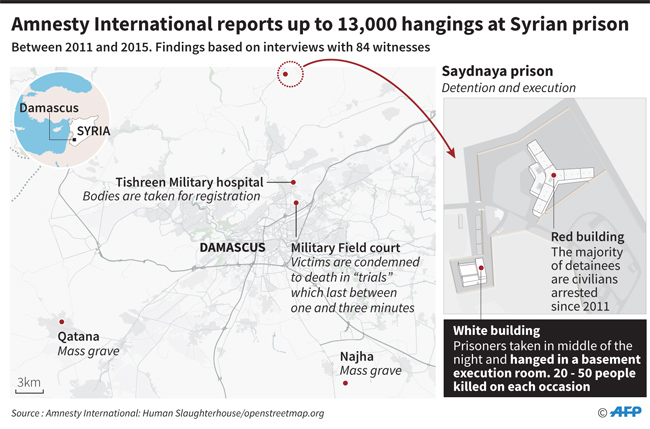
According to the findings, detainees were told they would be transferred to civilian detention centers but were taken instead to another building in the facility and hanged.
“They walked in the ‘train,’ so they had their heads down and were trying to catch the shirt of the person in front of them. The first time I saw them, I was horrified. They were being taken to the slaughterhouse,” Hamid, a former detainee, told Amnesty.
Another former detainee, Omar Alshogre, told The Associated Press the guards would come to his cell, sometimes three times a week, and call out detainees by name.
Alshogre said a torture session would begin before midnight in nearby chambers that he could hear.
“Then the sound would stop, and we would hear a big vehicle come and take them away,” said Alshogre, who spent nine months in Saydnaya. Now 21, he lives in Sweden.
Alshogre survived nine months in the prison, paying his way out in 2015 — a common practice. He suffered from tuberculosis and his weight fell to 35 kilograms.
Maha Akeel, director of communications at the Jeddah-based Organization of Islamic Cooperation (OIC) said: “The Syrian regime should be held accountable for what can only be described as war crimes and crimes against humanity.”
She urged the international community to take immediate action to stop “these horrific human rights violations and abuses.”
“With such credible reports as this one by Amnesty International, the UN Security Council in particular should have the moral responsibility to remove this bloody regime from power,” Akeel told Arab News.
A US State Department official told Arab News on condition of anonymity that the US administration is “in the process of looking at the report but our initial assessment is that we’re not surprised by its allegations.”
Tobias Schneider, a defense analyst and an expert on the Syrian war, said “the horrors described in this latest report, disturbing as they are, do not come as a surprise to those familiar with the merciless cruelty of Assad’s security services.” On its impact on the international community, Schneider is doubtful that it will change the narrative.
“Almost six years after the revolution, there is little reason to hope that Amnesty’s most recent revelations would change the fundamental calculus of those who long ago decided to abandon the Syrian people to their fates,” he added.
At best for Assad opponents, the expert sees the report magnifying “the sheer scale of the horror” that could be used to “slow (the) drift in Western capitals toward re-normalization of (the) Assad regime.”
However, Schneider added that “with the US strategically sidelined, and a majority of European states even slowly pushing for rapprochement with Damascus, forcefully worded statements and public hand-wringing by government officials is likely the most we can expect.”
Where the report might make a difference is in the legal procedures against the Assad regime. Schneider cites “the court case filed last week in Spain, where the report can help build a historical record that may aid exiled Syrians trying to permanently entrench opposition to the Assad regime in Western policy circles."


