WASHINGTON: While former US President Barack Obama came to office in 2009 pledging to end the wars in Iraq and Afghanistan, his successor Donald Trump has embraced more aggressive rhetoric, promising to “knock the hell out of” Daesh and to “win so much” in the Middle East.
But rhetoric aside, and as the Trump administration starts to draft policy plans to fight Daesh, the options it has on hand might be similar in strategy and goals to Obama’s, experts argue, while utilizing more force.
Yesterday, the US Defense Department handed its draft plan for defeating Daesh to the White House, as Defense Secretary James Mattis convened meetings with senior officials to finalize a holistic strategy stamped by Trump to defeat both Daesh and Al-Qaeda in Syria and Iraq.
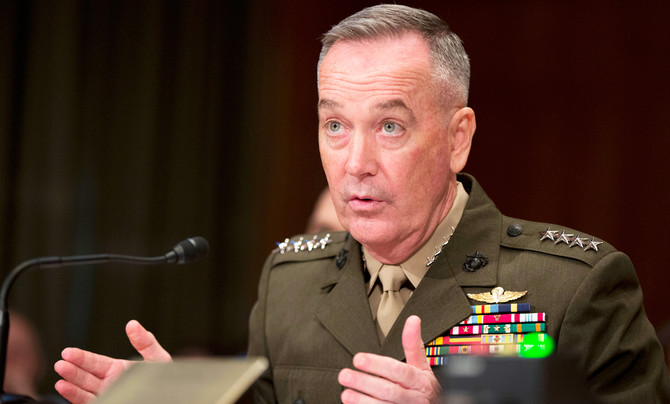
The review, which Trump tasked the Pentagon to draft a month ago, includes — according to Chairman of the Joint Chiefs Gen. Joseph Dunford — military, diplomatic and financial measures against Daesh.
Dunford told a policy crowd at Brookings last Thursday: “We’ve been given a task to go to the president with options to accelerate the defeat of ISIS (Daesh) specifically, but also obviously other violent extremist groups as well (Al-Qaeda).” He added: “So we’ll go to him with a full range of options from which he can choose.”
Dunford emphasized the long list of options that the military will provide Trump with, allowing him as the “final decider” to work with different tactics. “I’m in the business of providing the president with options,” Dunford said, describing the war in Syria as “about as complex an environment as you can” get.
Faysal Itani, a resident senior fellow with the Atlantic Council’s Rafik Hariri Center for the Middle East, told Arab News that “the US has a broad spectrum of action to act along” against Daesh in Syria and Iraq. “The military capability is there, and none of the likely options will call for a long-term deployment of US ground troops.”
While Dunford did not take any option off the table, including ground troops, he emphasized the local component of any anti-Daesh plan. The goal would be “to drive the threat down to the level where local law enforcement and security forces can deal with that threat and, first and foremost, it’s incapable of conducting operations against the United States,” he said.
Itani described the options presented to the White House as “likely to be realistic,” including “the augmentation of special forces, looser rules of engagement, and increased material support for the Syrian Democratic Forces (SDF).” The SDF is a local Kurdish-majority force supported and equipped by the US to roll back Daesh.
Alternatively, Itani said the Trump administration could opt out “and drop the SDF strategy, and instead coordinate a new approach with Turkey,” whose relations with the SDF are strained. The Turkey route would take the US “through northern Raqqa and Aleppo provinces” in defeating Daesh.
These options of escalating the war against Daesh and pushing it out of Raqqa, while empowering local forces, “are an enhanced version of the Obama approach,” said Itani. The difference between Obama and Trump is that the former “had a lower threshold for risk, and therefore would’ve been happy for this fight to take its time provided casualties are lower, the footprint is smaller and civilian deaths are controlled.”
Trump, on the other hand, is “more aggressive and could deepen US investment in this fight while sharing Obama’s basic goals: That ISIS (Daesh) should be defeated, and the US shouldn’t be saddled with thinking too much about the aftermath.”
Dunford did not exclude the option of establishing safe zones on the list of recommendations to fight Daesh and contain the crisis. Trump has flirted with the idea of safe zones, pledging two weeks ago to build them and have the Gulf states cover the cost.
But finance is the easy part of the puzzle in any debate on safe zones in Syria. Harder questions, according to Itani, involve: “Who will police it? What will happen to the armed groups in the area? What if it’s breached?” These questions will likely be addressed in the White House strategy sessions and in talks with Syria’s neighbors, which could oversee these protected areas.
The US military leadership has also stressed the political aspect of any plan it presents to Trump against Daesh, viewing any escalation as a step toward reaching the negotiating table. That objective was also an Obama tactic, but one that had no legs to gain enough leverage and force a political settlement.


![]()
Trump’s potential anti-Daesh plan: Obama’s on steroids
Trump’s potential anti-Daesh plan: Obama’s on steroids
Latest updates


© 2026 SAUDI RESEARCH & PUBLISHING COMPANY, All Rights Reserved And subject to Terms of Use Agreement.