EU to phase out China solar panel duties

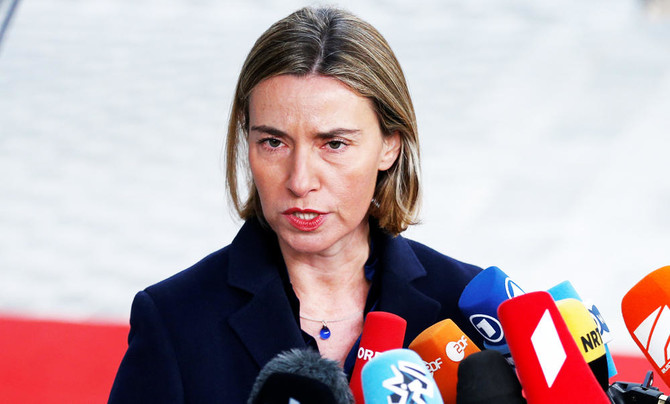
European Union foreign policy chief Federica Mogherini briefs the media during a European Union foreign ministers meeting in Brussels, Belgium on Monday. (REUTERS)
Updated 08 February 2017
Follow

EU to phase out China solar panel duties

BRUSSELS: The EU said Wednesday it aimed to phase out anti-dumping duties on Chinese solar panel imports after 18 months, ending a bitter dispute with one of its largest trading partners.
Stung by US President Donald Trump’s protectionist stance, the EU has touted its free-trade credentials and pledged closer cooperation with China in response.
The EU imposed the duties in 2013 after European panel manufacturers complained they were being forced out of business by underpriced Chinese imports.
Other companies, which installed solar panel systems, claimed the duties harmed them by increasing their costs and should be removed.
European Commission (EC) Vice President Frans Timmermans said: “There is no doubt we have the right to protect our industry... but at the same time we have to take into account other companies who import these products.”
These companies, he told reporters, provided thousands of jobs and were a key element in the renewable energy industry.
“The college (of the 28 member state representatives) weighed the options, including the different interests involved and decided to maintain the measures for 18 months and an eventual phase out,” he said.


Saudi Arabia surpasses $400bn in investment volume, minister announces

Updated 6 sec ago
Follow

Saudi Arabia surpasses $400bn in investment volume, minister announces

RIYADH: Saudi Arabia’s total investment volume surpassed SR1.5 trillion ($400 billion) for the first time in 2025, the Kingdom’s minister of investment has announced.

Speaking at the Government Press Conference in Riyadh, Khalid Al-Falih highlighted unprecedented growth across the financial landscape, with foreign capital inflows playing a central role.

The Kingdom is aiming to attract $100 billion in annual foreign direct investment by the end of the decade as part of its Vision 2030 economic diversification plan. 

“We expect foreign investment flows into Saudi Arabia in 2025 to range between SR140 billion and SR150 billion,” Al-Falih said, noting that this projection represents a five-fold increase from the SR28 billion recorded in 2017, a sign of rising global investor confidence.

The surge in international business activity is further reflected in the number of foreign companies operating in the Kingdom. Al-Falih revealed that licensed foreign firms have reached 62,000, a dramatic increase from just 6,000 in 2016.

Furthermore, the nation has attracted more than 700 regional headquarters for leading global corporations, solidifying its position as a premier commercial hub for the Middle East and North Africa.

The investment boom is creating substantial opportunities for Saudis. The minister highlighted that 800,000 new jobs have been created in the Saudi economy, with private sector wages rising by 45 percent. He also noted that women’s labor force participation has doubled, marking a significant societal shift.

The domestic entrepreneurial spirit remains robust, with the number of active commercial registrations held by Saudi investors reaching 1.86 million by the end of 2025.

Al-Falih also stated that 500,000 Saudis have been employed out of 1.5 million workers in foreign companies, and that three major companies have begun automobile manufacturing in the Kingdom.

The economic outcomes cited by Al-Falih are direct results of the nation’s Vision 2030 reform agenda. This transformation is being accelerated by the systematic opening of Saudi Arabia’s capital markets. 

On Feb. 1, the Capital Market Authority will allow all foreign investors direct access to the Main Market, eliminating previous qualification barriers. This follows a period of rapid growth in international participation, with foreign ownership exceeding SR590 billion by the third quarter of 2025. 

On this, the minister said that Tadawul is “prideworthy,” noting that it’s now one of the biggest 10 stock markets worldwide. He stated that the old restrictions on foreign investors were found to limit market access for all international investors. He confirmed that the new rules, which will be announced soon, are designed to be “balanced.”