The century-old car industry has achieved great leaps forward during its history.
The process has been far from smooth and the history of car-making is littered with failed attempts and bankrupt companies.
It is also full of success stories which combine to make the industry what it is today.
However, every now and then a car comes along that changes the status quo and opens up new possibilities and ways of thinking.
This was true from the very beginning when engineers in Germany produced the first petrol-propelled car while people were demanding faster horses.
Each of the following cars has taken the industry one step forward and inspired more innovations. For that they deserve a mention in a hall of fame for cars that changed the world. They are:
• The Benz Motorwagen: This was the first car designed by Karl Benz some 130 years ago. It does not resemble any car we know today with its three wheels, tiller steering and one seat. The Benz was running on a 954 cc engine capable of less than one horsepower. This car can be seen in a German museum and is the grandfather of all cars we see today.
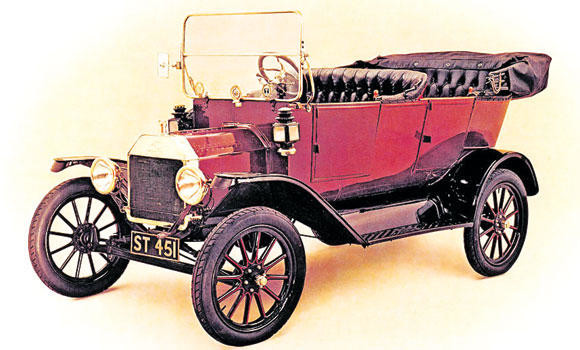
• Ford Model T: Until Henry Ford devised his first production line to make the car available to the masses, cars were the domain of the very wealthy class alone. If the majority of people own cars produced on production lines, they owe their luxury and convenience to Ford Model T which started that trend. The famous Model T had many innovations and simple design that made it part of the world culture at the beginning of the 20th century.
• The Mini: It was not the first front-wheel-drive car, of course — but the Mini was the first car that took front-wheel-drive, mated it to a transverse engine, and showed just what could be achieved. With compact dimensions, enough space inside for four people, and a cart-like driving experience, the Mini provided cheap, practical, economical and fun transport for millions. And, more than that, it turned out to be the template for almost every family car we see on the road today.
• Citroen DS: The DS has been much-lauded for its oleopneumatic suspension system — which, it has to be said, never achieved widespread uptake in its entirety except by Citroen itself. However, the oleopneumatic concept was used by several manufacturers — including Rolls-Royce, BMW and Mercedes-Benz — in order either to improve ride quality or to offer a self-levelling suspension system. What was more, the DS’s rotating headlamps — which were linked to the steering and changed direction to shed light around corners — were a precursor to today’s systems, now becoming commonplace on a huge variety of different models
• Land Rover: While the Land Rover wasn’t the first off-road vehicle, it was the first to be offered in production quantities to the public at large. In that, it offered people who lived in inaccessible areas a much easier way of getting around, not to mention giving farmers a welcome dose of easily-accessible utility. It also spawned the 4x4 segment of the new car market, which today is one of the most popular.
• Lancia Lambda: A rough sea crossing on a large ship inspired Vincenzo Lancia to attempt to build a unitary body for his next model, the Lambda, and in doing so he created a form of car building that transformed the industry. Unibody construction (otherwise known as ‘monocoque’) is stronger and lighter than the traditional body-on-frame form that was used at the time, so it’s no surprise that today it has become the default choice for almost all cars.
• VW Beetle: This is the German T Model designed by Porsche. Its simple design and air-cooled rear engine made it the first world-car in the 1950’s and 1960’s. It sold in millions and was produced in many countries even in Latin America. The beetle was the first car cheap to buy and easy to maintain and would have been at the top of the reliability list of the time.
• Toyota Prius: The Prius was the first mass-produced hybrid car, and became the poster car for the type. Today, almost every mainstream manufacturer has a hybrid of some sort in its range, and that popularity owes itself to the success of this forebear.
• Lamborghini Miura: Widely acknowledged to be the first mid-engine, rear-wheel-drive sports car, the Lamborghini Miura set out the template for what is considered to be a supercar today. The latest hyper-cars from McLaren, Ferrari and Porsche can all trace their layout back to this model. It also happened to be one of the most sensationally beautiful cars ever built.
• Tesla Model S: Electric cars have languished for decades at the bottom of the automotive industry, derided for their awful performance, poor range and often comedic styling. However, the Tesla Model S is modern, stylish, fast, practical, and has an entirely usable range. It is, in short, the car that’s made electric cars a realistic proposition, and it looks set to herald a sea change in the way we view electricity as an alternative fuel.
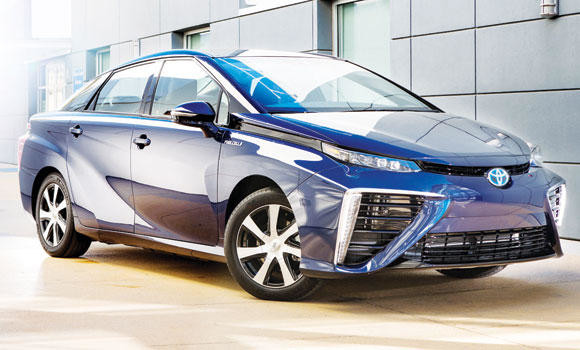
Are there cars in the pipeline that are set the change the status quo again? The only potential car to do so is the Toyota Mirai which will be the first ever production fuel-cell car.
The Mirai is the first vehicle that will make this technology widely available.
Fuel-cell vehicles are thought to offer many solutions to the current problems surrounding internal combustion engines, and if that proves to be correct, the Mirai could just be one of the most important cars of our time.


![]()
![]()
![]()
![]()
![]()

Ten cars that changed the world


Ten cars that changed the world
Latest updates



© 2026 SAUDI RESEARCH & PUBLISHING COMPANY, All Rights Reserved And subject to Terms of Use Agreement.