LONDON: In 2011, as unrest spread across Syria, Damascus came under renewed international scrutiny after refusing to dispel suspicions that it had worked on a suspected undeclared nuclear facility.
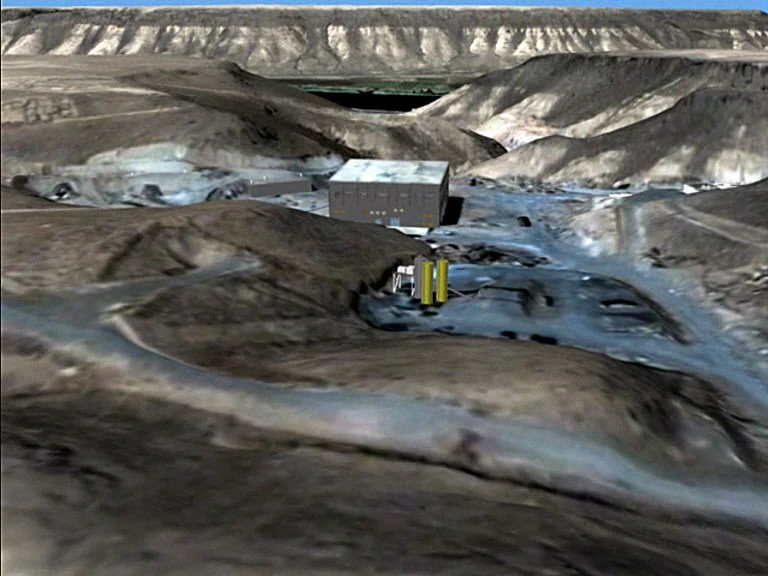
Those suspicions centered on Al‑Kibar, a remote site in Deir Ezzor governorate in eastern Syria, and followed a series of events that led the International Atomic Energy Agency to conclude it had enough evidence to say it was “very likely” that Bashar Assad was running a covert nuclear program.
“The Syrian Government was given ample time by the Agency to cooperate fully concerning the Deir Ezzor site, but did not do so,” Yukiya Amano, then director general of the IAEA, told the Board of Governors in June 2011. “Nevertheless, we had obtained enough information to draw a conclusion” that Assad built a nuclear reactor.
Fifteen years on, the evidence is laid bear for all to see.
On Tuesday, the UN nuclear watchdog confirmed the discovery of about 73 tonnes of undeclared natural uranium metal linked to Deir Ezzor, evidence that Assad presided over a covert, relatively sophisticated fuel‑cycle effort around a plutonium‑capable reactor, and that the site was not just an abandoned military building in the desert.
In a confidential report, the agency said it visited several sites in Syria in August and carried out verification work, confirming “that the cooling infrastructure which has now been uncovered is consistent with that of a nuclear reactor.”
While the discovery did not appear to catch experts by surprise, the confirmation of the Deir Ezzor findings sheds new light on the scale and ambition of Assad’s nuclear project, and the more worrisome use for it.
Since the mid‑2000s and before the IAEA reached its conclusion, US intelligence had assessed that Syria operated an extensive undeclared nuclear program, including a reactor built with North Korean assistance.
The site only became public knowledge after Israel launched air strikes in 2007 that destroyed the facility, following US and Israeli assessments that the Al‑Kibar complex hosted an undeclared reactor that could produce plutonium for nuclear explosive devices.
The Assad regime initially said the building was a disused military facility with no connection to nuclear activities and denied any nuclear cooperation with North Korea, before reportedly leveling the site and denying agency inspectors access or answers.
After three years of contested narratives, and the discovery of anthropogenic natural uranium particles through open‑source and member‑state information, the agency said it had enough evidence to move from “suspicions” to a formal assessment that the destroyed building was “very likely” a reactor.
In June 2011, the then IAEA Board of Governors adopted a resolution stating that Syria’s failure to declare the construction of a Yongbyon‑style gas‑cooled, graphite‑moderated reactor at Deir Ezzor constituted “non‑compliance with its obligations under its Safeguards Agreement with the Agency,” and called on Damascus to give the agency access to all information, sites, material and persons necessary to resolve the outstanding safeguards questions.
The reactor design is similar to North Korea’s 5 MWe facility at Yongbyon, which has been used to produce weapons‑grade plutonium.
The board’s resolution had no immediate effect on the stalemate between the IAEA and Syria over the unresolved safeguards issues, further eroding confidence that Syria’s nuclear program was exclusively for peaceful purposes.
While independent analysis had long pointed to the Marj Al-Sultan site near Damascus as a likely location for uranium conversion and fuel fabrication, Tuesday’s IAEA report suggested that the Deir Ezzor facility could have been the centerpiece of Assad’s wider, undeclared nuclear program.
In a confidential report circulated in Vienna, current IAEA chief Rafael Grossi wrote that the cache amounted to 73 tonnes of natural uranium metal, of which about 55 tonnes was contained in 8,808 fuel rods, with the remaining 18 tonnes made up of uranium scrap and waste from the manufacturing process.
While limited, that volume sets the find apart from a modest research project, which, combined with the scrap and waste recovered alongside the fuel rods, suggest a sustained production process rather than a single batch made to specification.
The IAEA previously assessed the Deir Ezzor reactor design at around 25 megawatts thermal, a size that would have required about 50 tonnes of natural uranium for a full core load — meaning the 73 tonnes recovered represent about one full core plus a significant surplus.
“The Syrian reactor would have held 50 tonnes of natural uranium metal,” David Albright, former IAEA inspector and president of the Institute for Science and International Security, an NGO specializing in analyzing the agency’s findings, said in a post on X.
“There is also evidence that Syria worked on putting together a facility to separate plutonium from the reactor’s irradiated fuel to be produced in the reactor.”
While further excavations are expected to shed more light on the exact ambitions of Assad's nuclear program, alarm among experts over the possible construction of a bomb remains limited.
Though strategically significant, the material is not weapons‑ready. Only if diverted and either reprocessed after reactor use or enriched elsewhere could they provide feedstock for a potential weapons program — and with the IAEA report remaining largely confidential, any such scenario remains speculative.
“While the building of a nuclear reactor is not prohibited, given the IAEA’s report remains confidential it is difficult to assess exactly what the previous Syrian government’s intentions were,” Susi Snyder, director of programs at the International Campaign to Abolish Nuclear Weapons, told Arab News.
“However, now the IAEA has been able to inspect the sites and assessed the risks from any remaining radioactive material, it should be possible to prevent any further possible contamination that could threaten human health and the environment.”
The Syrian government has been quick to break free from the “history of concealment” of the previous regime.
The new administration notified the IAEA in July that nuclear material was stored at an undeclared location outside Damascus, invited inspectors, and agreed a joint road map to verify the material and excavate Deir Ezzor under agency coordination.
The latest agency report explicitly praised Syria’s new authorities for their “transparency and cooperation” in helping clarify past nuclear activities and account for material that remains in the country, saying it had received the information and access needed from Syria to resolve outstanding safeguard issues that had previously been reported to its Board of Governors.
That, its report shows, is in contrast to the agency’s admission that it has made “no progress” over unresolved questions on Iran — which has barred inspectors from returning to nuclear sites that were hit by US and Israeli strikes in June 2025.
“We welcome the Syrian authorities’ decision to provide the IAEA with access to the sites in question,” said Snyder, adding that Damascus’ action should go further and adopt an additional protocol with the agency.
For Mark Hibbs, senior fellow at the Carnegie Endowment for International Peace, the “IAEA’s findings highlight the importance of transparency and continued international monitoring in the region. The discovery of such a large quantity of undeclared uranium raises proliferation concerns, especially given the regional security context.”
For now, Damascus says it wants to keep the uranium and related material in national custody for a future civilian nuclear energy program, but under IAEA supervision — a compromise that gives it both sovereignty over the stockpile and international cover.
That position sits alongside a separate, parallel track. According to a report by Axios, Washington has brokered a deal under which the IAEA will remove nuclear material from a clandestine storage site, known as “Site 99,” before the end of the year.
The site is said to contain material that could be used for a “dirty bomb” — a conventional explosive device designed to disperse radioactive material and contaminate an area, rather than produce a nuclear explosion.
Syrian officials told Reuters earlier in August that discussions with the IAEA were continuing and that no final agreement had been concluded on removal.
Grossi hinted at the stakes during a news conference in Damascus earlier in August. “We are talking about a few tonnes of nuclear material that could be put to bad use, and Syria has decided to open up this site to the inspectors of the IAEA,” he said.
For some experts, safeguards alone are not enough in a country still emerging from conflict.
“While we welcome the new government’s openness and cooperation with the IAEA, the country remains unstable,” Albright said.
“Removal is the preferred option to prevent future misuse by a new government or a terrorist faction that seizes the material.”
What the IAEA’s latest findings reveal about Assad’s secret nuclear program