- UK says council is determined to take decisive action as members renew sanctions and attempt to block supplies of components the Houthis use to make drones and missiles
- Resolution also strongly condemns cross-border attacks by the Houthis on Saudi Arabia, as well as the recent military escalation inside Yemen itself
NEW YORK CITY: The UN Security Council on Thursday renewed its sanctions on Yemen and moved to cut off supplies of dual-use components and chemicals the Houthi militia uses to build drones and missiles.
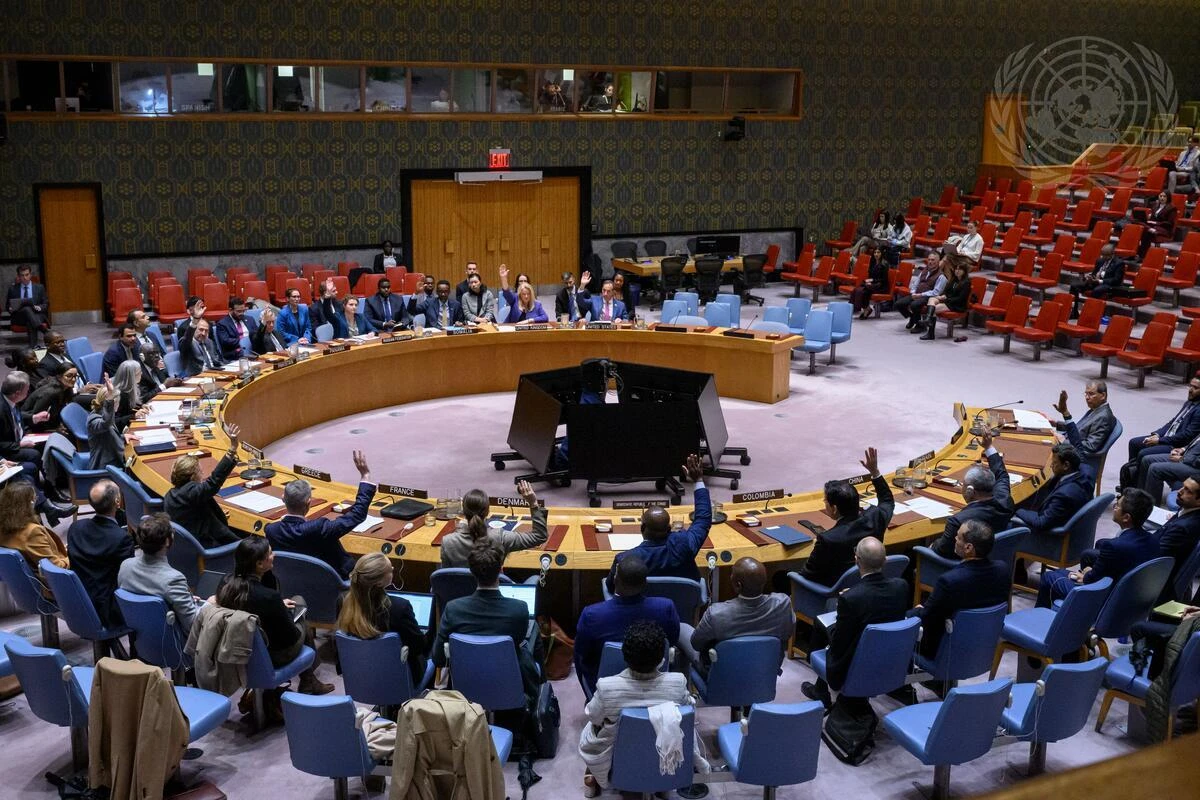
A resolution unanimously adopted by council members also strongly condemned the group’s military escalation inside Yemen and its cross-border attacks on Saudi Arabia.
The resolution, adopted by the council by consensus (meaning without a vote as there were no formal objections), demanded that the Houthis halt their military offensive in Yemen, their strikes against Saudi Arabia and their threats to commercial shipping.
It extended a targeted asset freeze and travel ban on members of the militia until Nov. 14, 2027, and renewed the mandate of the panel of experts that monitors the sanctions until Dec. 15, 2027. An arms embargo imposed on the Houthis under Resolution 2216 in April 2015 has no specified end date.
“Today’s adoption by consensus demonstrates this council’s determination to take decisive action against reckless attacks by the Houthis in Yemen and against the Kingdom of Saudi Arabia and the broader region,” said Sarah MacIntosh, the UK’s permanent representative to the UN. Britain is the Council’s penholder on Yemen, which means it has primary responsibility for the council’s activities relating to the issue.
“We stand in solidarity with the government of Yemen and the Kingdom of Saudi Arabia in the face of these attacks, and we reaffirm their right to defend their security and sovereignty in accordance with international law.”
The resolution aimed to address the growing capability of the militia to arm itself. MacIntosh said it ensured the sanctions regime “keeps pace with the evolving threat from the Houthis.”
This includes their reliance on dual-use components and precursor chemicals for localized weapons manufacturing, which supports “their ability to launch destabilizing attacks across the region.” Dual-use items are components that have legitimate civilian uses but could also be used in military operations.
UN monitors have found that the militia maintains its arsenal through smuggling and by diverting commercially available parts. This has gradually made it less dependent on outside support and allowed it to produce attack drones locally.
The council says it intended to decide by Jan. 11 what steps member states should take to prevent the Houthis from acquiring specified items, based on a list compiled by the expert panel.
MacIntosh said London would work with council members “in the coming months to agree a list of dual-use items to be subject to measures.”
The resolution also asked the expert panel to track the revenues the Houthis earn from their control of key economic sectors in Yemen, which has blunted the effectiveness of the asset freeze, and to recommend ways to prevent that money being diverted to military use.
The council also reaffirmed that the arbitrary detention by the Houthis of UN, diplomatic and humanitarian personnel could be grounds for further sanctions. Bahrain, backed by the US, proposed the inclusion of this in the resolution text. It followed the death in Houthi custody of Mohammad El-Shami, a Yemeni employee of the UN’s Human Rights Office. He had been arbitrarily detained by the militia since June 6, 2024, and his family was only recently informed that he had died more than a month ago.
“The United Kingdom condemns the Houthis’ continued detention of United Nations, humanitarian, civil society, and diplomatic personnel,” MacIntosh said, and she repeated a prior UK call for their “immediate and unconditional release.”
Though the resolution ultimately passed by consensus, the negotiations were difficult. The UK attempted to restore language that labeled the Houthis as a “terrorist group,” wording that was used in previous sanctions resolutions since 2022. It dropped the attempt after Russia objected that it would hinder political talks. Bahrain, the council’s Arab member, attempted, with support from the US, to reinsert it but the request was not accommodated.
China, backed by Russia, pushed back against the list of dual-use items, and on the expansion of the expert panel. Text relating to Houthi links with Al-Shabaab in Somalia was removed after objections from the council’s African members, along with China and Russia.
Yemen’s ambassador to the UN, Abdullah Al-Saadi, welcomed the council’s condemnation of the Houthis but regretted that it “was not able to agree on naming things with their names.” He cited what he described as the militia’s “rich terrorist record” of attacks on civilians, cross-border strikes and the targeting of international shipping.
“Not mentioning all this in the resolution does not absolve the supporters of the Houthis from their responsibilities,” Al-Saadi said. He accused the militia of “using starvation as a means of war” and called for the group’s long-running siege on the city of Taiz to be lifted.
The vote took place as the war in Yemen has reignited in recent weeks. The Iran-backed Houthis launched an offensive in early September and seized the strategic Red Sea port of Mokha after days of fighting with government forces, as they took control of Yemen’s entire Red Sea coastline and an increasingly dominant position in the vicinity of Bab Al-Mandeb Strait.
The militia also began to target Saudi territory with a series of missiles and drone strikes, including civilian airports and oil installations at Yanbu on the Red Sea coast, which had become the Kingdom’s principal export route following Iran’s blockade of the Strait of Hormuz during the war with the US and Israel that began in February.
MacIntosh pointed out that more than 22.3 million Yemenis now needed humanitarian aid and more than 330,000 had been displaced by the most recent fighting alone.
“Sanctions are not an end in themselves,” she said. “They are a tool to constrain those who threaten Yemen’s peace and security.”
Al-Saadi said the true importance of the resolution would depend on “its implementation on the ground,” and the council’s ability to turn its provisions into measures that “curb the flow of weapons.”