- Former Shamash Jewish School on Al-Rashid Street has been turned into a museum
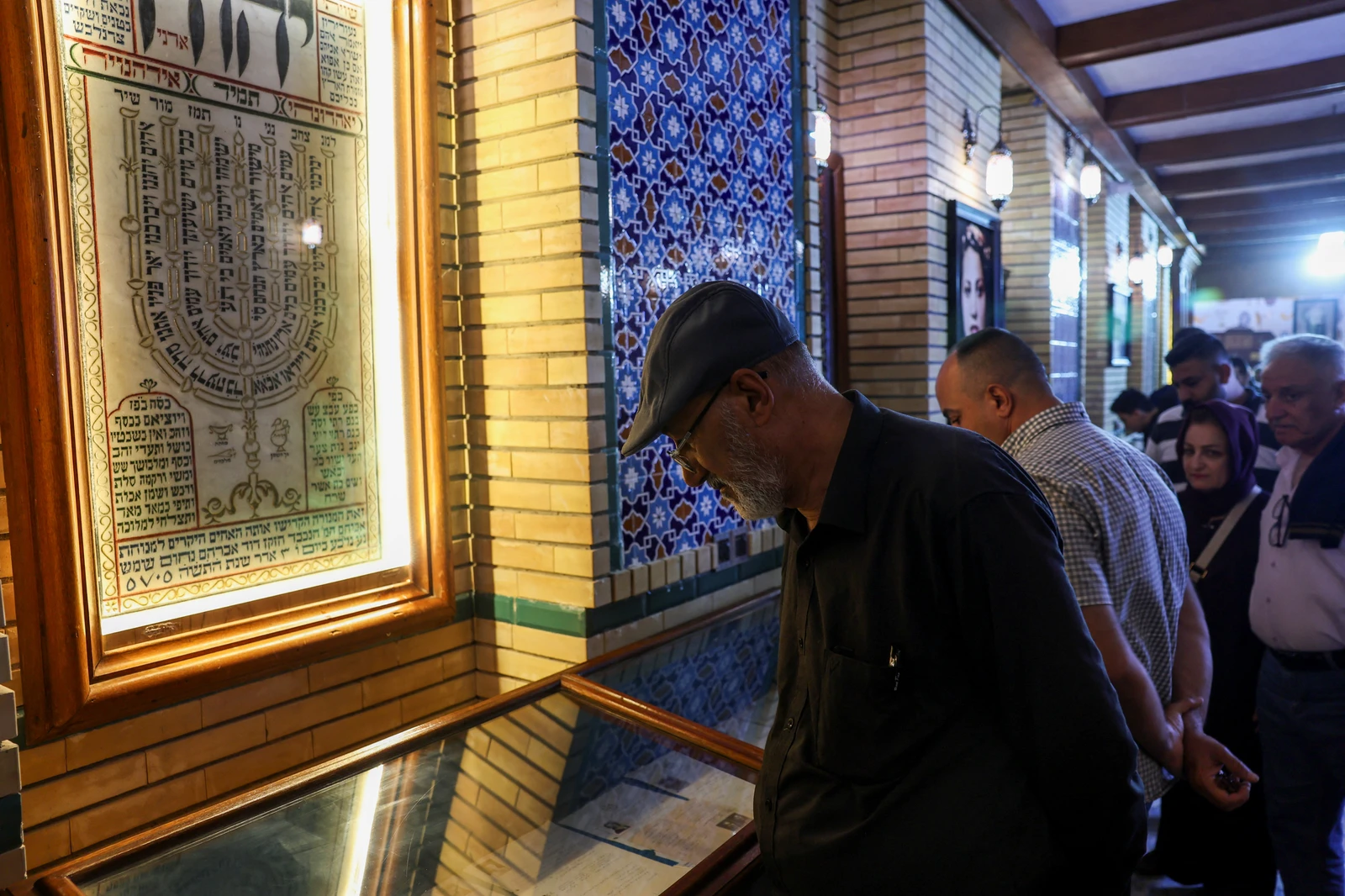
BAGHDAD: Dozens of Iraqis visit Baghdad’s first Jewish museum each day to view faded school certificates, handwritten documents and family photographs. The exhibits offer a glimpse into a once integral part of Iraqi life that has all but disappeared.
The museum occupies the historic Shamash Jewish School, founded in 1928 on Al-Rashid Street, a prominent thoroughfare in Baghdad. Iraq’s Jewish community opened the museum last month in a rare public celebration of the country’s Jewish heritage.
Inside the restored building, visitors move between display cases holding personal photographs, identity cards, graduation certificates and records of Jewish students who studied at the school, which the Jewish philanthropist Yacoub Shlomo Shamash founded. A brass menorah sits above archival documents, and another seven-branched candelabrum is displayed against polished wooden panels.
Framed black-and-white portraits line the walls, among them an image of Sassoon Heskel, a Baghdad-born Jew who served as Iraq’s first finance minister after the modern state was founded in 1920.
The museum also pays tribute to prominent figures from Iraq’s Jewish heritage, including celebrated singer Salima Murad. Born into a Jewish family in Baghdad, Murad rose to fame in the 1920s and 1930s as one of Iraq’s most acclaimed vocalists, known for performing the traditional Iraqi Maqam, a classical Arabic musical form, and lighter popular songs.
Her career reflected the prominent role Jews once played in Iraq’s cultural life.
No Jewish visitors have come yet, but Iraqis have arrived in significant numbers since the museum opened, said Ammar Al-Tamimi, legal representative of the Jewish community in Iraq.
Nabil Abdul Hameed, a 71-year-old Baghdad resident who has visited twice, said he did not believe the museum existed until he saw it himself.
He first visited alone and later returned with his daughter, a physician, and her children.
“I saw people’s interest in this subject, and I hope it is a seed of goodness that grows in the future, because the Jews were among the founders of this country,” he said.
“I hope those in charge will think about bringing the Jews back. The Jews have property, history and heritage. I wish they would come and take part in the revival of the country.”
Tamimi said the museum was created to preserve the school’s memory after demographic and economic changes transformed the surrounding area. The building is now part of a commercial district with warehouses and can no longer operate as a school, he said.
The project was led by Khalida Fouad Eliyahu, a 64-year-old dentist born in Baghdad to a Jewish family who heads Iraq’s small remaining Jewish community. She wants to restore other landmarks linked to the country’s centuries-old Jewish presence, Tamimi said, adding that all funding for the museum came from Jewish community resources.
Historian Saadi Al-Iraqi welcomed the opening and called for wider preservation of Iraq’s Jewish heritage.
“This step is wonderful and beautiful, and we want more,” he said. “I want the synagogues to open. We want their houses of worship to open too.”
A dwindling community
Under Ottoman rule and into the first half of the 20th century, Jews made up roughly a fifth of Baghdad’s population.
Jewish communities in the Middle East stretch back over 2,500 years, but anti-Jewish violence, fanned by Arab nationalism, started to sweep through the region in the early 1940s, gradually driving out most Jews.
Iraq’s Jewish community numbered about 150,000 in 1947. Between 1950 and 1952, around 125,000 Iraqi Jews were airlifted to Israel.
Nowadays, official Iraqi figures show only a handful of Jews remain in Baghdad, living quietly for safety reasons, while around 90 Jews of Kurdish origin still live in the Kurdistan region.
The legacy of Iraq’s Jewish community remains visible across the capital, from old commercial districts to riverside villas, where six-pointed Stars of David are etched into stucco facades.