- Syria says cooperation with the nuclear watchdog marks a break with Assad-era policies.
- Envoy urges international action as Damascus seeks to rebuild trust and regional stability
NEW YORK: Syria has called on the international community to protect its sovereignty against Israeli attacks, saying the country is committed to meeting its international obligations and rebuilding trust after decades of rule by the ousted regime.
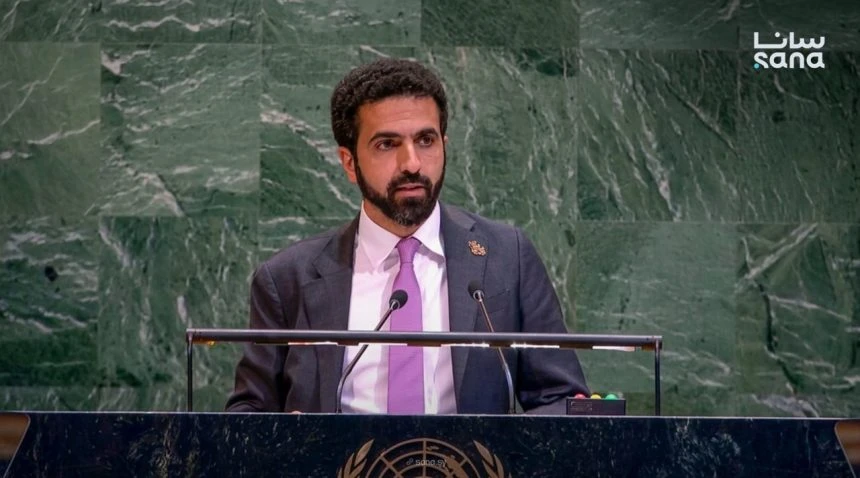
Syria’s Permanent Representative to the United Nations, Ibrahim Olabi, told the UN General Assembly on Friday that the country was working to restore stability, combat terrorism and drug smuggling, and cooperate with international institutions.
He condemned Israeli attacks on Syria, saying they extended beyond violations and incursions in the country’s south to include airstrikes on sites inside Syria on the same day International Atomic Energy Agency (IAEA) Director General Rafael Grossi visited to discuss the country’s nuclear file.
Olabi said Syria was pursuing transparent cooperation with the IAEA and seeking to address nuclear and chemical weapons issues inherited from the ousted regime, while continuing to face Israeli actions that undermine its sovereignty and security.
He called on the international community to support Syria’s efforts and uphold international law, pointing to demonstrations held across the country on Friday against the occupation.
Olabi said the country’s new leadership had chosen to meet its international obligations and rebuild relations with international institutions, contrasting its approach with that of the ousted regime, which he accused of using chemical weapons, facilitating drug smuggling and destabilizing the region.
For years, he said, the former government had obstructed international efforts to resolve outstanding issues, turning Syria into a source of cross-border threats and a theater of regional confrontation rather than cooperation.
Syrians and people across the region had paid a heavy price for that legacy, Olabi said, adding that the new authorities were working to secure the country’s borders, combat terrorism and drug networks, and resolve inherited nuclear and chemical issues.
Cooperation with nuclear watchdog
Olabi cited Syria’s cooperation with the IAEA as evidence of a significant change in the country’s approach to international commitments.
After nearly 15 years of restricting the agency’s access, Syria opened all relevant sites without restrictions, voluntarily disclosed previously undeclared nuclear materials and placed them under IAEA safeguards inside the country, he said.
That cooperation led to the removal of the inherited finding of noncompliance against Syria, Olabi added.
He said Syria believed regional security could be achieved through partnership, transparency and compliance with international obligations, rather than confrontation and mistrust.
The shift was particularly important amid declining confidence in the multilateral system, escalating conflicts and arms races, he said, arguing that diplomacy and international law must regain their standing.
“The new Syria has chosen to shoulder its responsibilities with courage and, through its commitment and cooperation, uphold an international system that is crumbling under the weight of violations, with its credibility and effectiveness facing a serious test,” Olabi said.
He urged the international community to support the country’s efforts as developments in southern Syria continued and Syrians demonstrated against the occupation.