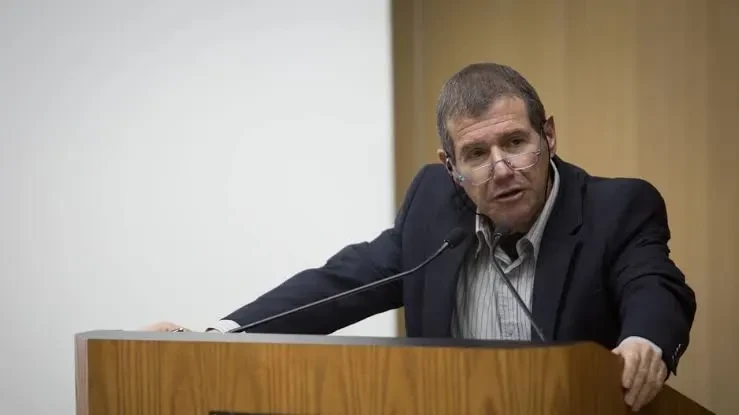
GAZA: The team at Gaza’s Al-Shifa Medical Complex had one micro-catheter to work with. It would have to travel from the patient’s groin all the way into the arteries of his brain.
If it kinked, blocked or broke halfway through, there was no second one in the building.
“If it had any fault, blockage or break, we had no replacement,” Dr. Mohammed Amin Matar, head of radiology at Al-Shifa, told Arab News. “It was a risk.”
The doctors went ahead anyway, and it worked. Earlier this week the hospital announced it had sealed a ruptured aneurysm in a young man’s brain through a catheter, without opening his skull. Dr. Matar describes it as the first procedure of its kind in the Gaza Strip.
Al-Shifa, Gaza’s largest hospital, was raided by Israeli forces in November 2023 and again in March 2024. Israel said Hamas used the hospital as a command center, a claim Hamas denied.
The patient arrived with a severe bleed in his brain. A CT scan traced it to an aneurysm, a balloon-like bulge in the wall of an artery, in the left middle cerebral artery.
“A brain bleed is highly life-threatening,” Dr. Matar said. “Most cases die before they even reach hospital.”
The young man survived the first bleed, but the aneurysm was large and could burst again at any moment. Doctors kept him in intensive care for two to three days until he was stable, then decided they could not wait any longer.
“The case could not bear waiting,” Dr. Matar said. “The chance of a second or third bleed was very high, and it threatened the patient’s life.”
Outside Gaza, such procedures are carried out only in highly specialized centers, Dr. Matar said, because of how delicate and sensitive work inside the brain is. In Gaza, getting ready for it meant searching storerooms. The team spent close to two days gathering the specialized wires, micro-catheters and coils the procedure needs, which are different from those used in ordinary catheterization.
“We searched through all the consumables from before the war and after the war to find these tools,” Dr. Matar said. He credited his colleague, Dr. Maher Al-Zaanin, with helping to secure them. “Without him, this would not have been achieved.”
In the operating room, the doctors entered through the femoral artery in the groin and guided a catheter up into the carotid artery in the neck, then into the vessels of the brain. They steered the micro-catheter into the aneurysm and pushed a tiny metal coil through it. The coil fills the bulge and causes the blood inside it to clot, which stops fresh blood from flowing in and building up the pressure that causes a rupture.
Neurosurgeons, anesthetists, radiology technicians and nurses all worked on the case. Not everyone was sure it would succeed.
“There were a lot of questions about whether we could succeed or not,” Dr. Matar said. “Thank God, it was a success.”
The patient spent one day in intensive care and five days on a ward. He is now out of danger and under follow-up.
The unit where he was treated, Al-Shifa's interventional radiology and cardiac catheterization unit, reopened only about two months ago after being rehabilitated.
“We were preparing for procedures like this before the war,” Dr. Matar said. “But the war destroyed everything, and we went back to zero.”
In September, the same department treated two patients with brain vascular conditions by catheter, working alongside a visiting Egyptian consultant, the Palestinian news site Palsawa reported.
For patients like this young man, sending them abroad is rarely realistic. More than 21,000 patients in Gaza were on waiting lists for treatment outside the Strip as of Nov. 17, including 6,430 urgent cases, according to the Gaza Health Ministry. The ministry says 2,027 patients have died while waiting since the Rafah crossing closed.
“Waiting for weeks or months is not possible in any way,” Dr. Matar said. “These cases need urgent intervention. The most practical option is to treat them here, inside Gaza.”
The success has not changed the shortages around it. Many simple procedures at Al-Shifa remain on hold, Dr. Matar said, because the supplies they depend on have run out. Gaza Health Ministry data from early November showed that 508 of the 1,006 medical consumables it lists were unavailable. Of 902 trucks that entered Gaza between Nov. 16 and 22, six carried medicines and medical supplies, according to figures from the Gaza Chamber of Commerce cited by the UN humanitarian office, OCHA.
“The staff qualified to do these cases are here,” Dr. Matar said. “But sadly, there are not enough medical supplies.”
The people doing the work are also stretched. “Most medical staff working now are doing so almost without salaries, and without any alternatives,” he said, calling on international organizations to support both the supplies and the doctors and nurses who use them.
For now, the young man who reached Al-Shifa with a bleeding brain is recovering. In a hospital rebuilding from almost nothing, his doctors saved him with one catheter and nothing to spare.
Arab News PK