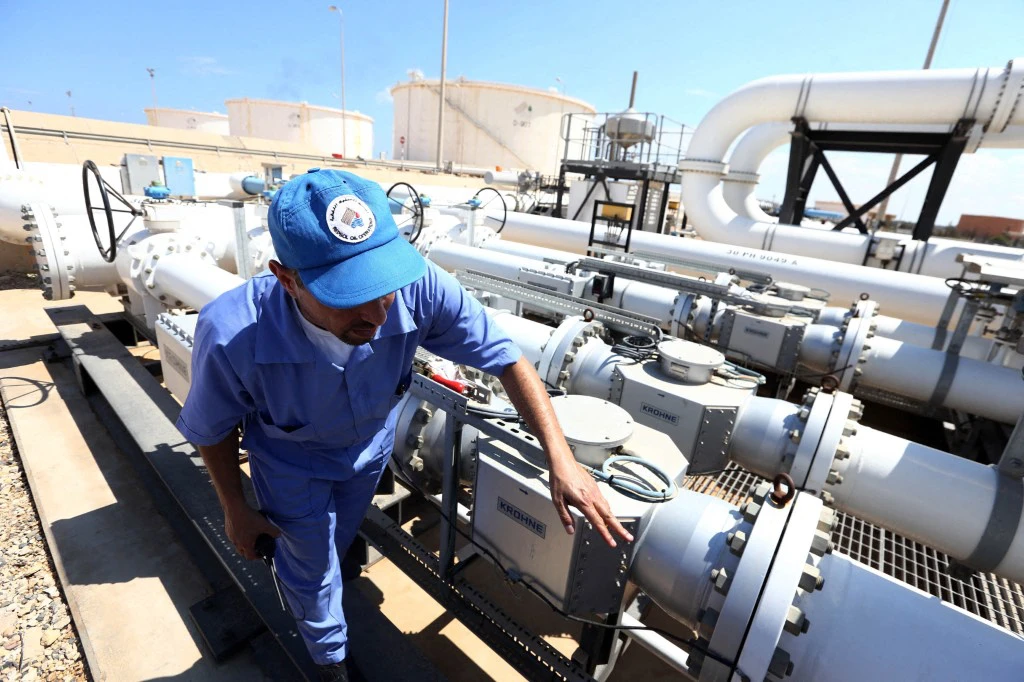
- Arkenu Oil Company was the first private firm to export crude oil from Libya
- Dbeibah instructed authorities to terminate the production sharing agreement with Arkenu
CAIRO: Libya’s internationally recognized government has asked a Tripoli court to annul a deal with an oil company that a report by UN experts in March said had moved more than $3 billion to bank accounts outside Libya, filings seen by Reuters show.
Arkenu Oil Company was set up in 2023 and soon became the first private company known to export crude oil from Libya, which has been divided between rival administrations since a civil war that broke out after a NATO-backed uprising toppled Muammar Qaddafi in 2011.
Arkenu said it rejected the UN panel’s characterization of its revenue and in an email to Reuters on Tuesday added that the oil it produced and the proceeds generated were handled in accordance with its deal with Libya’s National Oil Corporation.
Prime Minister Abdulhamid Dbeibah of Libya’s Tripoli-based Government of National Unity (GNU) gave instructions in April for authorities to take steps to end the 2023 production sharing agreement with Arkenu, citing widespread public opposition.
The panel of UN experts on Libya said that Arkenu was the result of a “mutually beneficial deal” between Ibrahim Dbeibah, the prime minister’s nephew and adviser, and Saddam Haftar, the son and deputy of Khalifa Haftar, a military commander who controls Libya’s east and large parts of the south.
Arkenu denied in the email to Reuters that Saddam Haftar had any direct or indirect ownership interest or management role in the company and said he exercised no control over it.
An official at Saddam Haftar’s office, when approached by Reuters for comment from him, said he had no connection to Arkenu, which was “a Libyan entity with a known board of directors” operating in accordance with Libyan law and granted licenses by the GNU.
Libya’s NOC is headquartered in Tripoli in the west, while many of its fields, pipelines and terminals are under the control of Haftar’s Libyan National Army in the east and south. Shutdowns regularly impede Libyan oil output.
A GNU official denied that Ibrahim Dbeibah had any connection with Arkenu when approached by Reuters for comment from him, pointing to a copy of its commercial registration, which did not list him among its partners or representatives.
Concerns over the deal have led to intense political pressure on Abdulhamid Dbeibah, including from powerful groups in his hometown of Misrata, where the Haftars are mistrusted, said Jalel Harchaoui, a contributor to Britain’s Royal United Services Institute think tank.
An influential military body in Misrata publicly called earlier this month for an immediate end to the Arkenu deal, saying “Libyan oil is a red line.”
“Many Libyans are looking for answers on Arkenu, how it operates, and whether it delivers benefits to the economy. These concerns were only heightened after the release of the Panel of Experts report. But Libyans have seen little in the way of action or reassurance,” said Chatham House analyst Tim Eaton.
GNU SEEKS ANNULMENT OF AGREEMENT
Court papers show the GNU suit seeks to suspend and ultimately annul the deal between the NOC and Arkenu, which gave the latter a portion of the oil from two of Libya’s biggest fields in exchange for investing in their development.
“The government asserts that the contract was marred by legal and procedural irregularities,” the GNU told Reuters.
“It further argues that the company failed to meet the necessary legal and technical requirements to carry out oil development and production activities,” the GNU added.
Arkenu said it had not received a copy of the filing and that to its knowledge no proceedings had been served.
“Arkenu’s agreement with the NOC is a commercial agreement, endorsed by the Government of National Unity’s own Council of Ministers. Any attempt by the same government to annul it would raise serious questions, including as to the proper forum for a commercial agreement,” it told Reuters.
Tensions in Libya have eased considerably since Haftar was repelled from an attempt to seize Tripoli in 2019-2020, with the rival legislative bodies agreeing on a unified budget.