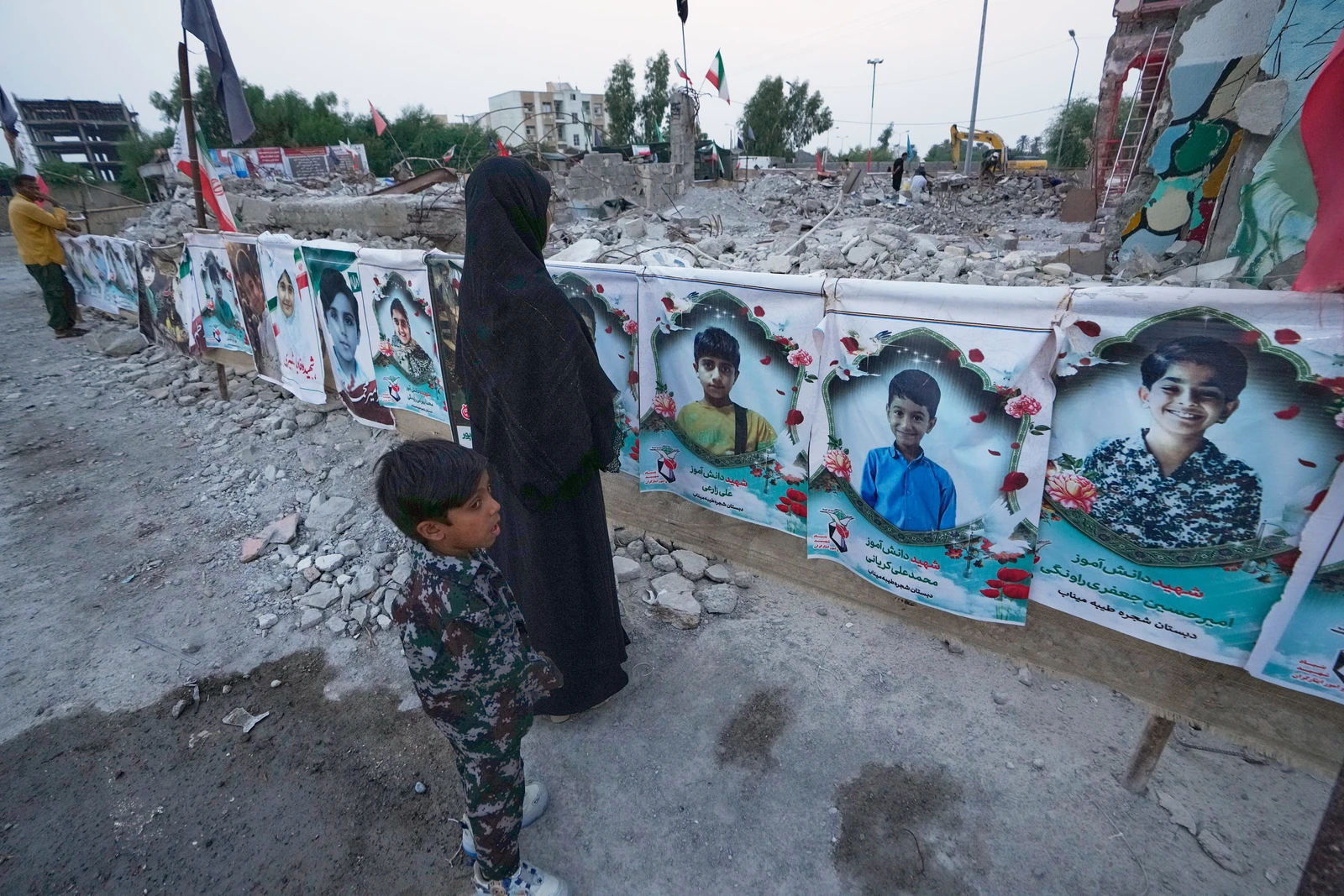
- The Shajareh Tayyebeh school in the southern Iranian city of Minab has become a place to wrestle with grief and preserve the memories of some 120 children killed here by an American airstrike on the first day of the war on Iran.
- At least one U.S.
MINAB: The sun set over this southern Iranian city, and Heydar Sadeghi was where he can be found almost every evening: on a bench next to the shattered remains of his grandson’s school. His face was soaked with tears.
A banner strung around the rubble showed the faces of children and teachers killed here by an American airstrike on Feb. 28, the first day of the war on Iran. Among them are Sadeghi’s 11-year-old grandson Hami and the boy’s mother, Neda Salehizadeh.
“I searched the bodies for my kids, thinking maybe one would be among them,” Sadeghi said Monday evening as he recounted how he rushed to the school in the moments after the explosions. He called out their names, saying, “‘Come with me! I’ve come to get you.’ They weren’t there,” he said, weeping.
The Shajareh Tayyebeh school has become a place to wrestle with grief and preserve the memories of the dead. Here, relatives try to comprehend the incomprehensible — how around 120 of their children could be snuffed out, just after they’d been dropped off for a day of classes.
At least one U.S. missile hit the school that morning in Minab, according to an Associated Press investigation, but there has been no final accounting of what happened. Iranian state media have said 168 people were killed in the strike, most of them children.
The Trump administration has yet to directly accept the blame or release findings of a Pentagon investigation into the bombing.
A grandfather grieves every day
For Sadeghi, the day of the strike began as every school day did.
He drove Hami and the boy’s 9-year-old sister Nila to school along with their mother, his daughter-in-law Salehizadeh, who was a teacher. As usual, he planned to pick them up at 1 p.m.
“But the bell was rung early — by Trump,” he said.
Hami was a fifth grader who loved soccer and riding his bicycle, Sadeghi said. His body was so mangled in the blast, they could only identify him from the clothes he was wearing, he said.
Nila was pulled alive from the rubble.
“Thank God, she is physically fine,” Sadeghi said. “But mentally, no.”
The girl and her father have moved in with Sadeghi and his wife. The slightest, unexpected noise frightens her. She often goes to bed in her grandmother’s arms but lies awake for much of the night.
Sadeghi said he often invites Nila’s friends to come spend the night, hoping their presence will distract her.
He wants to see Nila smile. So he grieves here at the school away from her.
“I come here and cry,” he said. “Then I go home and dance in front of the girl.”
The site is becoming a memorial to the dead
The school had a girls’ school upstairs and a boys’ school and preschool on the ground floor. Some of the students were children of officers at a Revolutionary Guard base located next to the school; many were local children from Minab, which is populated predominantly by members of Iran’s Baluch ethnic minority.
The banner at the site listed 120 students killed – 47 girls and 73 boys – and 26 teachers and staff. Three more children are presumed dead but their bodies were never found.
The governor of Hormozgan province, where Minab is located, has said the damaged building would be preserved to be turned into a memorial and war museum.
Several dozen visitors there Monday evening included relatives of the dead but also out-of-towners who had come to see.
In a government-sponsored mourning ceremony held every evening, men and women – including one in the Guards uniform -- took turns at a microphone, telling wrenching stories about those who died and describing in graphic detail the day of the attack. Some visitors broke down weeping from their accounts.
A separate section of Minab’s cemetery has also been set aside for those killed at the school. Every grave has a photo of the dead, with a shade overhead and artificial grass around so families can sit with their loved ones. Some lay flowers and prayer beads on the graves. Others bring dishes of “shuleh-zard,” a saffron rice pudding eaten at funerals.
One teacher tried to protect her students
At the cemetery, Fatemeh Barani sat by the grave of her daughter, Nasim Neyestani, a second grade teacher at the school. Barani comes several times a week to be with her daughter.
She thinks about her daughter’s last hours, which school staffers later described to her, and how everything could have turned out differently.
At around 9 a.m. news came of the airstrikes in the capital Tehran that had hit the compound of Iran’s supreme leader. They didn’t know it at the time, but those initial Israeli strikes killed Ayatollah Ali Khamenei and much of the top military leadership.
Neyestani was alarmed, fearing wider strikes, and urged the principal to cancel classes and call parents to come collect their children, Barani said, according to what she was told by other staffers. The principal didn’t think that was necessary. But Neyestani began calling the parents of her 22 students herself, urging them to come get their children, Barani said.
Fourteen of Neyestani’s children were picked up before the strike, Barani said. The parents of eight others did not get there in time.
Neyestani took the eight children into the schoolyard, her mother said. But the principal told her to take them into the school’s prayer room, thinking it would be safe.
The prayer room was hit. Barani said her daughter and all eight children with her were killed.
“My daughter’s classroom was mostly left intact,” she said. “Probably if she had been in that classroom, she would not have been killed.”
Details of Barani’s account could not be independently verified, but it meshes with other accounts. The AP’s investigation of the strike found that several teachers called parents to pick up their children before Iran’s government ordered schools closed nationwide at 10:15 a.m. The first missile hit the school about an hour later. Accounts of the strikes posted on banners at the school say three missiles struck. The principals of both the boys and girls schools were among those killed.
A teacher’s mother is overwhelmed with grief
After the strikes, Barani’s husband and sons went to the school; later, they told her her daughter had been killed.
They found Neyestani’s bag. But Barani said her sons have hidden it from her because they fear seeing it would only hurt her more.
Parents of students who escaped the school because Neyestani had called them visited the family to pay their condolences, but Barani said she was so overwhelmed with grief that she doesn’t remember any of their visits.
She said she still hasn’t been able to enter her daughter’s bedroom.
She talked about how her daughter, who had not married, was rarely idle. She taught in the mornings and worked as a salesperson at a cosmetics store in the evenings. At home, she stayed busy with her hobby making handicrafts, particularly “minakari,” a traditional art of decorating objects with enamel. The enamel work relaxed her, Barani said.
The enamels are still there around the house, a reminder of her daughter.
“Every day, this grief feels fresh again,” Barani said.