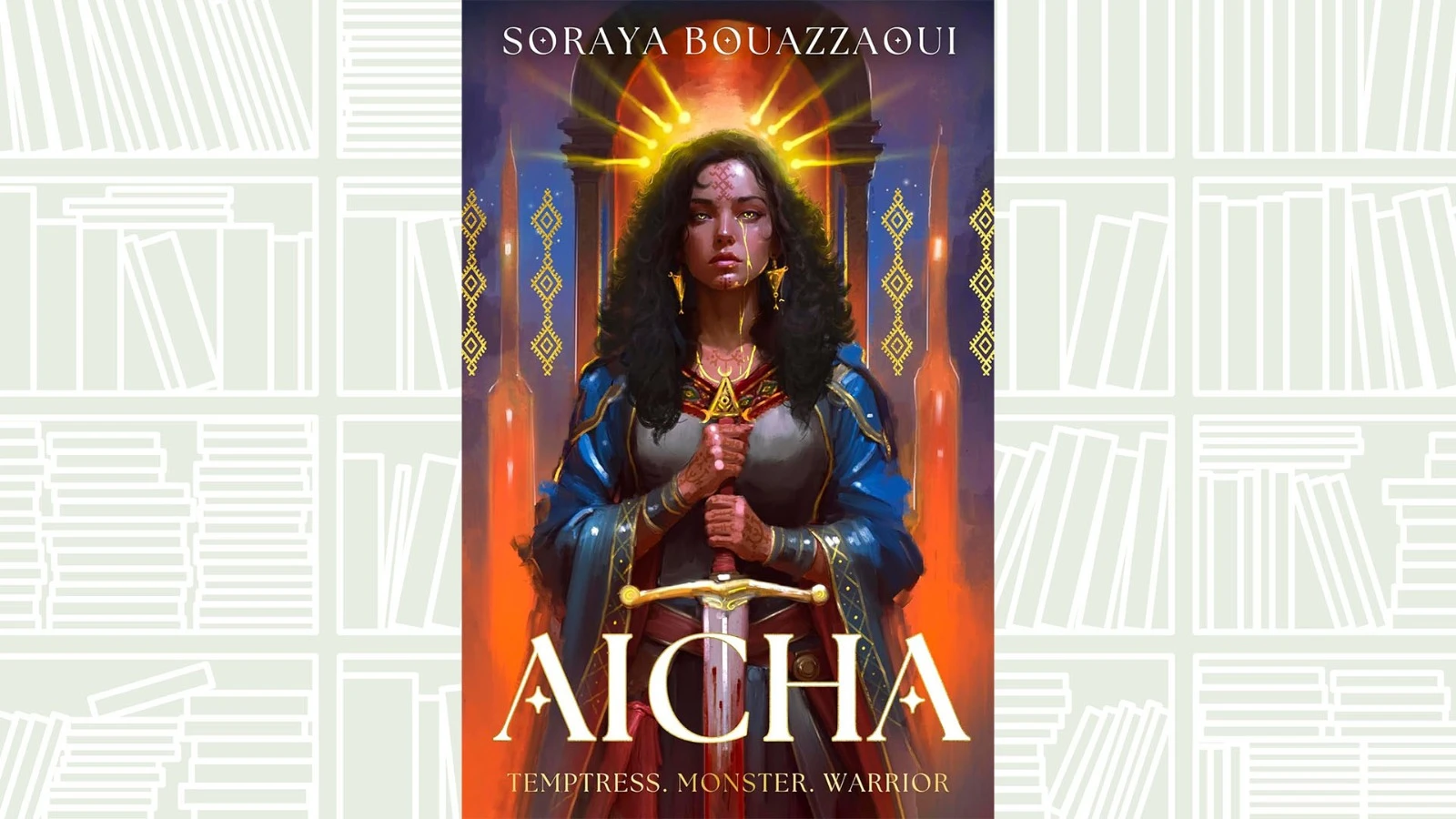
RIYADH: For centuries, famed spirit Aicha Kandicha has lurked in the corners of Moroccan folklore, invoked to frighten children and warn them away from danger. In her debut historical fantasy novel "Aicha," Moroccan British writer Soraya Bouazzaoui retells her story as a young girl whose life becomes entangled with love, occupation and resistance.
“Aicha Kandicha was my boogeyman growing up,” the London-based author told Arab News. “It was what me, my siblings and cousins were told would come and get us in the night if we didn’t behave.
“She was a woman with the legs of a goat that would consume naughty children.”
Popular tellings of Aicha Kandicha often flatten her into a seductress-predator, a moralizing tale about the dangers “roaming roads, beaches or sewers looking for men to enchant and kill.”
The writer only later learned that these childhood stories had teeth far beyond the reaches of young imagination. “When I first started playing with the idea of retelling her story, that was when I discovered her anti-colonial origins,” Bouazzaoui said.
Buried beneath the folklore, she found a spirit that is said to have resisted, by some accounts, the Portuguese and Spanish incursions onto Moroccan soil.
Published by Orbit Books, a science fiction and fantasy imprint of Hachette Book Group, the myth-making novel takes place over the eight days leading up to the sultan’s long-awaited siege to drive out the occupiers from the city.
“I wanted to combine the two (colonial history and folklore), and legitimize her anger and violence,” the author said. “The core of the story is that violent resistance is a valid and important tool when it comes to revolting against an oppressor. Aicha is the most literal example of that.”
Born and raised in London to Moroccan parents (her father is Arabic-speaking Moroccan, her mother Amazigh), Bouazzaoui is a romance editor for a UK publishing house and lives with her husband and cat. Perhaps her proximity to the craft of love stories explains why “Aicha,” for all its rebellion and bloodshed, insists on tenderness, and does it so well.
The personal is what makes the novel most persuasive: The titular heroine is a daughter, sister, friend and lover. She has a home to defend and people she loves within it. “I wanted Aicha to be a real person with real relationships and a deep, protective love for her home.”
The author admits, however, that her initial impulse was to “make it a super literary book, so that Aicha and non-Western myths could be taken ‘seriously’.” It was only when her agent encouraged her to relinquish that “obligation” she was able to “serve the voice of Aicha a lot more.”
To give the novel its historical outline, Bouazzaoui researched the Portuguese military occupation of the Moroccan coast, the final years of the conquest of Ceuta, as well as Jadida’s position as one of Portugal’s last strongholds. She consulted archival maps of the port city from 1769 and studied the military strategies employed by Portuguese and Moroccan forces during the siege.
“I definitely used a lot of creative license … I was reading about men who wanted to start and end wars a lot,” she said, adding, “And so many maps!”
When she went “deeper into the more covert, insidious tactics of occupation,” her research expanded to other regions and centuries: the Spanish and French occupations, the Algerian War of Independence, Israel’s occupation of Palestine and South African apartheid.
“There’s a lot of similarities when it comes to armed resistance … mainly that the occupied nations are naturally very emotionally tied to the land, and that they sacrificed so much of their own futures for the sake of their people.”
Beyond its political and historical strata, “Aicha” is compelling because it does not ask Muslim readers to step outside their cultural understanding of the unseen in order to enter the fantasy realm.
“I had nightmares with jinn in them (tall, smoky figures that are too tall for normal rooms) repeatedly as a child,” she said, recalling how her mother took measures to protect her with verses of the Qur’an. “I used the memory of those nightmares. I also did read some articles about pre-Islamic relationships with spirits and magic in Morocco.”
Faith, in “Aicha,” is not an ornamental detail; Islamic references and rituals are allowed to exist as naturally as the other elements of the characters’ lives.
But perhaps the most defiant of Bouazzaoui’s creative choices is linguistic, as she leaves the Darija woven through her prose largely untouched.
“I do believe a lot of the Darija used can be understood if you pay attention to its context,” she said, referring to the Moroccan dialect of Arabic. “I guess it was my own form of little rebellion.”
Inspired by a Mexican author she came across while studying postcolonial literature at university, the refusal to translate reflects the impulse to resist the expectation that non-Western cultures must always be explained to Western readers, and to deny them the comfortable distance that can come with translation.
Bouazzaoui is unsparing on this point, having watched readers online profess a love of fictional resistance, from “The Hunger Games” and “The Poppy War” to “Star Wars,” while recoiling from its real-world counterpart.
“When the genocide of Palestinians began (in Gaza in 2023), I saw an obscene amount of readers who love those books becoming overwhelming defenders of Israel,” she said. “Supporting resistance had only ever been a fantasy for them, and so witnessing the carnage of a war with an occupier made them too uncomfortable.”
The author thus rooted the story in Morocco’s history, refusing Western readers the distance of an imaginary kingdom where colonial violence can be consumed safely as fantasy: “That’s why I decided to keep the setting of Morocco, so Western readers could not make that separation from the real world.”
Her hope is for “Aicha” to be one version of the Moroccan folklore among many. “I really really want to see other Moroccan writers create a fictional iteration of Aicha,” she said. “I want so many versions of her story, in the same way we have hundreds of retellings of Greek myths.”
The research for the novel reoriented Bouazzaoui’s relationship to her own heritage, particularly the Amazigh half of it she feels she neglected in her youth.
“It made me a little sad that I didn’t make more of an effort as a teenager to understand Amazigh history and speak the language,” she said. “Since researching my second book, I’ve bought a lot of books to teach myself Tamazight.”
Asked what she hopes readers will carry away from “Aicha,” Bouazzaoui is unambiguous: “Palestine. I am always, always thinking of Palestine. Sudan, too … I want readers to come out of it, and resist in any ways they can.”
Moroccan British author’s debut turns folklore into resistance