KATMANDU: A powerful earthquake struck Nepal Saturday, killing at least 718 people across a swath of four countries as the violently shaking earth collapsed houses, leveled centuries-old temples and triggered avalanches on Mt. Everest. It was the worst tremor to hit the poor South Asian nation in over 80 years.
At least 688 people were confirmed dead in Nepal, according to the police. Another 20 were killed in India, six in Tibet and two in Bangladesh. Two Chinese citizens died at the Nepal-China border. Given the scale of the destruction, the death toll is almost certain to rise, said Home Ministry official Laxmi Dhakal.
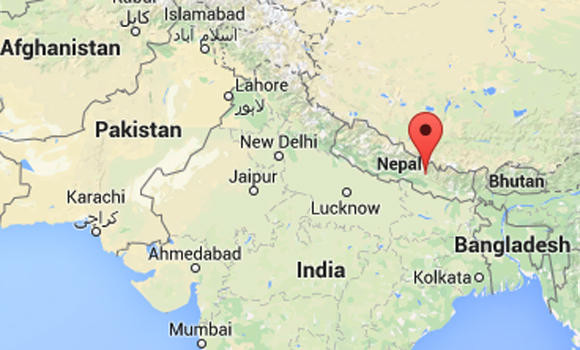
It was a few minutes before noon when the quake, with a preliminary magnitude of 7.8, began to rumble across the densely populated Katmandu Valley, rippling through the capital Katmandu and spreading in all directions — north toward the Himalayas and Tibet, south to the Indo-Gangetic plains, east toward the Brahmaputra delta of Bangladesh and west toward the historical city of Lahore in Pakistan.
A magnitude-6.6 aftershock hit about an hour later, and smaller aftershocks continued to jolt the region for hours. Residents ran out of homes and buildings in panic. Walls tumbled, large cracks opened up on streets and walls. Towers collapsed and clouds of dust began to swirl all around.
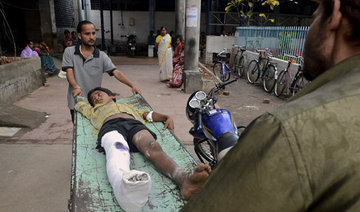
Within hours, hospitals began to fill up with dozens of injured people. Many came to the main hospital in central Katmandu. Among them was Pushpa Das, a laborer, ran from the house when the first quake struck but could not escape a collapsing wall that injured his arm.
“It was very scary. The earth was moving ... I am waiting for treatment but the (hospital) staff is overwhelmed,” he said, gingerly holding his right arm with his left hand. As he spoke dozens of more people showed up with injuries, mostly from falling bricks.
Following the quake, Katmandu’s international airport was shut down.
While the extent of the damage and the scale of the disaster are yet to be ascertained, the quake will likely put a huge strain on the resources of this poor country best known for Everest, the highest mountain in the world, and its rich Hindu culture. The economy of Nepal, a nation of 27.8 million people, is heavily dependent on tourism, principally trekking and Himalayan mountain climbing.
A senior mountaineering guide, Ang Tshering, said an avalanche swept the face of Mt. Everest after the earthquake, and government officials said at least 30 people were injured.
Tshering of the Nepal Mountaineering Association said the avalanche occurred between the Khumbu Icefall, a rugged area of collapsed ice and snow, and the base camp where most climbing expeditions have their main camps.
Carsten Lillelund Pedersen, a Dane who is climbing the Everest with a Belgian climber Jelle Veyt, said on his Facebook page that they were at Khumbu Icefall , a rugged area of collapsed ice and snow close to base camp at altitude 5,000 meters (16,500 feet) when the earthquake hit.
He wrote on his Facebook that they have started to receive the injured, including one person with the most severe injuries who sustained many fractures.
“He was blown away by the avalanche and broke both legs. For the camps closer to where the avalanche hit, our Sherpas believe that a lot of people may have been buried in their tents,” he wrote in English.
“There is now a steady flow of people fleeing basecamp in hope of more security further down the mountain“
The quake’s epicenter was 80 kilometers (50 miles) northwest of Katmandu, and it had a depth of only 11 kilometers (7 miles), which is considered shallow in geological terms. The shallower the quake the more destructive power it carries, and witnesses said the trembling and swaying of the earth went on for several minutes..
Several buildings collapsed in the center of the capital, the ancient Old Katmandu, including centuries-old temples and towers, said resident Prachanda Sual.
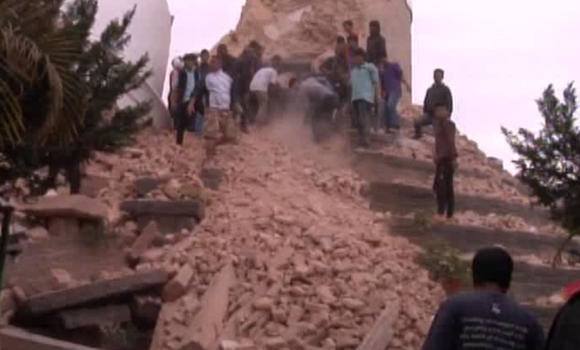
Among them was the nine-story Dharahara Tower, one of Katmandu’s landmarks built by Nepal’s royal rulers as a watchtower in the 1800s and a UNESCO-recognized historical monument. It was reduced to rubble and there were reports of people trapped underneath.
Hundreds of people buy tickets on weekends to go up to the viewing platform on the eighth story.
Video footage showed people digging through the rubble of the bricks form the collapsed tower, looking for survivors.
The Katmandu Valley is densely populated with nearly 2.5 million people, and the quality of buildings is often poor.
In Katmandu, dozens of people were gathered in the parking lot of Norvic International Hospital, where thin mattresses were spread on the ground for patients rushed outside, some wearing hospital pajamas. A woman with a bandage on her head sat in a set of chairs pulled from the hospital waiting room.
Doctors and nurses hooked up some patients to IV drops in the parking lot, or were giving people oxygen.
The US Geological Survey revised the magnitude from 7.5 to 7.9 but then lowered it to 7.8. It said the quake hit at 11:56 a.m. local time (0611 GMT) at Lamjung. It was the largest shallow quake since the 8.2 temblor off the coast of Chile on April 1, 2014.
The quake — with the same magnitude as the one that hit San Francisco in 1906 — was about 16 times more powerful than the 7.0 quake that devastated Haiti in 2010.
A magnitude 7 quake is capable of widespread and heavy damage while an 8 magnitude quake can cause tremendous damage.
A Swedish woman, Jenny Adhikari, who lives in Nepal, told the Swedish newspaper Aftonbladet that she was riding a bus in the town of Melamchi when the earth began to move.
“A huge stone crashed only about 20 meters (yards) from the bus,” she was quoted as saying. “All the houses around me have tumbled down. I think there are lot of people who have died,” she told the newspaper by telephone. Melamchi is about 45 kilometers (30 miles) northeast of Katmandu.
Residents reported seeing trails of destruction -collapsed walls, broken windows and fallen telephone poles — as they drove through the capital, along with streets filled with terrified people.
But scattered reports also indicated that most buildings in the capital did not collapse.
“It’s too early to make any assessment but the damage isn’t as bad as it could have been,” said Liz Satow, the Nepal director for the aid group World Vision. She said she drove from Katmandu to the nearby town of Lalitpur and said that while there was considerable damage, most buildings were still intact.
Nepal suffered its worst recorded earthquake in 1934, which measured 8.0 and all but destroyed the cities of Katmandu, Bhaktapur and Patan.
The sustained quake also was felt in India’s capital of New Delhi and several other Indian cities.
India’s Prime Minister Narendra Modi called a meeting of top government officials to review the damage and disaster preparedness in parts of India that felt strong tremors. The Indian states of Uttar Pradesh, Bihar and Sikkim, which share a border with Nepal, have reported building damage. There have also been reports of damage in the northeastern state of Assam.
Pakistan Prime Minister Nawaz Sharif offered “all possible help” that Nepal may need.
___
Naqvi reported from New Delhi. Associated Press writer Munir Ahmed in Islamabad, Jan M. Olsen in Copenhagen and Seth Borenstein in Washington DC contributed to this report.

Nepal quake: Hundreds dead, history crumbled, Everest shaken
World leaders react cautiously to US and Israeli strikes, death of Iran’s Ali Khamenei
BRUSSELS: How long will it last? Will it grow? What will the conflict and the reported death of Iran’s Supreme Leader Ayatollah Ali Khamenei mean to us — and to global security overall? Those questions echoed across the Middle East and the planet Saturday as world leaders reacted warily to US and Israeli strikes on Iran.
US President Donald Trump said on social media that Khamenei was dead, calling it “the single greatest chance for the Iranian people to take back their Country.” Iranian state media said early Sunday the 86-year-old leader had died without elaborating on a cause.
Israeli officials previously told The Associated Press on condition of anonymity that Khamenei was dead. And Israeli Prime Minister Benjamin Netanyahu, in a televised address, said there were “growing signs” that Khamenei had been killed when Israel struck his compound early Saturday.
The apparent demise of the second leader of the Islamic Republic, who had no designated successor, would likely throw its future into uncertainty — and exacerbate already growing concerns of a broader conflict. The UN Security Council scheduled an emergency meeting.
Perhaps cautious about upsetting already strained relations with Trump, many nations abstained from commenting directly or pointedly on the joint strikes but condemned Tehran’s retaliation. Similarly to Europeans, governments across the Middle East condemned Iran’s strikes on Arab neighbors while staying silent on the US and Israeli military action.
Other countries were more explicit: Australia and Canada expressed open support for the US strikes, while Russia and China responded with direct criticism.
The US and Israel launched a major attack on Iran on Saturday, and Trump called on the Iranian public to “seize control of your destiny” by rising up against the Islamic theocracy that has ruled the nation since 1979. Iran retaliated by firing missiles and drones toward Israel and US military bases in the Middle East.
Some leaders urge resumption of talks
In a statement, British Prime Minister Keir Starmer, French President Emmanuel Macron and German Chancellor Friedrich Merz called on the US and Iran to resume talks and said they favored a negotiated settlement. They said their countries didn’t take part in the strikes on Iran but are in close contact with the US, Israel and partners in the region.
The three countries have led efforts to reach a negotiated solution over Iran’s nuclear program.
“We condemn Iranian attacks on countries in the region in the strongest terms. Iran must refrain from indiscriminate military strikes,” they said. “Ultimately, the Iranian people must be allowed to determine their future,” they said.
Later, at an emergency security meeting, Macron said France was “neither warned nor involved” in the strikes. He called for intensified efforts for a negotiated solution, saying “no one can think that the questions of Iran’s nuclear program, ballistic activity, regional destabilization will be settled by strikes alone.”
The 22-nation Arab League called the Iranian attacks “a blatant violation of the sovereignty of countries that advocate for peace and strive for stability.” That coalition of nations has historically condemned both Israel and Iran for actions it says risk destabilizing the region.
Morocco, Jordan, Syria and the United Arab Emirates denounced Iranian strikes targeting US military bases in the region including in Kuwait, Bahrain, Qatar and the Emirates.
Under former President Bashar Assad, Syria was among Iran’s closest regional allies and a staunch critic of Israel, yet a statement from its foreign ministry singularly condemned Iran, reflecting the new government’s efforts to rebuild ties with regional economic heavyweights and the United States.
Saudi Arabia said it “condemns and denounces in the strongest terms the treacherous Iranian aggression and the blatant violation of sovereignty.” Oman, which has been mediating the talks between Iran and the US, said in a statement that the US action “constitutes a violation of the rules of international law and the principle of settling disputes through peaceful means, rather than through hostility and the shedding of blood.”
Careful wording is (mostly) the order of the day
New Zealand refrained from full-throated support but acknowledged Saturday that the US and Israeli attacks were keeping the Iranian regime from remaining an ongoing threat. “The legitimacy of a government rests on the support of its people,” New Zealand Prime Minister Christopher Luxon and Foreign Minister Winston Peters said in a joint statement. “The Iranian regime has long since lost that support.”
Countries in Europe and the Middle East used careful wording, avoiding perceptions that they either support unilateral American action or are directly condemning the United States.
Others were more blunt. Russia’s Foreign Ministry called the strikes “a pre-planned and unprovoked act of armed aggression against a sovereign and independent UN member state.” The ministry accused Washington and Tel Aviv of “hiding behind” concerns about Iran’s nuclear program while actually pursuing regime change.
Similarly, China’s government said it was “highly concerned” about the US and Israeli strikes on Iran and called for an immediate halt to the military action and a return to negotiations. “Iran’s sovereignty, security and territorial integrity should be respected,” a Chinese Foreign Ministry statement said.
Despite recent tensions with the US, Canada too expressed its support for the military action. “The Islamic Republic of Iran is the principal source of instability and terror throughout the Middle East,” Prime Minister Mark Carney said.
And the UN Security Council scheduled an emergency meeting on the US and Israeli attacks on Iran, at the request of Bahrain and France.
Concerns expressed of ‘new, extensive’ war
Palestinians in the occupied West Bank said they were largely unfazed as war erupted Saturday, barely pausing as booms echoed across the sky from Israel’s Iron Dome intercepting missiles overhead.
Unlike Israel, Palestinian cities have no warning sirens or bomb shelters, despite the risk of falling debris or errant missiles. As people sheltered less than 10 miles (16 kilometers) away in Jerusalem, streets in Ramallah swarmed with shoppers browsing meat counters, vegetable stalls and Ramadan sweets, some stopping to record the sounds of distant sirens and missile interceptions.
But as Israel closed checkpoints to the movement of people and goods on Saturday, gas stations saw longer-than-usual lines as residents filled spare canisters in case of supply disruptions.
The Palestinian Authority, in a statement, condemned the Iranian attacks on Arab nations, many which have historically helped underwrite its finances. It made no mention of the Israeli or US strikes.
Nervousness is perceptible across multiple countries. Norwegian Foreign Minister Espen Barth Eide told Norwegian broadcaster NRK that he was concerned the failure of negotiations between the US and Iran meant a “new, extensive war in the Middle East.”
The Nobel Peace Prize-winning International Campaign to Abolish Nuclear Weapons condemned the US and Israeli strikes on Iran in harsher words. “These attacks are totally irresponsible and risk provoking further escalation as well as increasing the danger of nuclear proliferation and the use of nuclear weapons,” said its executive director, Melissa Parke.
EU leaders issued a joint statement Saturday calling for restraint and engaging in regional diplomacy in hopes of “ensuring nuclear safety.” The Arab League, too, appealed to all international parties “to work toward de-escalation as soon as possible, to spare the region the scourge of instability and violence, and to return to dialogue.”