KATMANDU: A historic 19th-century tower collapsed in the heart of Katmandu’s old quarter after an earthquake on Saturday, with at least a dozen bodies seen pulled from the rubble and fears of scores still trapped.
The nine-story Dharhara tower is a major tourist attraction in Durbar Square at the heart of Katmandu’s historic old city where kings were once crowned, with its eighth-floor balcony providing panoramic views of the Katmandu valley.
The tower — which was white, topped with a bronze minaret and contained a spiral staircase of over 200 steps — was reduced to just its base when the 7.8-magnitude quake struck at lunchtime.
Rescue workers were seen dragging bodies from the rubble and TV footage showed chaotic scenes at the site, as people desperately tried to dig through piles of bricks and dust with their bare hands.
Katmandu police spokesman Dinesh Acharya said rescuers were frantically trying to “bring everyone out to safety.”
“Our team is still deployed in Dharara to rescue people. However, we do not know how many are still trapped,” he told AFP.
People took to social media to express their dismay at the historic site’s collapse.
“Devastating to see Dharhara (Bhimsen Tower) collapsed,” user Prabir Bhatt said on Twitter.
“The historic #Dharhara tower in #Nepal destroyed by the #Earthquake. Prayers!” wrote Rahul Sharma.
Saturday was not the first time the 50.5-meter-high tower — built by Nepal’s then prime minister for the queen in 1832 — has been hit by an earthquake.
Much of Durbar Square, a UNESCO World Heritage site and the social and cultural heart of the city, had to be rebuilt after a huge quake in 1934.
The tower collapsed in that quake and was rebuilt two stories lower than the original.
The tower was a popular attraction, with tourists charged a small fee to climb the steps to the viewing deck. A small shrine to the Hindu god Shiva was located at the top.
The Wikipedia page for the tower was updated within minutes after the earthquake hit, with the news of its collapse.


Historic Katmandu tower collapses in quake
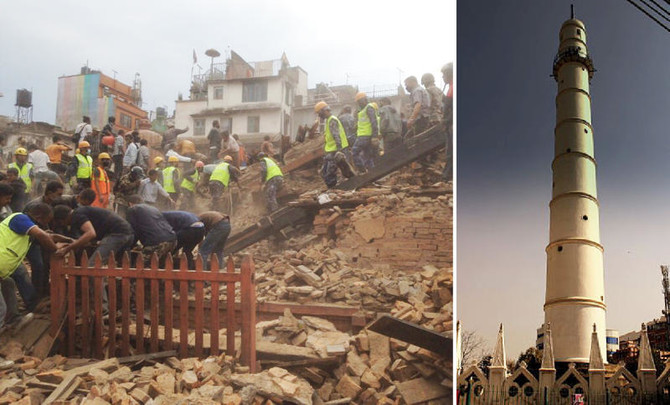
Historic Katmandu tower collapses in quake


UK warship to leave for Cyprus next week: officials
- HMS Dragon, a Type 45 defense destroyer, will sail to aid Britain’s “defensive operations”
- Opposition lawmakers have accused the government of being too slow to deploy additional resources
LONDON: A UK warship due to be sent to Cyprus amid the US and Israel’s war with Iran will not set sail from Britain until next week, Western officials said Wednesday.
Prime Minister Keir Starmer announced on Tuesday that he was deploying HMS Dragon, a Type 45 defense destroyer to aid Britain’s “defensive operations” in the region.
Starmer also said he was sending two Wildcat helicopters with counter-drone capabilities.
The announcement came after several drone attacks from Iran targeted UK allies in the Middle East and after the UK Royal Air Force base Akrotiri was struck overnight Sunday to Monday.
Opposition lawmakers have accused the government of being too slow to deploy additional resources after the war started on Saturday with no British warship in the region.
The destroyer is being resupplied with ammunition and will sail next week, the officials told reporters in London.
“We’ve had to change weapon systems on it, finish welding, get it up and running, and get it sailing as fast as possible,” Defense Minister Al Carns told Sky News.
Its voyage to the eastern Mediterranean is expected to take several days.
Starmer refused to allow the Americans to use UK air bases to launch the initial strikes on Iran on Saturday.
He later agreed to a US request to use two British military bases — one in southwest England and the other in the Chagos Islands in the Indian Ocean — for a “specific and limited defensive purpose.”
The officials said Wednesday that US bombers have not yet used those bases to launch missions but they are expected to do so in the coming days.
They also said that the drone, which caused little damage and no casualties when it hit the runway at Akrotiri, had not been launched from Iran.
A Cypriot government source said Monday that the drones had been launched from Lebanon, “most likely” by Hezbollah, a historical ally of Iran in the Middle East.


