- IMF says Pakistan’s 2024 budget a missed opportunity as loan deal deadline looms
- Moody’s says Pakistan’s external funding prospects for fiscal 2024 ‘highly uncertain’
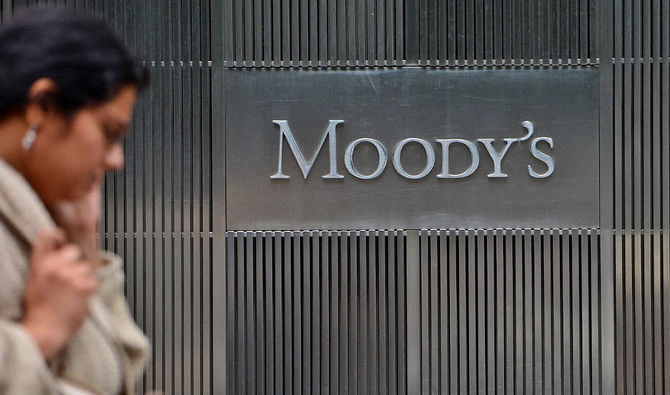
KARACHI: Moody’s Investors Service said on Thursday it was “not guaranteed” Pakistan would be able to secure $2.4 billion from the International Monetary Fund (IMF) as presented in the fiscal 2023-2024 budget, adding that whether Pakistan joined a new IMF program would only become clear after the next general elections.
Moody’s statement follows one by the IMF in which it expressed dissatisfaction with Pakistan’s recently presented budget, a blow for the cash-strapped country which has only two weeks left until its bailout program expires.
In its new budget, Pakistan projected a consolidated (federal and provincial) budget at Rs19.5 trillion. The budget deficit was estimated at 6.5 percent of GDP, narrowing from an estimated deficit of 7.0 percent in fiscal 2023. Real GDP growth was projected at 3.5 percent for fiscal 2024, up from 0.3 percent in fiscal 2023, and headline inflation at 21 percent versus 29 percent in fiscal 2023.
“Pakistan’s external funding prospects for fiscal 2024 and later are highly uncertain,” Moody’s said in its statement on June 15, commenting on the budget.
“It is not guaranteed that Pakistan will be able to secure $2.4 billion from the IMF as budgeted. Whether Pakistan will join another IMF program may only become clear after elections, which are due by October 2023.”
Negotiations for any future IMF program would also take some time even if they succeed, Moody’s added, and until a new program was agreed, Pakistan’s ability to secure loans from other bilateral and multilateral partners would be severely constrained.
The rating’s agency said Pakistan’s deficit estimates and growth projections in the budget were optimistic but the document did not contain significant revenue raising or spending-containment measures.
It said Pakistan’s low revenue/GDP (stable at around 12 percent from 2019-22) was a major
constraint on the government’s debt affordability and debt burden.
“The budget targets fiscal 2024 tax revenue at PKR9.2 trillion, up 28 percent from an estimated PKR7.2 trillion in fiscal 2023. Given a lack of new significant revenue-raising measures, the government’s revenue projections rely mainly on the assumption that nominal GDP growth will be high and support an increase in revenue. In the current context, we see significant downside risks to that Assumption,” Moody’s said.
It said Pakistan’s very weak debt affordability drove high debt sustainability risks. About 60 percent of the fiscal 2024 budget (PKR11.7 trillion) goes toward servicing interest and principal payments
on the government’s debt. Having a significant share of its budget going toward debt payments would constrain the government’s capacity to service its debt while meeting the population’s essential social spending and infrastructure needs.
Pakistan’s government liquidity and external positions also remained fragile.
“The budget projects PKR6.35 trillion ($21 billion) of loans from external sources, including $1.5 billion from eurobond issuances, $4.6 billion from commercial banks, $2.4 billion from the IMF and another $2.7 billion from other multilateral partners,” Moody’s said.
“The government expects most of the remaining sums to come from other bilateral partners, including China, Saudi Arabia and the United Arab Emirates. Pakistan is unlikely to access market financing at affordable costs, either from eurobonds or commercial banks, in the foreseeable future.”
In fiscal 2023, the government issued no eurobonds and raised only Rs521 billion from commercial banks, far short of the Rs1.4 trillion it targeted in the fiscal 2023 budget, Moody’s said.
“The country’s external debt repayment will remain high for the next few years, with about $25 billion of repayments (principal and interest) due in fiscal 2024. Meanwhile, foreign exchange reserves are very low at $3.9 billion as at 2 June.”