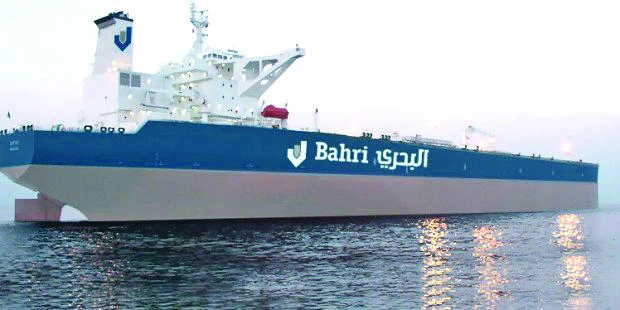
- Bahri's third-quarter net profit surged 890.7% year on year to SR5.09 billion ($1.36 billion), driven by increased freight rates and oil transportation activity.
- Revenue grew 503.7% to SR14.83 billion during the same period, with Bahri Oil leading the expansion with a 913% rise in quarterly revenue to SR13.33 billion.
RIYADH: Saudi shipping company Bahri’s third-quarter net profit surged nearly ninefold to SR5.09 billion ($1.36 billion), up 890.7 percent year on year, driven by higher freight rates and increased activity in its oil transportation business.
Bahri, formally known as The National Shipping Co. of Saudi Arabia, reported profit attributable to shareholders of SR513.36 million a year earlier, according to a Saudi Exchange filing.
Revenue climbed 503.7 percent to SR14.83 billion in the three months ended September.
Regional conflicts and security risks have disrupted shipping routes in the Middle East, pushing up tanker rates and limiting vessel availability.
Longer turnaround times and restrictions on ship-to-ship transfers have further tightened capacity.
Freight rates for very large crude carriers on the Middle East Gulf–China route reached a record $28.28 per barrel in September, up $12.90 from August, according to commodities analytics firm Kpler.
Bahri Oil led the expansion, with quarterly revenue rising 913 percent to SR13.33 billion.
The company attributed higher tanker rates primarily to regional shipping disruptions and maritime security risks that limited vessel availability. It also hired additional vessels to meet increased customer demand.
Bahri CEO Ahmed Ali Al-Subaey said the company had been operating in an “exceptionally complex” environment, and the loss of two crew members “are a profound reminder of the conditions in which our seafarers operate and reinforce our responsibility to protect our people.”
He added: “Looking ahead, we are entering the next phase of Bahri’s growth from a position of strength.
“We are continuing to modernise and diversify our fleet, strengthen our core shipping and logistics businesses and expand selectively into new segments, including gas and ammonia transportation.
“Our focus remains on disciplined growth that strengthens Bahri’s competitiveness, supports the Kingdom’s expanding trade and maritime ambitions, and creates sustainable long-term value for our shareholders.”
Earnings and cash flow
The oil business generated a SR4.4 billion increase in gross profit year on year during the quarter.
Bahri also benefited from a SR240 million increase in its share of earnings from equity-accounted investments, higher finance income and lower financing costs. These gains were partly offset by a SR102 million decline in net other income.
Despite the earnings surge, the group’s margin on earnings before interest, tax, depreciation and amortization fell to 39 percent from 51 percent a year earlier. Bahri attributed this to a larger contribution from lower-margin hired vessels, even as margins improved across its owned fleet.
For the first nine months, net profit increased 586.7 percent to SR9.98 billion, while revenue rose 268.4 percent to SR26.1 billion. Earnings per share reached SR10.82, compared with SR1.58 a year earlier.
Quarterly net operating cash flow fell 81 percent year on year to SR204 million. However, cash generated from operations over the nine-month period increased 83 percent to SR4.07 billion.
Fleet expansion
Bahri entered the liquefied petroleum gas and ammonia transportation market during the quarter through the acquisition of three second-hand medium gas carriers.
The first arrived in September, with the remaining deliveries expected in the fourth quarter of 2026 and first quarter of 2027.
The company also disclosed that conflict-related incidents affected four owned vessels during the first nine months, resulting in two crew fatalities.
Two vessels had returned to commercial service following repairs, while the others remained under repair.
Separately, Bahri signed a SR1.692 billion contract with International Maritime Industries on Oct. 22 to build three very large crude carriers, each with a capacity of 320,000 deadweight tonnes.
Delivery is scheduled between 2029 and 2030. Bahri, which owns 19.9 percent of the shipbuilder, will finance the contract through internal cash resources and banking facilities.
“Looking ahead, market conditions for the remainder of 2026 are expected to remain highly volatile,” Bahri said in the oil-business section of its earnings release, adding that freight rates would depend heavily on geopolitical developments in the Arabian Gulf and Red Sea.