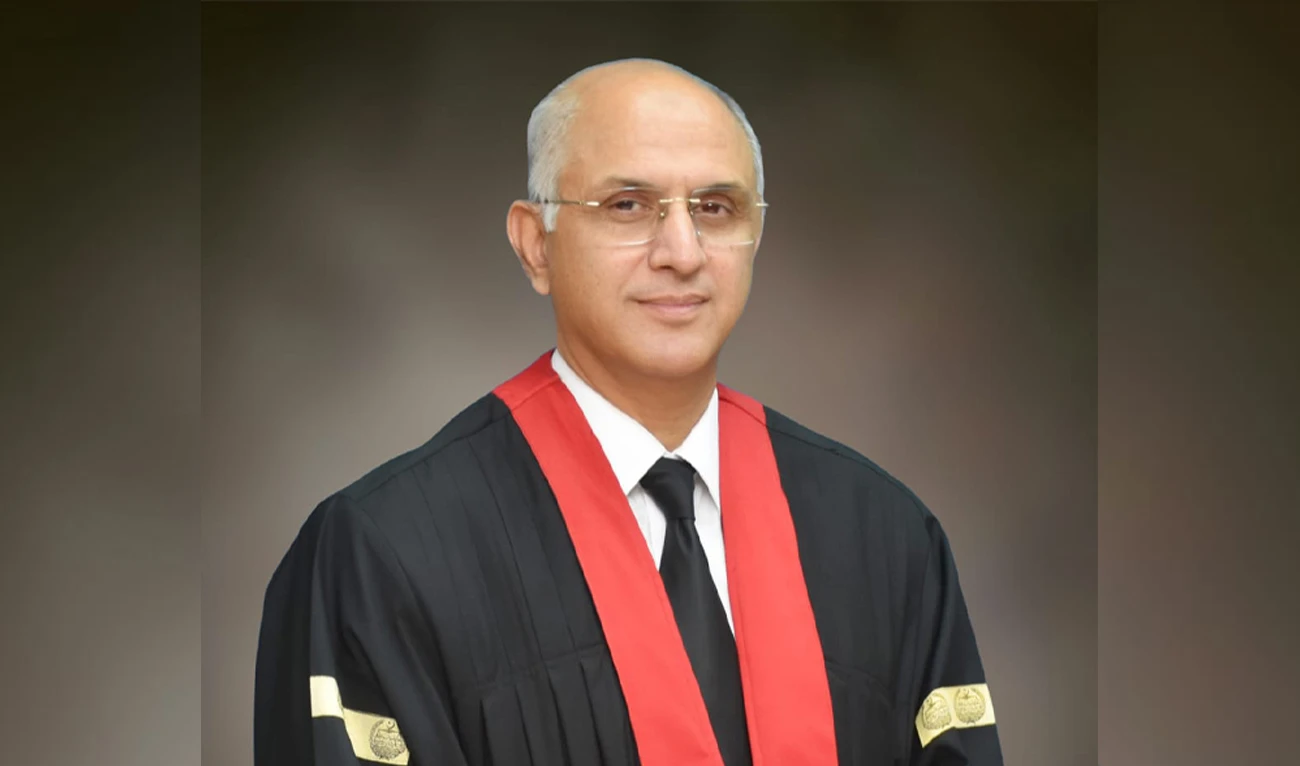
- Pakistan’s government introduced constitutional amendments in 2024 and 2025 granting executive sweeping powers in some judicial matters
- Justice Mohsin Akhtar Kayani says executive’s “growing control” over judicial institutions have eroded public confidence in judicial independence
ISLAMABAD: Lahore High Court’s (LHC) Justice Mohsin Akhtar Kayani resigned from his post on Wednesday, citing “growing control” of the executive over judicial decisions following recent constitutional amendments, health and personal reasons.
Pakistan’s government passed the 26th constitutional amendment in October 2024, which grants sweeping powers to the executive to appoint the chief justice from a panel of the three most senior judges of the top court for a period of three years. The amendments also stated that Supreme Court judges will be appointed by a Judicial Commission of Pakistan, led by the chief justice and three senior judges.
The 27th amendment introduced sweeping changes to Pakistan’s judicial and military command structure. It established a new Constitutional Court, transferring select judicial powers from the Supreme Court. The government argued the move would reduce case backlogs and ensure quicker decisions, while critics said it would weaken the Supreme Court. The amendment further outlined new procedures for transferring judges between high courts.
“I, Justice Mohsin Akhtar Kayani, hereby tender my resignation from the office of judge of the Lahore High Court for personal reasons, including health concerns following my recent surgery, and for the reasons of conscience set out below,” Justice Kayani wrote in a letter seen by Arab News.
Kayani mentioned that he had disposed of more than 23,000 cases of various categories during his career, endeavoring always to uphold the constitution, safeguard fundamental rights, and administer justice without fear or favor.
“However, in my considered view, the changes introduced through the 26th and 27th Constitutional Amendments have compromised the independence and institutional integrity of the high courts,” the judge wrote.
“I have witnessed what I regard as the executive’s growing control over judicial institutions, extending to the appointment and transfer of judges. Such interference has, in my assessment, seriously eroded public confidence in judicial independence and the fairness of the judicial process.”
Justice Kayani said he was concerned about the plight of the ordinary litigant, saying their suffering continues to deepen as a result of these changes.
“The needs of those seeking justice have too often been neglected, while other actors have become the beneficiaries of a system intended to serve them,” he said.
He described the decision to resign as a “painful” one but said it reflected his conviction that judicial offices must remain inseparable from independence and protection of human dignity.
“I, therefore, consider that the time has come for me to lay down my robes and return to legal practice, through which I intend to continue serving the people, protecting their rights, and promoting legal awareness,” the judge wrote.
Kayani completed his early education at F.G. Boys High School in Islamabad and pursued his higher education at F.G. College for Men, graduating in 1989. He earned his LLB from the University of Punjab in 1994, followed by an MA in Political Science in 1996, and an LLM from Karachi University in 2001-2003. He also secured an MSc in Pakistan Studies in 2005, and further enhanced his academic credentials with a Postgraduate Diploma in Human Rights from Peshawar University.
He enrolled as an advocate of the district courts in 1995, ascending to the high court in 1997 and the Supreme Court in 2009. He was elevated to the bench of the Islamabad High Court on December 23, 2015.
Kayani was serving at the Islamabad High Court (IHC) before his transfer to the LHC in April, assigned to the LHC’s principal seat in Lahore.
According to Pakistani newspaper Dawn, Kayani was expecting to be elevated to the post of the high court’s chief justice during his time at the IHC.
However, the transfer of incumbent IHC Chief Justice Sardar Muhammad Sarfraz Dogar from the LHC, along with two other judges from the Sindh and Balochistan high courts, prompted him to challenge the inter-high court transfers. The Supreme Court’s constitutional bench upheld the transfers, including that of Justice Dogar.
Following his own transfer to the LHC, Justice Kayani lost his seniority and was placed 12th on the high court’s seniority list.