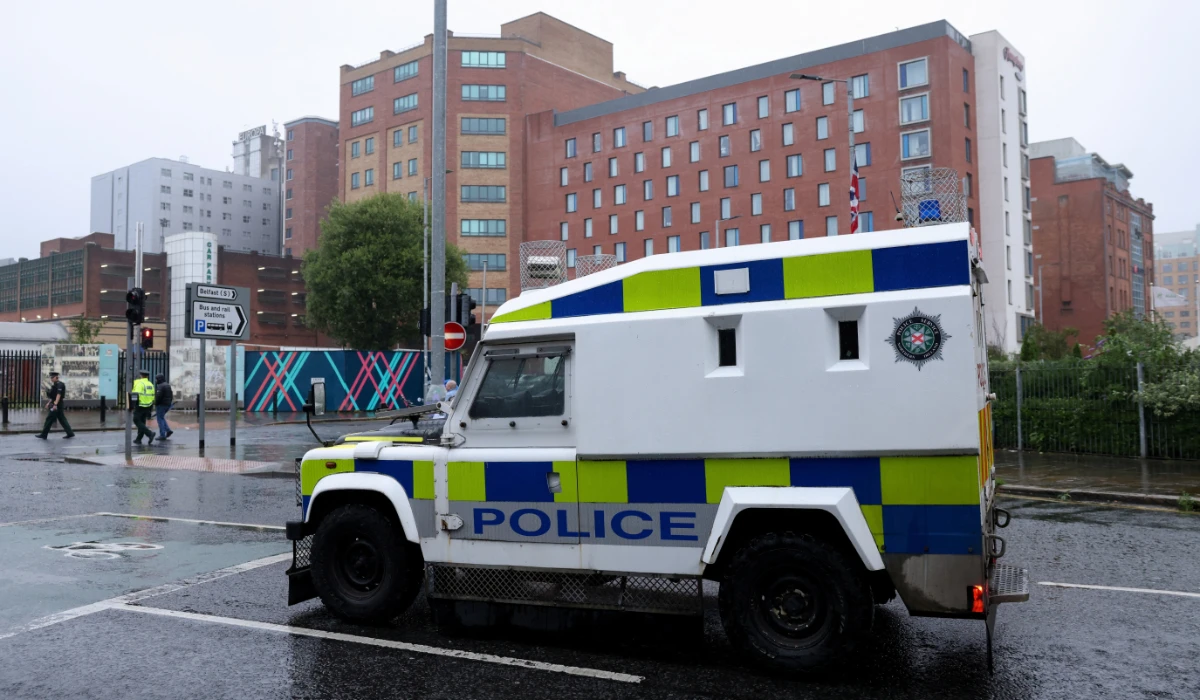
- The Orangemen have since remained at nearby Drumcree Church, demanding to complete the march, while residents maintained their protest
LONDON: Britain’s Northern Ireland Secretary on Friday banned a contentious Protestant parade through a mostly Irish nationalist and Catholic district after a nearly two-week standoff.
The Parades Commission, Northern Ireland’s independent body regulating contentious processions, had authorized 35 Orangemen to march silently along the mostly Irish nationalist enclave of Garvaghy Road in Portadown, without bands or supporters from 8:00 am (0700 GMT) on September 27.
But thousands blocked the procession, halting the first parade which had been allowed along the route in almost three decades.
The Orangemen have since remained at nearby Drumcree Church, demanding to complete the march, while residents maintained their protest
“I call for all protests, rallies and demonstrations to be stood down. There is no excuse for a continued ratcheting up of tensions,” the minister, Chris Bryant, said in a statement.
In the interest of public safety, Bryant said circumstances under which the procession was given the go ahead had now “changed considerably.”
“As a result, the procession cannot go ahead as it was determined,” he said, adding: “No-one wants a return to the past.”
The procession last went along Garvaghy Road in Portadown, 25 miles (40 kilometers) southwest of Belfast, in 1997.
It was barred the following year, soon after a peace accord largely ended three decades of conflict over British rule in Northern Ireland.
Police Service of Northern Ireland Chief Constable Jon Boutcher welcomed the decision.
He said he wrote to Bryant on Friday asking him to review an earlier decision by the province’s Parades Commission.
TRUST IN PEACE PROCESS
Boutcher said he outlined his assessment “that all available, lawful and proportionate options to facilitate completion of the procession had been exhausted.”
He added that any operation to allow the march to go ahead would have carried an “unacceptable” risk of serious injury and disorder.
This, Boutcher said, would also have had “catastrophic long term consequences for trust and confidence in... the peace process.”
A dispute over the same parade triggered deadly unrest in the 1990s.
In a joint statement, the Irish Republican Sinn Fein party’s president Mary Lou McDonald and vice president Michelle O’Neill paid tribute to the residents of the Garvaghy Road who they said had “shown remarkable strength and dignity in the face of provocation and intimidation.”
“There will be an enormous sense of relief within the community this evening,” the said.
“For two weeks, local residents have endured fear and anxiety through no fault of their own. They never asked for this wound to be reopened.”
But Gavin Robinson, leader of the Democratic Unionist Party (DUP), Northern Ireland’s largest pro-UK party, said the rule of law in Northern Ireland had been “fatally undermined.”
“The decision of the Chief Constable to refer the matter to the Secretary of State and his conclusion that the parade cannot proceed is a direct result of republican agitation, mobilization and the looming threats of potential violence,” he said.
“These decisions are a mistake, and send profound signals that the country should be run on force of numbers and who shouts the loudest,” he added.
Northern Ireland was blighted for three decades by conflict between largely Catholic, pro-Irish republicans and Protestant, pro-UK unionists.
The Orange Order is a pro-British organization that takes its name from William of Orange, the Protestant Dutchman who seized the English, Scottish and Ireland throne from Catholic King James II in 1689.