- Israel has killed over 74,000 Palestinians, according to Gaza’s Health Ministry
- Human rights groups and many experts on genocide have reached similar conclusions
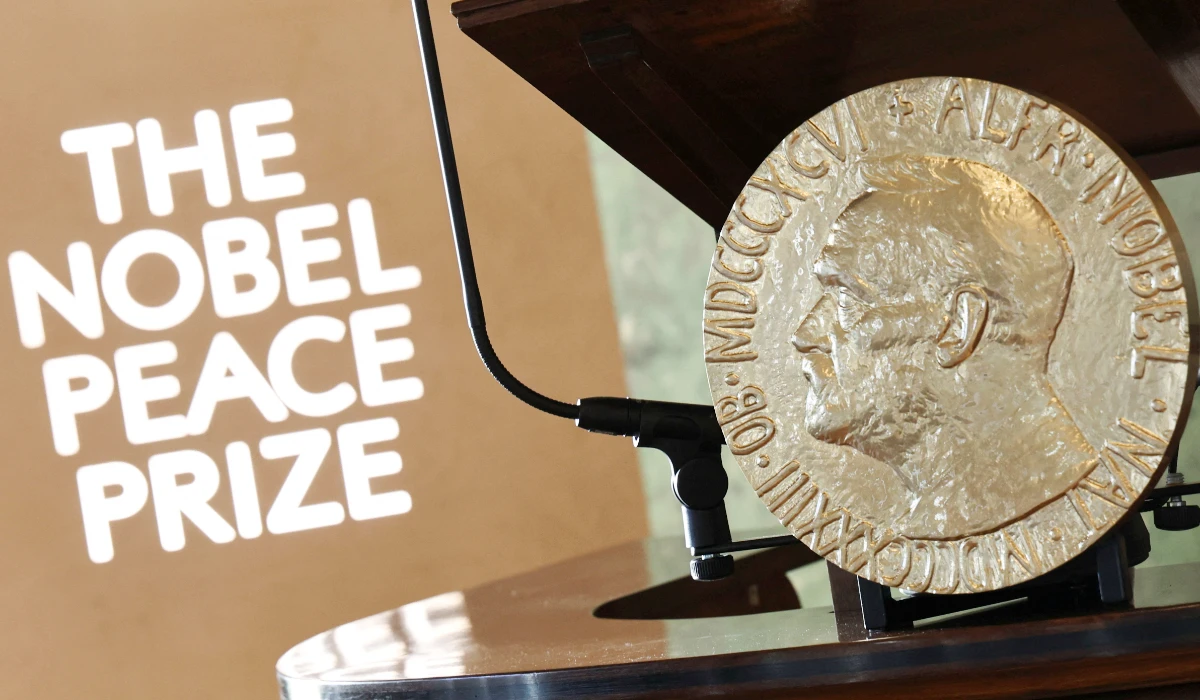
OSLO: The decision to award this year’s Nobel Peace Prize to veteran jurist Navi Pillay has exposed the vast gulf between Israel and global institutions charged with upholding international law, a rift that has widened over the war in Gaza.
Over a decades-long career, Pillay served at the highest levels of international organizations created in the wake of World War II to prevent a recurrence of its horrors. As a young lawyer in her native South Africa she campaigned against apartheid and for the release of Nelson Mandela, and as an international jurist she helped sentence dozens of people convicted of taking part in the 1994 Rwandan genocide.
But her leadership of a UN-backed panel that determined Israel committed genocide in Gaza — allegations it vehemently denies — has led many in Israel to see the Nobel nod as a high-profile rebuke of the country just days after the anniversary of the Oct. 7, 2023, Hamas attack that triggered the war.
Allegations of genocide are particularly explosive in Israel, which was founded in part as a refuge for survivors of the Nazi Holocaust.
“Awarding Pillay the Nobel Peace Prize isn’t a recognition of justice. It’s the grotesque weaponization of an award to legitimize anti-Israel hatred and prejudice,” Israel’s Foreign Ministry said on X. “Joseph Goebbels is certainly applauding from hell,” it added, referring to the Nazi propagandist.
The vitriol comes from the widespread perception in Israel that the United Nations and other international bodies are biased against it. The United States has echoed that criticism and announced a raft of sanctions aimed at dismantling the International Criminal Court hours after the Nobel Prize announcement.
But Pillay’s findings over the years were largely consistent with those of major human rights groups and other international bodies, and the facts she cited in reaching her conclusions had been widely reported.
Pillay led a panel that accused Israel of genocide in Gaza
Pillay led a three-member expert panel commissioned by the UN Human Rights Council that concluded last year that Israel had committed genocide in Gaza.
Their 22-page report cited the death toll; Israeli restrictions on humanitarian aid that led to widespread hunger; a policy of “systematically destroying” the health care system; the direct targeting of children and “explicit statements” of intent by Israeli civilian and military authorities.
Human rights groups and many experts on genocide have reached similar conclusions.
The commission has also issued reports accusing Hamas of war crimes during its Oct. 7, 2023, attack, when militants killed some 1,200 people and abducted 251 others. Israel’s retaliatory offensive has killed over 74,000 Palestinians, according to Gaza’s Health Ministry. The ministry, part of the Hamas-run government, maintains detailed records seen as generally reliable by UN agencies and many independent experts.
Israel has vehemently denied the allegations, casting them as an antisemitic blood libel. The Israeli military says it takes extraordinary measures to prevent harm to civilians and blames their deaths on Hamas because it operates in densely populated areas.
The International Court of Justice, the UN’s top court, is investigating genocide allegations brought by South Africa, and the International Criminal Court has issued an arrest warrant for Israeli Prime Minister Benjamin Netanyahu, for war crimes and crimes against humanity.
Pillay currently serves as an ad hoc judge in the ICJ’s ongoing genocide case against Myanmar and served as an ICC judge from 2003-2008.
Israel has rejected the commission since its inception
The commission was created after the 2021 Israel-Hamas war and is the first to have an open-ended mandate. Critics say such permanent scrutiny shows anti-Israel bias, while supporters say it’s needed to keep tabs on injustices faced by Palestinians under decades of Israeli rule.
Israel has refused to cooperate with the commission or other UN-endorsed investigations. It has pointed to the presence of notoriously repressive countries on the 47-member Human Rights Council and accused it of relentlessly singling out Israel while ignoring violations elsewhere.
A member of the commission, Indian jurist Miloon Kothari, sparked controversy in 2022 when he referred to a “Jewish lobby” in a media interview and questioned Israel’s UN membership, citing its alleged violations of member state obligations.
Pillay issued a letter at the time saying Kothari had been misquoted and that the commission does not question Israel’s status or UN membership.
She addressed the wider criticism in an interview with The Associated Press last year after she and the other commission members resigned, citing personal reasons and the need for change. They have since been replaced.
“We’re an independent panel,” she said. “People who accuse us of being antisemitic ... they twist the facts, they invent facts, falsify facts. I would like to see them challenge the report: Which of the facts that we have set out are incorrect?” she said.
Pillay also investigated Israel’s decades-long occupation of the West Bank
Even before the latest Israel-Hamas war, Pillay had repeatedly taken Israel to task over its open-ended military rule over millions of Palestinians.
In a report released more than a year before the Oct. 7 attack, the commission accused Israel of de facto annexation of the West Bank, which it captured alongside Gaza and east Jerusalem in the 1967 Mideast war. The Palestinians want an independent state encompassing all three territories.
The International Court of Justice later issued a landmark ruling that Israel’s occupation of the territories was unlawful.
The commission had said Israel’s continuous expansion of Jewish settlements, its demolition of Palestinian homes and its fragmentation of Palestinian life were aimed at securing permanent rule over the territory, which is home to some 3 million Palestinians and 500,000 Israeli settlers.
Palestinians in the West Bank live under Israeli military rule, with the Palestinian Authority administering population centers. The settlers have Israeli citizenship, including freedom of movement and the right to vote.
Israel’s UN mission rejected the report at the time of its release, calling it part of an “anti-Israel agenda” at the international body.
But Israel’s current government and most of its political class is opposed to Palestinian statehood, and Netanyahu has repeatedly said Israel will maintain permanent control over the territories.
Israel views the West Bank as the biblical and historical cradle of Judaism, and says its withdrawal would pave the way for a Hamas-run state that would threaten its existence. The last substantive Israeli-Palestinian peace talks broke down in 2009, after Netanyahu returned to office.
Pillay’s commission had also raised concerns about Israel’s potential annexation of Gaza, saying its efforts to carve out buffer zones and military corridors were “vastly disproportionate to any reasonable military objective.”
It said calls by Israeli officials for the “voluntary migration” of much of Gaza’s population from the war-ravaged territory, if implemented, would amount to forcible transfer, a crime against humanity.