- Michigan's Jewish voters, approximately 100,000, could play a crucial role in deciding the upcoming US Senate race
- Despite criticism, El-Sayed retains some support from Jewish leftists who relate to his experiences of discrimination
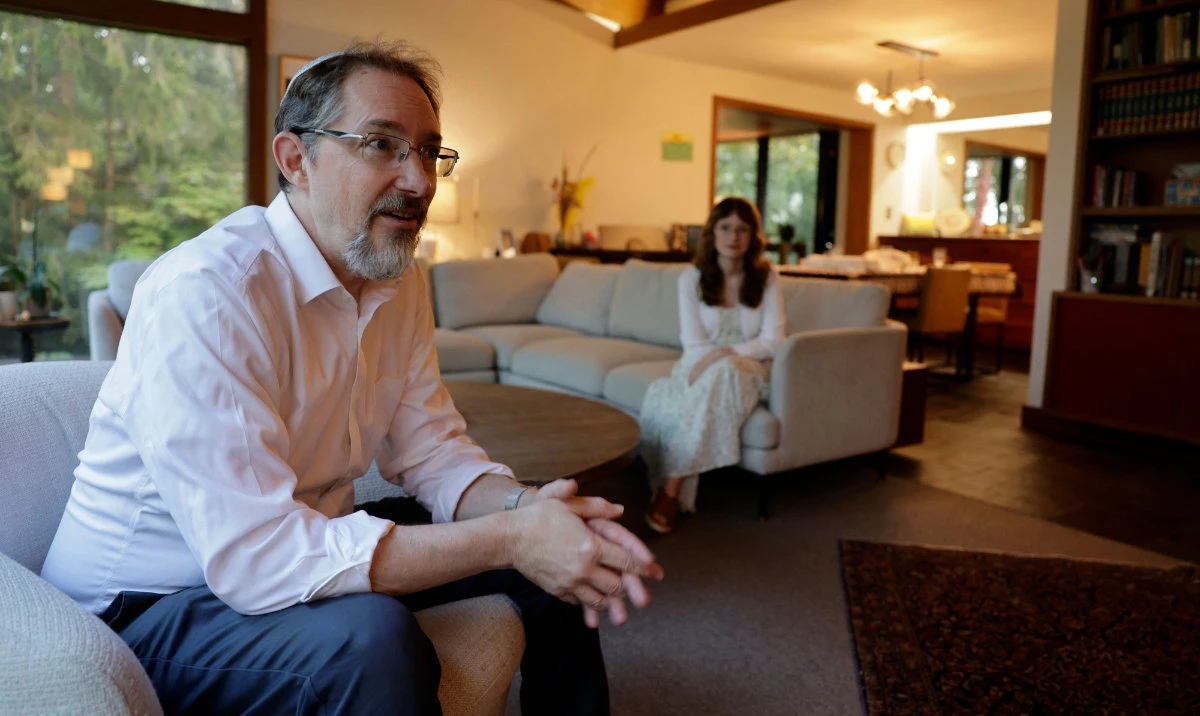
ANN ARBOR, United States: Rabbi Nadav Caine and his family gathered in their Michigan home to break challah bread for their weekly Shabbat meal, a brief respite from the acrimonious midterm election campaign dividing Jewish voters in their state.
The braided loaf, candles and sweet grape juice are weekly staples for many of Michigan’s roughly 100,000 Jewish voters who could help determine which party win a US Senate seat — and overall control of the chamber.
But while Caine is a longterm Democrat, he’s put off by the party’s candidate Abdul El-Sayed.
“I’m just mainly torn,” said Caine, 60.
El-Sayed, who won an upset Democratic primary victory on a populist message, is a Muslim — and like growing numbers of Americans strongly opposed to Israel’s government and US military aid. He’s also questioned Israel’s foundation as an explicitly Jewish state.
His outspoken defense of Palestinians and messaging missteps in the wake of a 2026 attack on a Michigan synagogue have dented his appeal in one of the country’s largest Jewish — and largely pro-Democrat — communities.
“The dilemma for us is that (El-Sayed) is someone that I strongly believe and sense doesn’t believe Israel has a right to exist as a state — or as a Jewish state — and is someone who fosters the sense that Jews deserve the antisemitism they receive,” said Caine, a rabbi at a conservative synagogue in Ann Arbor.
“I think for a public figure that puts Jews’ safety at great risk,” he added, describing himself as socially moderate and religiously conservative in his expansive home nestled among vibrant fall foliage.
‘Jewish safety’
Caine was among Jewish locals signing a petition of “Nonnegotiable” red lines, including Jewish sovereignty in Israel, in response to El-Sayed’s rise.
It demands candidates “treat Jewish safety, self-definition, statehood and political participation as baseline, nonnegotiable commitments.”
El-Sayed, seeking to become the first Muslim US senator, has not signed.
He drew criticism when he said “hurt people hurt people” after a Lebanese-born American drove an explosive-packed car into a West Bloomfield synagogue, before opening fire and killing himself.
El-Sayed says he has “been able to listen and learn ... and where my comments in the past have caused unnecessary pain, to apologize.”
Caine said that if El-Sayed wins on November 3, there’s still hope he could do more to embrace Jewish community “values.”
And El-Sayed, who has faced intense Islamophobia, including from his Republican opponent Mike Rogers and President Donald Trump, still enjoys some Jewish backing, particularly among leftists.
Businessman Kirk Dornbush, 65, staked out the October 8 televised debate between El-Sayed and Rogers in Grand Rapids, wearing a yarmulke and brandishing an “Abdul for US Senate” sign.
“Of the two candidates for Senate in Michigan only one of them has been discriminated against because of his religion,” he told AFP. “I’ve been discriminated against because of my religion and I’m Jewish so I’m voting with the guy who knows what it’s like.”
Bitter debate
Ahead of the bitter debate, during which Rogers accused El-Sayed of supporting jihadists, dozens of students marked the October 7, 2023, attacks on Israel at the University of Michigan’s Ann Arbor campus.
Attendees carried Israeli flags and heard an Israeli soldier whose speech was punctuated by shouts of “Free Palestine” from opponents.
“Many Jews here in Michigan are concerned about (El-Sayed’s) candidacy,” said University of Michigan graduate Michael Schostak, a Republican running for the institution’s governing board.
“I think the majority will not be voting for him ... That doesn’t mean they’re going to be voting for Mike Rogers.”
Both El-Sayed, 41, and Rogers, 63, recognize the importance of Jewish votes.
“What the polls aren’t picking up is our effort in the Democrat Jewish community,” said Rogers, who narrowly trails El-Sayed, at a factory outside Detroit.
“There’s about 100,000. Those numbers are swelling up. It’s huge for us,” added the Republican who calls his rival “anti-Jew.”
Rogers insisted Jewish voters, as well as Black, Indian American and Albanian American voters, would deliver him victory.
But University of Michigan-Dearborn politics professor Ronald Stockton estimated that one-third of Jewish were Republican, suggesting the remainder were “mostly not being won over by arguments that Jews are going to be at risk.”
During the October 7 vigil, an Ann Arbor Chabad House Rabbi Alter Goldstein said he hoped the winner would “have tolerance.”
“(But) hey, I’m not a prophet.”