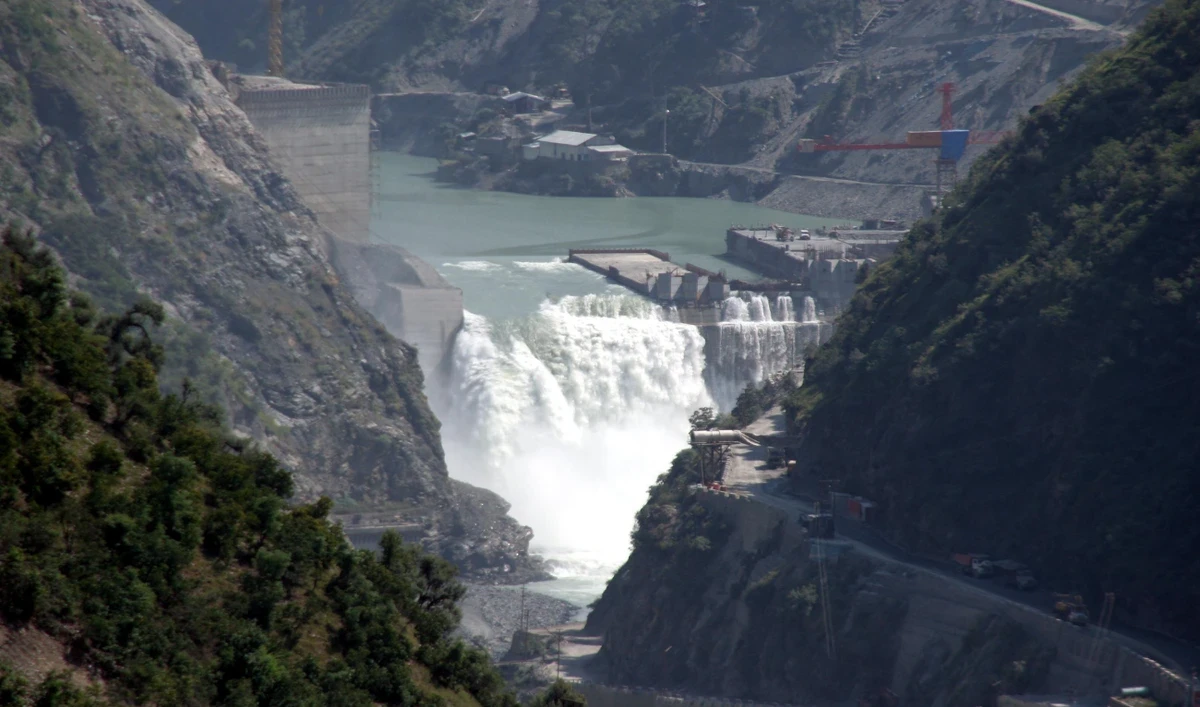
- India last year announced that it was placing the World Bank-brokered agreement ‘in abeyance’
- PM Shehbaz Sharif says shared water resources must never be weaponized for political pressure
ISLAMABAD: Prime Minister Shehbaz Sharif on Wednesday reiterated that water remained a “red line” for Pakistan, warning that any violation of the Indus Waters Treaty by India would be regarded as an “act of war.”
Signed in 1960, the treaty was brokered by the World Bank and governs the distribution of waters from the Indus river system, allocating the western rivers — Indus, Jhelum and Chenab — primarily to Pakistan, which relies on them for most of its agriculture. The three eastern rivers — Ravi, Beas, and Sutlej — were allocated primarily to India for unrestricted use.
India announced in April 2025 that it was placing the agreement “in abeyance” following a deadly militant attack in Indian-administered Kashmir that New Delhi blamed on Pakistan. Islamabad denied the allegation and maintains that the treaty cannot be suspended unilaterally. Pakistan accuses India of pursuing reservoir, expansion and diversion projects on rivers covered by the IWT in violation of the agreement.
Addressing a joint press stakeout with Maldivian president following delegation-level talks in Islamabad, PM Sharif said that Pakistan had conveyed its position on the treaty at international forums, including the United Nations General Assembly.
“Our position is clear. Water is a lifeline for humanity, particularly for lower riparian countries,” the prime minister said. “Let it be known to all and sundry that any violation in this regard will be regarded by Pakistan as an act of war.”
There was no immediate response from New Delhi to Sharif’s comments.
The prime minister said Pakistan had “serious concerns” over India’s decision to place the treaty in abeyance and strongly objected to what he described as the unilateral violation of an internationally binding agreement.
“Pakistan’s position is loud and clear, beyond any doubt, that legally binding treaties must be respected, and shared water resources must never be weaponized or used as an instrument of political pressure or blackmailing,” he said.
Pakistani officials have said in recent months that they have witnessed unusual fluctuations in river flows, while Islamabad has previously said that it would not let New Delhi restrict the flow of Indus waters.
“Water flows in every canal, river, ocean and sea, carrying a message of prosperity and progress, not threats, confrontations and conflicts,” Sharif added.