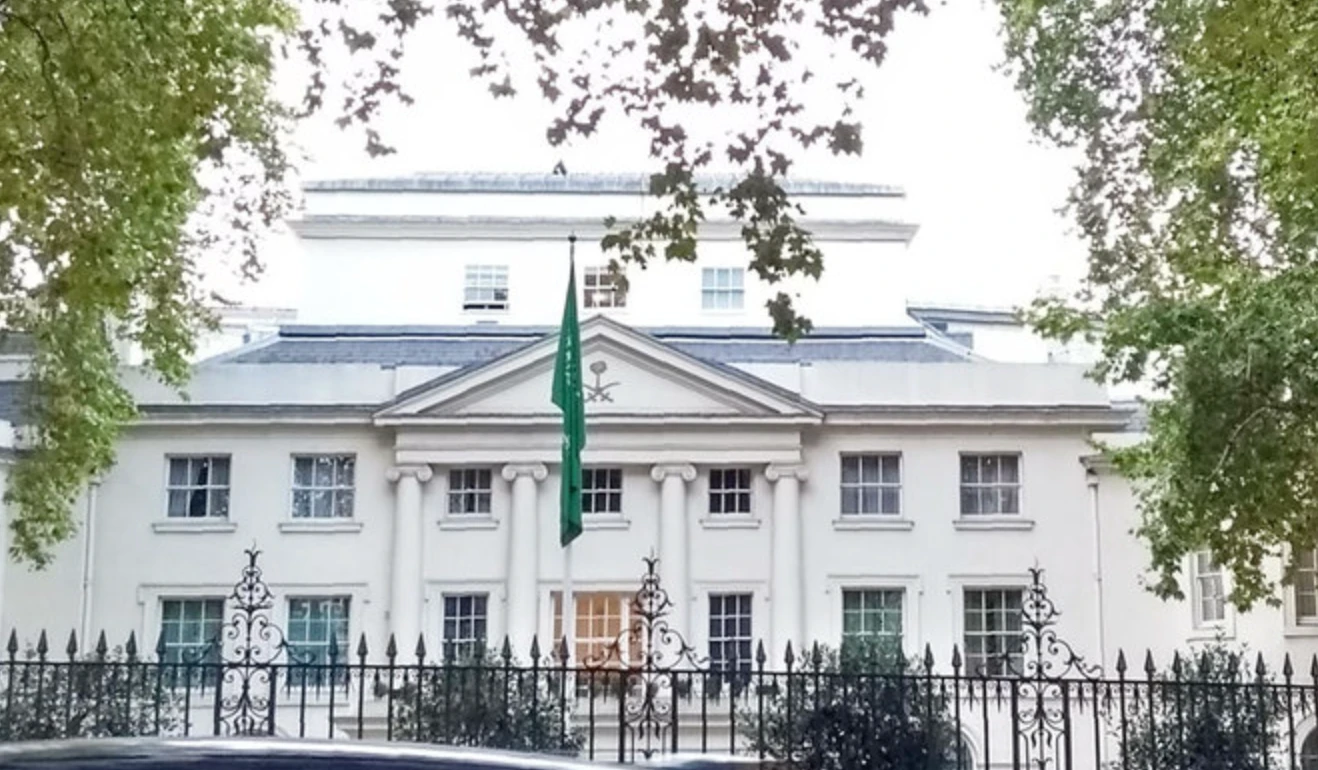
LONDON: The stabbing of a Saudi visitor during an attempted robbery in one of London’s wealthiest districts this week has sparked new discussions about the safety of Gulf tourists in the British capital and the precautions travelers should take in major European cities.
The man, in his 40s, was stabbed in Berkeley Square, Mayfair, on Thursday. Metropolitan Police officers and London Ambulance Service crews attended the victim, who was treated and taken to hospital. His injuries are said to be not life-threatening.
A 58-year-old man was arrested at the scene on suspicion of grievous bodily harm, possession of an offensive weapon and attempted robbery.
“This appears to be an isolated incident and there is currently nothing to suggest an ongoing risk to the wider public,” a Met spokesman told Arab News. “We recognize that this will cause concern among the community. Tackling knife crime and serious violence remains a priority for the Metropolitan Police.”
The Saudi embassy in London said it was coordinating with British authorities, supporting the victim and monitoring his condition until he is discharged.
It called for the investigation to be completed swiftly and for those responsible to be held accountable, while urging Saudi citizens in Britain to exercise caution and avoid carrying valuable possessions openly in public.
Arab News understands the embassy is expected to release the victim’s name shortly.
Reports indicate the attempted robbery may have been motivated by a luxury watch inside the man’s backpack, although it was not visible and nothing was ultimately stolen.
The incident has nevertheless resonated among Gulf travelers for whom London has long been a home-away-from-home and one of their favorite European destinations.
Jocelyne Elia, travel editor at Asharq Al-Awsat, said high-profile incidents could influence how visitors perceive the city even when they are statistically rare.
“Incidents like the recent stabbing are understandably concerning and can affect how safe Gulf visitors feel when travelling to the UK,” she told Arab News. “The Gulf is an extremely important tourism market for Britain, so repeated incidents could damage confidence and influence people’s decisions about where they travel, stay and shop.
“It is important that UK authorities respond strongly to these crimes while making clear that they are isolated incidents and that the UK remains a welcoming destination for Gulf visitors.”
Saudi tourism alone is a significant market for Britain.
The UK received a record 344,000 visits from the Kingdom in 2024, during which Saudi travelers spent about £771 million — an average of more than £2,200 per visit according to VisitBritain, citing data from the Office for National Statistics’ International Passenger Survey.
Figures obtained from the Metropolitan Police provide a partial picture of the crimes experienced by Saudi and other Gulf nationals in London. Records show 35 Saudi nationals were recorded as crime victims in 2021, rising to 65 in 2022 and 85 in 2023 — a total of 185 over the three years. Of those cases, 97 involved theft, 41 violence against the person and 12 robbery.
Across the six Gulf Cooperation Council nations, 498 people were recorded as victims during the three-year period, including 219 involving theft and 137 violence against the person.
The Met says some 92 percent of total recorded victims do not have a first nationality recorded. The figures also do not distinguish tourists from residents, students or other people, and so cannot be used to calculate the risk of a Saudi or Gulf visitor becoming a crime victim.
The Mayfair attack also comes little more than a year after the death of a Saudi national in Britain in another stabbing attack, although the circumstances were very different.
Mohammed Yousef Algasim, 20, was attending a 10-week English-language course in Cambridge when he was stabbed in the neck in an unprovoked attack outside his accommodation on Aug. 1, 2025.
His killer, Chas Corrigan, was convicted of murder in March and sentenced in June to life imprisonment with a minimum term to be served of 22 years and six months.
CCTV showed Corrigan, who had been drinking and had taken drugs, approach Algasim before walking away, turning back and stabbing him with a kitchen knife.
Such cases have contributed to concerns over violent crime, while the much more common experiences of pickpocketing, phone snatching and theft has increasingly shaped tourists’ perceptions of some European capitals.
The picture, however, is more nuanced than individual incidents might suggest.
Berkshire Hathaway Travel Protection’s 2026 ranking of the safest cities for travelers places four European cities among its top five; in order, they are Reykjavik, Copenhagen, Zurich, Amsterdam and Honolulu. London is ranked 13th safest overall and eighth specifically for safety from violent crime.
The company cautions that the survey measures conditions and traveler perceptions at a particular point in time rather than providing a guarantee that visitors will not encounter crime.
At the opposite end of the spectrum, a 2024 Forbes Advisor study of 60 international cities ranked Caracas as the riskiest destination for tourists, followed by Karachi, Yangon, Lagos and Manila.
Its assessment went beyond street crime to consider personal and health security, infrastructure, natural-disaster exposure, digital safety and government travel advisories.
However, a city can rank comparatively highly for overall safety while still experiencing particular forms of crime at levels noticeable to visitors. In London, mobile-phone theft is perhaps the most visible example.
A Metropolitan Police data series recorded 117,211 mobile phones stolen in London in 2024, the highest annual figure in the series and equivalent to about 321 phones a day. That followed 115,261 recorded stolen phones in 2023 and 90,810 in 2022.
The Met said it moved to a new crime-recording system in February 2024, meaning care must be taken when making direct comparisons. A newer offence series recorded 81,365 mobile-phone theft offences in 2024 and 71,391 in 2025, a decline of 12.3 percent. The difference reflects different police datasets and recording methodologies.
Police have since mounted their largest crackdown on phone theft to date. Earlier this summer, the Met released footage showing officers pursuing suspected phone thieves on high-powered e-bikes, conducting raids, arresting alleged handlers and recovering stolen devices as part of Operation Reckoning.
One raid on a shop in northwest London recovered more than 1,000 suspected stolen phones.
An earlier four-week phase of the operation resulted in 248 arrests and the recovery of 770 devices, while another investigation dismantled what the Met described as the UK’s largest mobile-phone smuggling network, responsible for trafficking as many as 40,000 stolen devices to China during 2024 and 2025.
Police said the network was handling the equivalent of about 40 percent of phones stolen in London at the time.
The crackdown appears to be having an effect, something London Mayor Sadiq Khan has been quick to capitalize on.
Across London, the Met said theft-from-the-person and robbery offences involving stolen mobile phones fell by 18 percent in the 12 months to May, representing around 14,000 fewer offences. Those falling figures provide an important counterpoint to perceptions of London as a city experiencing an unchecked crime wave.
But Elia said the Mayfair stabbing demonstrated why travelers should still take practical precautions, particularly in areas associated with luxury shopping, restaurants and nightlife.
She rejected the suggestion that Arab visitors should change traditional clothing or conceal their nationality because of safety concerns.
“The advice should simply be to be discreet with expensive watches, jewelry and designer bags, and phones, particularly in crowded areas or late at night,” Elia said.
“Keep valuables covered where possible, stay aware of your surroundings and avoid openly displaying expensive items. This is sensible advice for all tourists, not just Arabs.”
She added: “Saudi-British relations are strong, but the British government must do more to tackle rising crime, especially phone theft and robberies.”
For Gulf travelers, the latest attack presents a dilemma familiar to visitors to many of Europe’s largest cities.
London remains highly ranked for overall tourist safety and police data suggest several forms of street crime are falling after intensive enforcement.
At the same time, the stabbing of a Saudi visitor in the heart of Mayfair — coupled with the prevalence of phone and luxury-item theft — is a reminder that relative safety does not eliminate individual risk.
For the hundreds of thousands of Saudi visitors who travel to Britain each year, the message from both the embassy and travel experts is therefore one of vigilance rather than avoidance: London remains open to them, but valuables, surroundings and personal security cannot be taken for granted.
Stabbing of Saudi visitor highlights need for vigilance among Arab tourists in London