- Indonesian state secretary said alleged wiretapping operations ‘may amount to treason’
- Incident seen as one that could endanger national security and sovereignty, official says
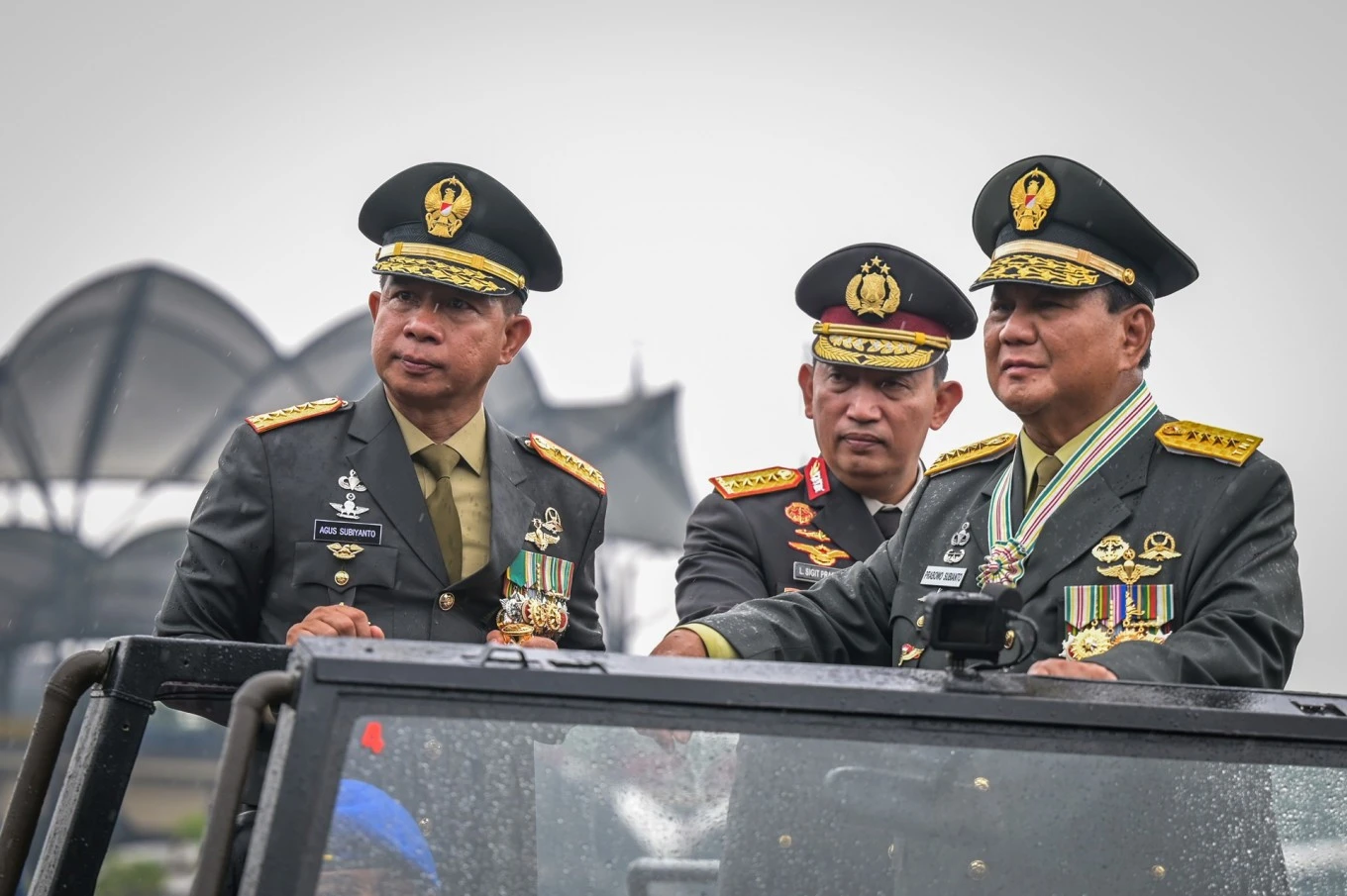
JAKARTA: The Indonesian military is mobilizing more than 20,000 troops to heighten security in the capital, Jakarta, as authorities investigate three police generals over alleged wiretapping targeting President Prabowo Subianto.
Around 5,700 troops from outside the capital are expected to arrive on Wednesday, after the first phase comprising about 2,100 personnel from units stationed in Jakarta were deployed on Monday, according to a statement attributed to Vice Adm. Yayan Sofiyan, assistant chief of staff for operations of the Indonesian Navy.
With an additional 13,140 on standby, the plan to “deploy reinforcement troops” involves 20,980 personnel in total, including those from marine and navy units, as well as training centers and naval bases from various Java provinces and Lampung.
The troop deployment comes as former National Police Chief Listyo Sigit Prabowo and two other top police officials were arrested on Tuesday over an alleged surveillance operation that not only targeted the president, but also numerous ministers, political leaders, media figures and civil society leaders between 2025 and 2026.
Officials have not said that the deployment is connected to the wiretapping investigation, with military spokesperson Maj. Gen. Muhammad Nas telling state news agency Antara that the troop deployment was standard procedure for “maintaining national security and territorial integrity.”
On Wednesday, State Secretary Prasetyo Hadi described the alleged wiretapping case as an “extraordinary case” and the actions of a “handful of rogue individuals” that “may amount to treason.”
He told a news conference at the presidential palace in Jakarta that the sensitive information accessible through the communications of a head of state could “endanger the security and sovereignty” of the nation.
According to Hadi, Prabowo was “deeply concerned that an institution under his authority would engage in such actions,” adding that the president had instructed the police chief to pursue the case.
He also said Listyo had been removed as presidential chief of staff, a role he held for just over a month after being replaced as police chief on Oct. 1.
Listyo and the two senior police officials, identified by investigators as ASN and EH, face potential prison terms of up to 10 years.
The full scale of the operation and its purpose are not yet disclosed. Investigators said they have so far questioned 10 witnesses and three experts, seized 11 mobile phones, an iPad and four flash drives.
The alleged wiretapping operations were most likely politically driven, said Ray Rangkuti, political analyst and founder of democracy watchdog Lingkar Madani.
“It could be related to governance, power grab, or even the internal politics concerning positions (within the national police) that led them to conduct such wiretapping operations,” he told Arab News.
Rangkuti also sees this as part of a democratic backsliding process in Indonesia, which in recent years included legal revisions that reduced the independence and investigative power of key anti-corruption agencies and rulings by the Constitutional Court that were widely seen as facilitating political dynasticism.
“Almost every level of our state institutions has been compromised to serve the interests of those in power. That is precisely what has left me so shocked because it’s not just this wiretapping incident; it’s something that has been compounding from prior events,” he said.
“This is why the president must make sure that the case is thoroughly investigated, completely resolved … to make sure that such incidents will never happen again.”