Since Andy Burnham became UK prime minister in July, Britain’s approach to Israel and Palestine appears to be entering a new phase, with the government promising a more comprehensive policy and potentially tougher measures.
But for Chris Doyle, director of the Council for Arab-British Understanding, a London-based nonprofit and cross-party organization, the real test is whether words are followed by consequences.
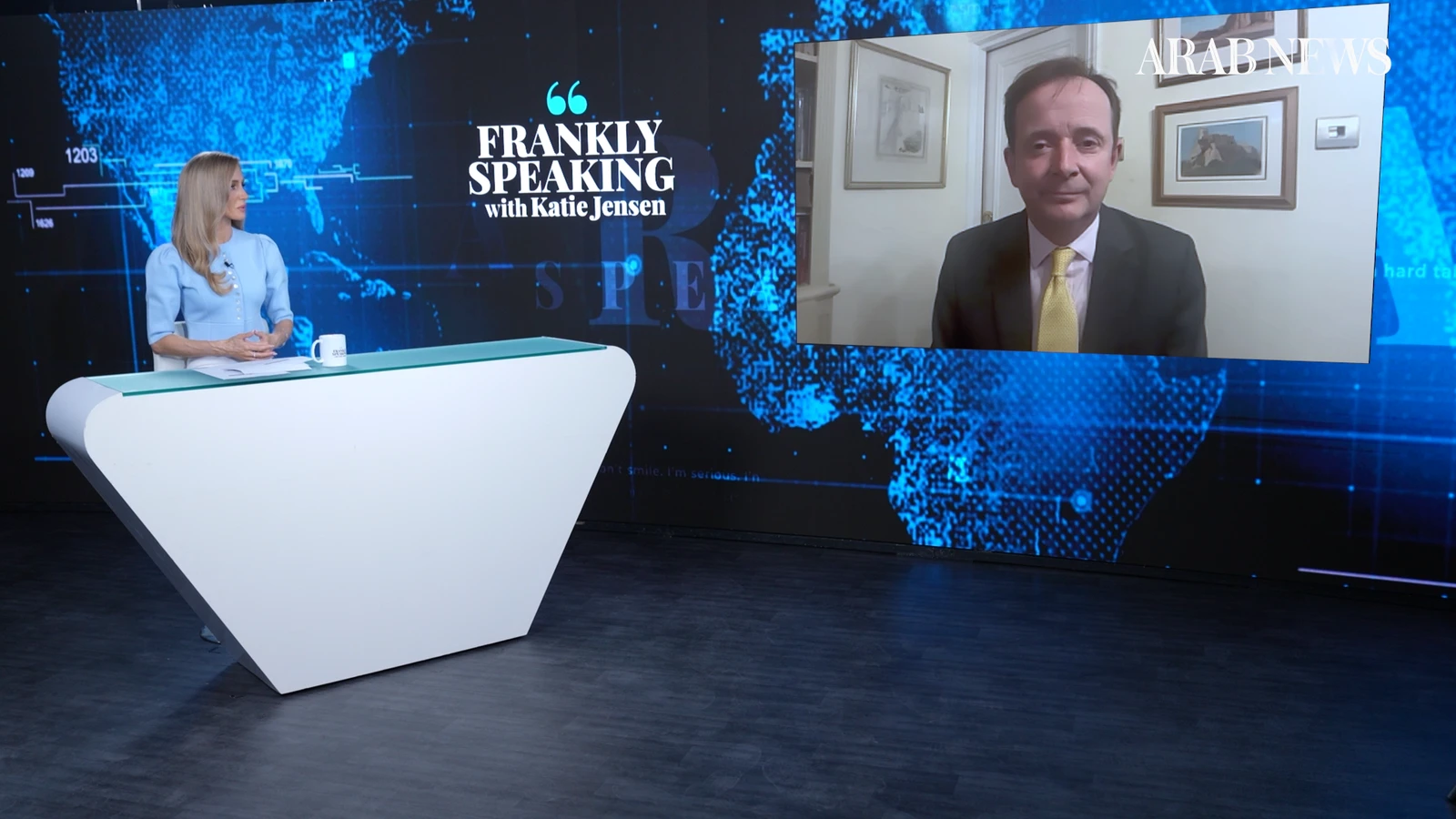
Appearing on the Arab News current affairs program “Frankly Speaking,” Doyle said the two-state solution is now “on life support at best,” as Israel’s government advances settlements, settler violence continues across the West Bank and Gaza remains devastated by war.
“It’s really hard to see where this goes,” Doyle told “Frankly Speaking” host Katie Jensen. “It’s on life support at best because we have an Israeli government that is essentially committed to ending it.”
Doyle pointed to the advancement of the E1 settlement plan east of Jerusalem, as well as what he describes as strategic settler attacks on Palestinian communities across the West Bank. But Gaza, he argued, has made the situation even more urgent.
“The other part of that potential Palestinian state, Gaza, it’s suffering from what most of us consider to be a genocide,” he said. “It’s been to all intents and purposes flattened.”
He also pointed to recent comments by Israeli Defense Minister Israel Katz advocating what he calls the “voluntary migration” of Palestinians from Gaza. “This is ethnic cleansing. It must be called out as such,” Doyle said.
For European governments that still want a two-state solution, he argued, the response can no longer be limited to diplomatic language.
“They really need to act fast. They need to act decisively,” he said. “It’s not just good enough to sort of pause settlement building.” Instead, he said, there must be a process that “will genuinely see the reconstruction of Gaza.”
That challenge has become more acute following Katz’s remarks that Israel is prepared to remove Gaza’s entire population if US President Donald Trump gives the green light.
Doyle said the international response to those comments will be an important test of whether institutions such as the Board of Peace have any meaningful influence.
“It’s not just any Israeli minister. It’s the Israeli defense minister and, in the Israeli political system, arguably the second most important politician after the prime minister,” he said. “So where is that international reaction?”
Doyle believes the Board of Peace is not designed to create the kind of political settlement required to integrate Gaza into a future Palestinian state.
“It is simply not designed to bring about, in my view, the reconstruction of Gaza, the opening up of Gaza, to make Gaza part of a Palestinian state,” he said.
Britain, meanwhile, appears to be preparing for a significant change in policy. Foreign Secretary Ed Miliband has promised what he calls a “comprehensive” restatement of UK policy on Israel in the coming weeks. For Doyle, the word itself is significant.
“A comprehensive set of measures,” he said. “I think that’s some of the most robust language we’ve heard from a British foreign secretary.”
Doyle believes that could mean more than a proposed ban on trade with Israeli settlements. Other sanctions could follow, while suspension of the UK-Israel trade agreement and a pause in military and security cooperation could eventually be considered.
“I think that it is untenable to sanction two ministers in the current government to say that Israel is in flagrant breach of international law, committing all these violations, but then still continue to treat it as if it’s business as usual,” he said.
For Doyle, that marks a notable change from the language of the previous British government.
“A lot of the statements that have been made since the end of July have been far more assertive,” he said. “There hasn’t been this sort of artificial balance and hesitant language: ‘on the one hand, on the other.’ It’s been far more clear-cut.”
But the first practical test may be Britain’s proposed response to Israeli settlements. The UK has previously sanctioned a limited number of extremist settlers, but Doyle argues that such measures have done little to change the situation.
“It should have been doing this and much more years ago,” he said, when asked whether Britain was doing enough. “Basically, Israel has enjoyed a climate of impunity for decades.”
Doyle said a settlement trade ban could be significant, but only if it is broad enough to have an impact.
“The question here is not whether that’s going to happen, but how tough this will be,” he said. “Will it be a UK ban on just trading with the settlements in terms of products, or will it include investments and financial services?”
“It needs to have teeth,” he added, arguing that it would also require an enforcement mechanism capable of imposing meaningful consequences.
The bigger question for Britain, however, is whether it is prepared to apply the same principles over Gaza.
Doyle sees a contradiction in the UK’s willingness to take a leading role in supporting Ukraine in its war with Russia while taking a more cautious approach to Israel and Palestine.
“The British government has not once said that Israel has violated international law in Gaza, which is extraordinary,” he said.
“We need to speak out and say you are violating international law. What you’re doing in Gaza is unconscionable. There are consequences.”
Britain’s recognition of Palestine in September 2025, he argues, should also have consequences beyond being a symbolic gesture.
Doyle acknowledged that recognition was important as an affirmation of Palestinian rights, but said it was never going to end the occupation or stop settlement expansion by itself.
“It is at least a very symbolic and important recognition of Palestinian national sovereign rights, the right to self-determination,” he said. “But now that the British government has done that, you also have an additional argument to deploy.”
That argument, he says, is straightforward. If Britain recognizes Palestine as a state, it should also act against the continued settlement of Israeli citizens on territory claimed for that state.
“Why then are you not doing more to stop what effectively are colonies in that state, where a second state has implanted its own population into that state?” he said.
Doyle also pointed to the International Court of Justice’s 2024 advisory opinion on Israel’s presence in the occupied Palestinian territory, which deemed it unlawful.
“If it were to do that, then it would have legal consequences,” he said. “That occupation being unlawful means that you must not have anything to do with it. You must not aid and abet it in any way, shape, or form.”
The pressure on Britain is not occurring in isolation. Across Europe, public attitudes toward Israel have deteriorated sharply, even as governments remain divided over how far they are prepared to go.
Doyle’s organization, Caabu, commissioned a poll in July which, he said, found that 50 percent of the British public believed Israel was committing genocide in Gaza, compared with 16 percent who did not.
“So Israel has a massive problem in terms of public support,” he said.
Yet political action has lagged behind public sentiment, partly because European Union sanctions require unanimity and some governments remain unwilling to support stronger measures.
Doyle believes that could eventually leave Israel facing a much wider diplomatic isolation. “And there are many Israelis who don’t want that,” he said. “They want to be welcomed into the global community. They don’t want to be outcasts.”
For Britain, the question is therefore not simply whether its policy is changing, but whether it can use its influence beyond Gaza.
Lebanon provides one example. With UNIFIL’s mission due to end after nearly five decades, Doyle argued that Britain still has an important role to play, particularly alongside France and Germany.
“Britain can do plenty in Lebanon in concert with other partners,” he said. That should include making clear that “Lebanese sovereignty must be respected” and pressing Israel to establish a clear timetable for withdrawing its forces.
Doyle argued that progress on Hezbollah’s disarmament is also linked to the question of Israeli withdrawal.
“The other part of it is the disarmament of Hezbollah, which can only really be achieved if there is a clear statement that Israel would be leaving Lebanon once and for all,” he said.
Beyond Lebanon, the wider regional picture remains unsettled.
Doyle sees some grounds for optimism in post-Assad Syria, where he says the absence of the Assad family and greater freedom of expression are welcome developments. But the country’s economic crisis remains severe.
And the war between the US, Israel and Iran has demonstrated the limits of military power even more starkly. Doyle argued that the conflict has failed to produce a decisive military outcome and risks becoming a prolonged cycle of escalation.
“What we’ve discovered, for those who didn’t realize it in the first place, is there’s no military solution to all of this,” he said. “The US, with all its military firepower, with the addition of Israel as well, could not militarily defeat Iran.”
Instead, he believes mediation and a political agreement will ultimately be required.
“We need to dial this down and find a realistic path out of this that gives everybody peace of mind and security.”
Frankly Speaking: Britain breaks with the past — but is it enough?