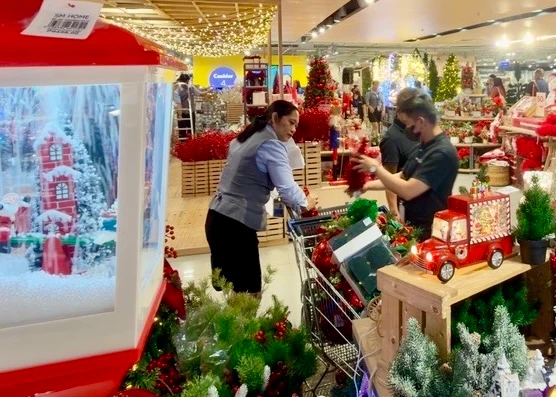
MANILA: As the Philippines started the world’s longest Christmas season in September, shops and public spaces compete to put on the most festive look. But this year, Santa figures and baubles face a more pressing rival: rising prices that are squeezing household budgets after months of the US-Israeli war on Iran.
Over the past few days, colorful decorations have begun to pop up outside Filipino homes, in streets and on public buildings, as people in one of the largest Catholic-majority countries embark on their four-month-long preparations to commemorate the birth of Jesus.
The tradition covers the four months ending in “-ber” until Christmas Day. Filipinos start the Christmas celebration during the “ber” months because the 100-day Christmas countdown normally begins during this time.
Normally, in the first days of September, residents of Metro Manila would be flocking to Dapitan Market in Quezon City — a main destination for holiday ornaments. But this time it is different.
“We’re not sure if we’ll still have a lot of customers coming in this season,” said Joy Oros, one of the sellers at the market, as he expected sales to be slower.
“In the past, by Sept. 1, we would already have some buyers. Now it’s still just one or two customers.”
The slowdown comes as the Philippines grapples with surging fuel, electricity and commodity prices. Highly dependent on imported fuel, the Southeast Asian nation has been immediately affected by disruptions to supplies from Gulf countries and shipping through the Strait of Hormuz. In March, days after the start of US-Israeli attacks on Iran and Tehran’s retaliatory strikes on American bases in the region, the Philippine government declared a national energy emergency.
As fuel prices directly affect the costs of transportation, agriculture, manufacturing and distribution, the impact has rippled through the economy, making everyday consumer goods more expensive.
Most of the sellers at Dapitan Market have increased their prices.
“We raised them a little because the suppliers also increased their prices, by at least 10 percent,” Jen Valenzuela, another seller, told Arab News, expecting that her sales would be lower.
“People are much more conscious about prices … People’s priority now is their basic needs, rather than decorations. People are already struggling to afford basic necessities.”
But celebrating and rejoicing Christmas is something that every Filipino household looks forward to and will never forgo the tradition.
“We are known for having the longest Christmas in the world. We really celebrate Christmas,” said Marjorie Jalosjos, one of the visitors to the market.
“Whatever is happening, you have to keep it in your heart that you have to spend Christmas and celebrate the birth of Jesus Christ the Filipino way. And we have to teach our children also to celebrate Christmas.”
As the rising cost of living has already affected her family, she is looking for ways to cut back on other expenses to make sure Christmas is still a merry one, as it should be.
“You have to make adjustments. For example, when it comes to extracurricular activities — or if you eat out or go on outings — you have to cut back a little so you can set aside some budget for Christmas decorations,” she said.
“The decorations add cheer and happiness to our eyes, and our neighbors and family. We want them to be happy.”
To always find a way to observe traditions, especially ones that are related to family, is for some, like Joy Ruguyal, also part of Filipino resilience.
She and her family went to one of Manila’s biggest malls over the weekend to buy a new Christmas tree.
“Our Christmas tree is more than 10 years old, and this is the first time we’re replacing it,” she said.
“Even if we have a crisis going on, we still owe it to them, the kids, to make sure they’re happy, and also to uphold this Filipino tradition.”
Even if the Christmas tree and window lights cannot shine as long as they usually do to conserve energy, her family will still turn them on and just have the air conditioner running for shorter periods instead.
“It’s not that we are blind to what’s happening around us … We like to celebrate, we like to look at things from a better angle,” she said.
“Even when things look bad, we have the resilience. Despite everything, we still find ways to be happy and celebrate.”
Filipinos begin world's longest Christmas season as Iran war fuels crisis