- Death toll from Wednesday’s flash flood has risen to more than 500
- More than 14,000 security officers on the ground for relief operations
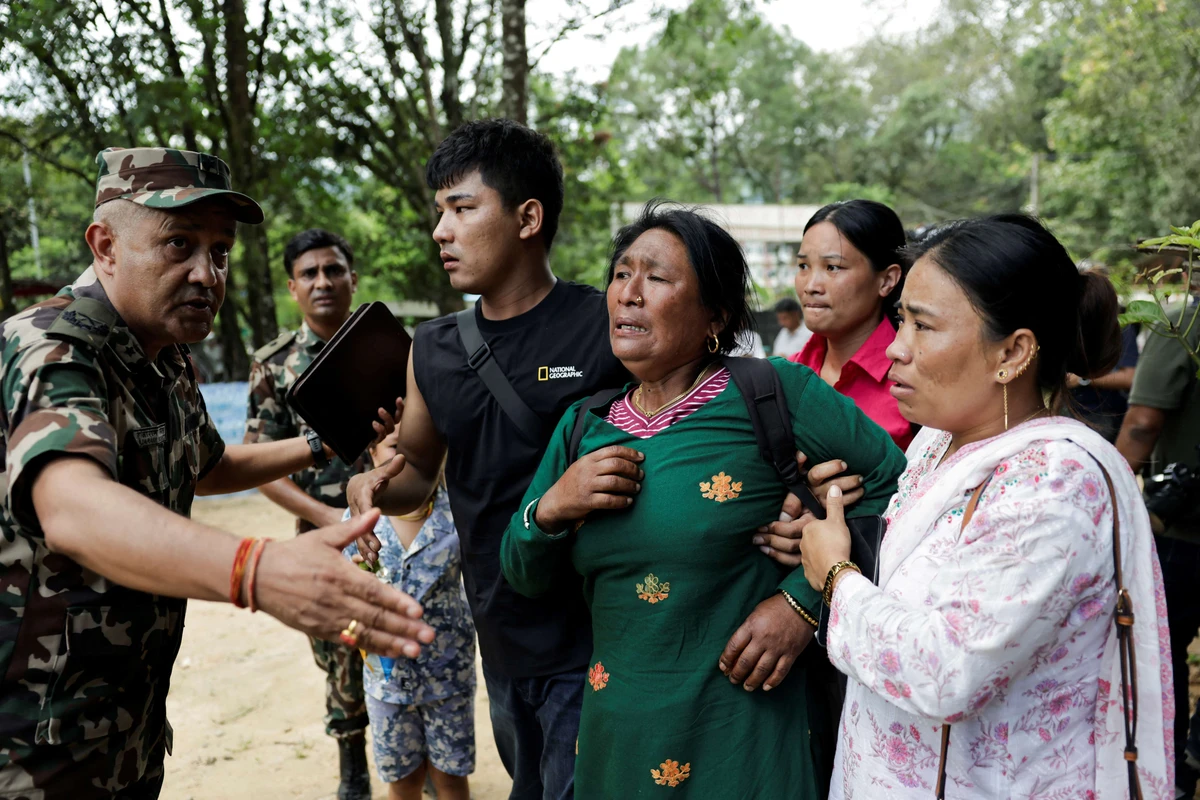
NUWAKOT, Nepal: Biskila Tamang has not heard from her husband since Wednesday morning. At Maithali Barrack, an army training facility that was turned into a rescue operations center, she stood among more than a thousand people looking to find loved ones who have been missing since a catastrophic flash flood hit Nepal.
“It has been two days and there is no word — not that he is alive, not that he is dead,” she told Arab News. “He was staying with his friends in Timure. There has been no contact since.”
The last time she heard from him, Tamang’s husband was headed for the customs office in Nepal’s Rasuwa district to collect items for a delivery to the capital, Kathmandu.
Not long after, tsunami-like floodwaters and mud swept through villages and towns along Nepal’s Bhote Koshi and Trishuli rivers — including the town of Timure — destroying homes and washing away bridges in the districts of Rasuwa, Nuwakot and Dhading.
For the past few days, people have crowded the army center in Nuwakot for the same reason: someone in their family had gone missing in the deadly deluge.
Some were there to check the army’s list of rescued people. By the gate, people tried giving descriptions to soldiers: a name, an age, the clothes they were last seen in, or the road they were traveling on.
Nepali authorities have recovered 547 bodies so far. Nearly 1,000 people remain missing.
More than 14,000 security officers have been deployed to scour the steep valleys, but rescue efforts were briefly halted on Friday due to fresh flood warnings.
In the village of Devighat in Nuwakot, the flood destroyed Luna Nepal’s home. He is now pinning all his hopes on the government to find his son, Baburam.
“The flood has taken away my home. I have nothing left except the clothes I am wearing,” the 65-year-old told Arab News. “My son works as an officer at the Rasuwa Customs Office and has been missing since Wednesday. We have not been able to contact him. I ask the government to help me find my son.”
Some Nepalese traveled for hours to reach the valley regions, desperate for news of their families. As she held on to her husband for support, Sapana Tamang told Arab News her four-year-old son and in-laws were missing, and were last known to be in the family home in the village of Betrawati.
“We were working in Kathmandu. Our son was living with his grandparents and going to school there,” she said.
Like her, Binod BK was also at the Maithali Barrack, hoping to find his elder brother Rajkumar.
“He went to Rasuwagadhi to pick up passengers. The last contact was at eight on Wednesday morning, and after that his phone was off,” he said. “He drives a Rimal Deluxe bus. His name was not on the list of those rescued.”
Residents across the flood-hit Himalayan valleys are wrestling with both fear and disbelief. These communities have lived by the rivers for generations and know what a bad monsoon season looks like. But what happened on Wednesday was unprecedented — no warning and no time to move.
“Bodies were lying scattered in the open,” said Rasuwa resident Cheku Lama, of the aftermath.
“We live in Khalte. We were displaced in the 2015 earthquake as well,” he continued, referring to the devastating 7.8-magnitude quake that killed thousands in the country and displaced around 2.8 million people.
“This flood has taken lives. It destroyed Khalte village completely.”