- The evacuation operation, facilitated by humanitarian organizations, welcomed tired travelers with food and support
- An estimated 2,000 people remained in Oleshky, with many choosing to stay behind for their homes or pets despite dire conditions
CHERNIHIV REGION, Ukraine: Residents of Russian-occupied Oleshky crossed into Ukrainian-held territory Saturday in a major evacuation operation carried out under the most significant truce since Russia’s full-scale invasion of Ukraine 4½ years ago.
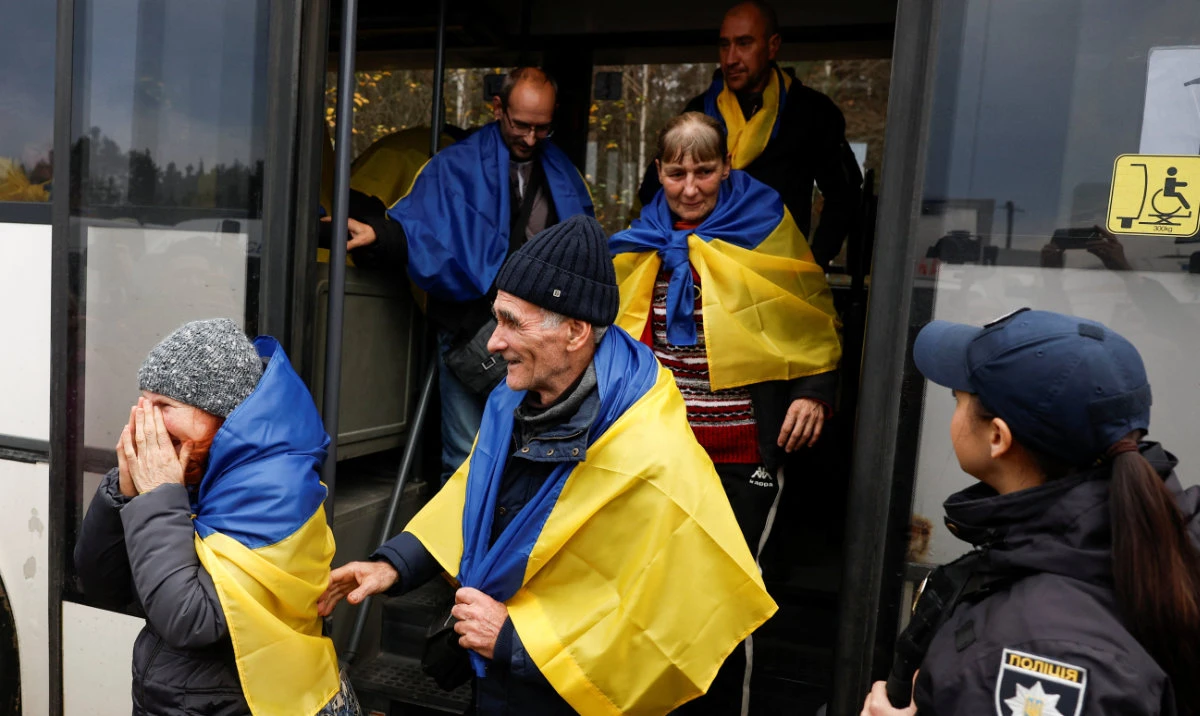
Evacuees wrapped in blue and yellow Ukrainian flags stepped off buses at the Ukrainian-Belarusian border and reunited with family members. Volunteers with hand-drawn welcome signs handed out coffee to the weary travelers who had journeyed by bus and plane through Russia and Belarus. Residents of nearby villages lined the highway waving flags and flashlights to greet the convoy.
Tetiana Leonidivna, 71, thanked the Ukrainian soldiers who helped her flee.
“We love them, we love them,” she said through tears. “We know that they are protecting us. And a deep bow to them, and a deep bow to their parents, for having such children. I am proud, I am simply proud.”
The ceasefire in Ukraine’s southern Kherson region began early Tuesday and was expected to continue through Sunday evening. The White House has said US first lady Melania Trump helped to broker the localized truce, while Pope Leo XIV pressed Russia and Ukraine to allow aid deliveries and evacuations.
Evacuees and their families express fear and hope
Relatives and volunteers with the Red Cross, Doctors Without Borders and World Central Kitchen welcomed the evacuees as they arrived at the border, ready to provide aid and food. Crews unloaded crates of pets — including cats, dogs, a parrot and a raccoon — from the buses.
Holding a cigarette between shaking fingers, 48-year-old Ivan Yevhenovych described his last months in Oleshky.
“It was very difficult. There were a lot of drones. It was hard to move around the streets,” he said. “Since spring, there hasn’t really been any staple food left. People had a little bit of their own reserves. We are thrifty people.”
He said land mines or drone strikes were killing residents every day.
An estimated 2,000 people remained in Oleshky when the temporary truce took hold. They were offered the choice of evacuating to territory controlled by Ukraine or Russia, or remaining in the city with replenished food and medical supplies.
“Many people stayed behind and didn’t want to leave,” Yevhenovych said. “Some for their houses, some for their animals.”
Ukrainian authorities, seeking to protect those who remained and safeguard future humanitarian missions, have not said how many residents were evacuated from Oleshky and have restricted details of their route. Melania Trump posted on social media Friday that the humanitarian convoy could safely evacuate more than 750 people.
Liza Paliy, 19, waited at the border for her father, whom she last saw more than 2½ years earlier when she fled the occupied city with her mother and sister.
“We thought at that time that it would be a month, two maximum, and we would return, but unfortunately, two years have already passed,” she said.
Ukraine and Russia plan more humanitarian missions
Ukraine’s human rights ombudsman, Dmytro Lubinets, hailed the humanitarian mission as a win.
“This is an extremely important moment. Behind us are difficult negotiations, agreements, preparations, and an enormous amount of work. But most importantly, the people who waited so long to be rescued are finally safe,” he said in an online post.
Lubinets and Yana Lantratova, Russia’s human rights commissioner, said in separate statements that the two sides agreed to continue working on similar humanitarian missions.
“The mission has concluded, but, unfortunately, living conditions in Oleshky remain extremely difficult,” Lantratova said. “We will make every effort to support those residents who have made the decision to stay.”
Some Oleshky evacuees who chose to move to Russian-occupied territory were taken to a temporary shelter in Simferopol, Lantratova said. Crimea is a Ukrainian peninsula that Russia annexed in 2014.
“After everything they have endured and a long journey, it is essential for these people to rest, recover, and feel cared for. However, support should not be limited to just a roof over their heads and a hot meal,” she said in a social media post.
The US approves Patriot missile sale for Ukraine
Ukrainian President Volodymyr Zelensky on Saturday welcomed US approval of his country’s purchase of 500 PAC-3 Patriot interceptors, which are needed to stop Russian ballistic missiles.
“Right now, the Russians are attacking our energy infrastructure every single day. In just these past two weeks of October, there have already been more than 30 Russian strikes on critical parts of our power grid,” Zelensky wrote on X.
The Trump administration said Friday it has approved the proposed $2.1 billion sale. It remains subject to congressional review.
Additionally, 500 Patriot missiles would be purchased for Ukraine through a US program using donations from Canada, Germany and Norway, the State Department said.
A Ukrainian drone attack kills 2 in Russia
Meanwhile, a Ukrainian drone attack killed a 30-year-old woman and a 41-year-old man in Russia’s western Bryansk region, local Gov. Yegor Kovalchuk said Saturday. Five others were wounded, he said.
Local officials also reported Ukrainian drone attacks in the Russian republic of Bashkortostan. Russian media outlets said there was a fire in the region’s capital, Ufa, home to several oil refineries.
The Russian Defense Ministry said Saturday its forces had shot down 433 Ukrainian drones overnight.
Zelensky said Moscow launched drone attacks on energy and railway infrastructure across Ukraine overnight, leaving 280,000 households in Dnipro and Kyiv regions without power.
The attacks targeted combined heat and power plants in Kyiv and Sumy regions, four electricity substations and a gas distribution facility in the Dnipro region and railway infrastructure in Dnipro and Kharkiv, he said, adding that repair crews were working to restore power.
Zelensky urged partners to impose new sanctions on Russia and continue to support Ukraine.
“The world sees Russia targeting civilian infrastructure every day. Everyone who does not want to see this Russian escalation spread further into Europe must help Ukraine,” he said in an online post.