- About 70,000 police and gendarmes were deployed across France as Paris protests were rerouted outside city center
- Demonstrations also took place across Germany and in Portugal and the Netherlands
PARIS: Hundreds of thousands of mostly young protesters took to the streets across France on Saturday in a third consecutive weekend of demonstrations over living costs and education.
About 70,000 police and gendarmes were deployed across the country, and Paris marches were rerouted to the capital’s edge. Youth-led demonstrations were also reported in Germany and Italy.
France’s government estimated that 320,000 people protested nationwide Saturday, fewer than in previous protests but still a significant turnout. Mass protests on Oct. 17 that deteriorated into some of France’s worst rioting in years drew more than 500,000 people around France, and demonstrations on Oct. 24 drew 410,000, according to government estimates. Organizers’ turnout estimates are much higher.
Authorities in France reported about 300 arrests nationwide so far — down from 800 at the same point in last week’s protests.
French Interior Minister Laurent Nuñez warned of a “very high risk” of disorder, especially after dark on Halloween. Police had arrested thousands of people following riots and looting that marred the largely peaceful protest marches the previous two Saturdays.
At Porte de Bagnolet, on the eastern edge of Paris, thousands gathered behind a line of students who led the march hand in hand. Security agents from the CGT, one of France’s largest labor unions, were keeping watch at the front of the gathering, while police were massed on side streets.
The Interior Ministry told reporters that of the 320,000 protesting Saturday, 70,000 people are estimated to have turned out for the main protest in Paris, which police moved outside the city center to reduce the risk of unrest around government buildings and tourist sites after a last-minute court battle.
The marchers’ grievances are diverse.
Each group carried its own banner: high school students, climate activists and people angry about the cost of living.
Corentin Cabreux, a 21-year-old student, said that he lives in a state-run student residence where “there are damp stains all along the bottom of my walls, whole sections peeling off, cockroaches everywhere, rats.”
The crowd streamed along the Boulevards des Maréchaux, the ring of avenues that skirts the edge of Paris, in a march that was joyful for hours. Techno music blasted from speakers, a painter at work along the route drew cheers from the crowd, and some marchers went trick-or-treating. A police helicopter hovered overhead as the sun set slowly over the city.
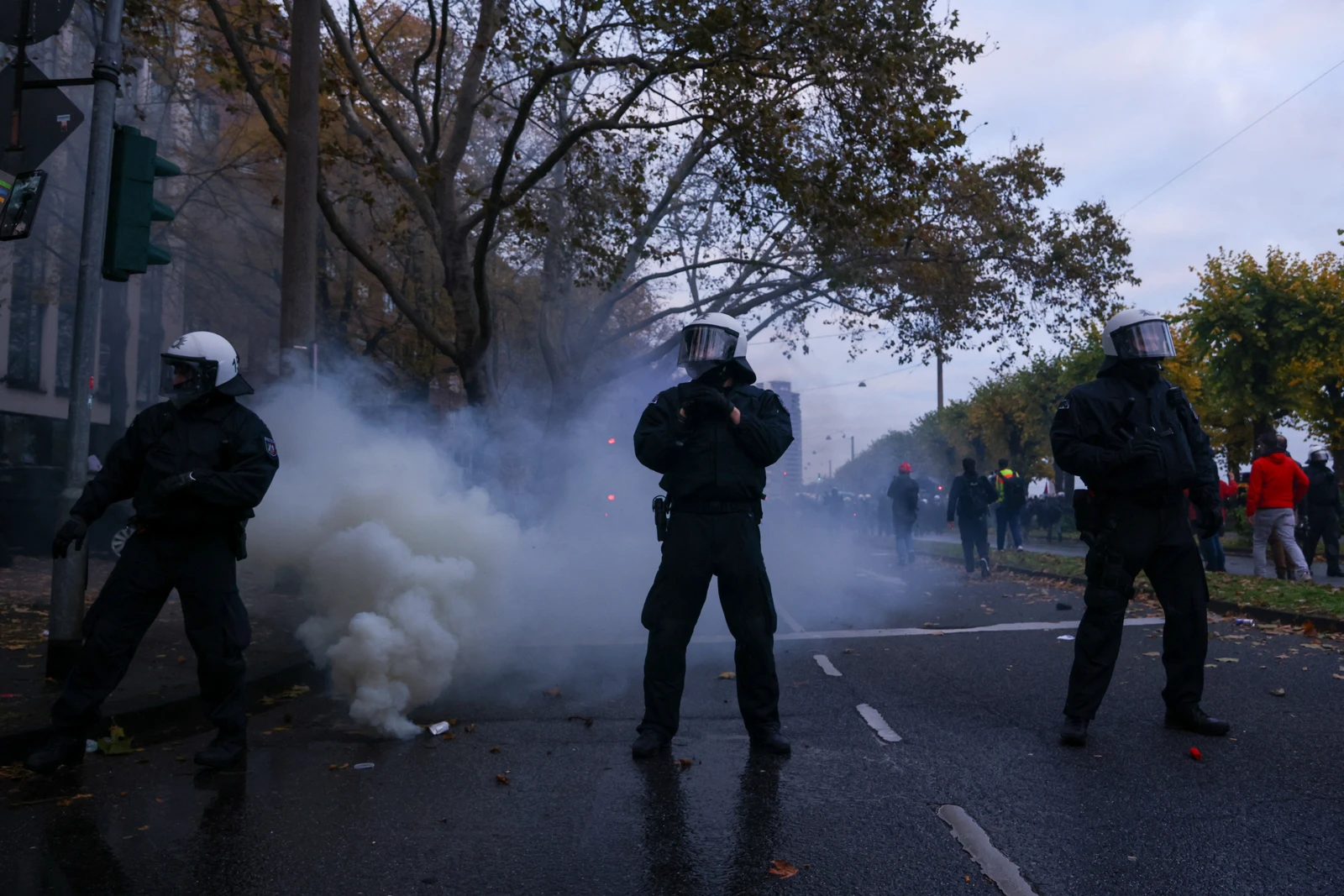
Later, clashes broke out near Porte de Charenton, where the march ended. Protesters hurled glass bottles and fireworks at police. Officers responded with volleys of stun grenades and tear gas. The blasts echoed through the streets, and smoke filled the air as dusk fell.
Many peaceful marchers turned back, coughing, their eyes streaming with tears, and left the march, some scattering into the nearby Bois de Vincennes, one of the largest parks in Paris.
Police impose curfew and other measures
The rallies started last month as a movement of high school students protesting neglected buildings, teacher shortages and a university admissions system seen as unfair to disadvantaged students. Labor unions and others angry at President Emmanuel Macron joined in with a variety of demands.
While the vast majority of protesters have been peaceful, groups of troublemakers routinely target police with fireworks and projectiles. Some protests have degenerated into rioting and looting — including unrest on Oct. 17 that appeared to take the government by surprise. Police have responded with tear gas, dispersion grenades, water cannons and other tactics that have resulted in severe injuries.
Protests took place in Germany, Portugal and the Netherlands
In Germany, a youth initiative called “Gen Z regelt” — roughly “Gen Z’s got this” — rallied in more than 30 cities “for education, health, climate protection and an affordable life,” and against any return of military conscription. Organizers said that tens of thousands participated in the protests across the country, but official figures weren’t immediately available.
In Berlin, young protesters also gathered at Brandenburg Gate on Saturday afternoon, demanding more investments in education and housing.
Later on Saturday, police ended a protest march early in the western city of Cologne after protesters used pyrotechnics, threw stones at them and covered their faces despite a ban. Police also used water cannons to disperse demonstrators. In the northern city of Hamburg, some protesters also shot pyrotechnics toward police and burned down barricades. Police used water cannons and tear gas to disperse the crowds in Hamburg. In Frankfurt, protesters pummeled police with stones, injuring several officers, one of them severely, police said.
Thousands of protesters, including families with small children, converged in downtown Lisbon to peacefully protest Portugal’s housing crisis.
In The Hague, Netherlands, there was a strong police presence in and around the downtown shopping area on Saturday afternoon after online appeals for protests and fears of rioting and looting.