The Masmak Palace is a tourists’ favorite and a must-visit destination in the capital city of Saudi Arabia. Not only do Saudis and expatriates appreciate the majesty of this vast architectural wonder, but it draws interest from across the world as well. However, while we all know about the Masmak Palace and most of us have paid a visit to it at least once, we often overlook the secrets this monument has in store for us.
So, here are some facts that you probably did not know about the Masmak Palace that glorifies the streets of Riyadh. In fact, in the heart of Riyadh’s old quarters, Masmak Fort is a magnificent citadel that takes us back to the history of Saudi Arabia. This is the fort stormed by the late King Abdul Aziz Ibn Saud in 1902, creating a turning point in the history of the Arabian peninsula. You can still see his spearhead embedded in its wooden gate.
Today, Masmak Palace is an acute and virtually official symbol of the pivotal rise of the Saudi nation. An episode dramatically recreated in a short film that plays in Masmak’s museum tells the historic story even today. Amid its halls and rooms displaying photographs, weapons and armor, there is a plaque commemorating Saudi Arabia’s national day that refers to the late King Abdul Aziz. The Masmak Fort popularly known as Qasr Al-Masmak stands today as a testament to the late King Abdul Aziz’s bravery that led to the reunification of Saudi Arabia.
Masmak Fort captures the feel of old Arabia and the essence of a struggle that created a modern Saudi state today. As a preserved piece of history, the actual location of the capture of Riyadh by the young Abdul Aziz Al-Saud, it is a great privilege to visit. There is additional interest in the surrounding sights — the grand mosque, Deira Souk and Chop Chop Square.
Within the fort, visitors can find traditional dresses and crafts, a diwan with an open courtyard, functioning well, and a mosque besides many other attractions that are a feast for the eyes. Just 200 meters southeast of Masmak Fort is Al-Thumairi Gate, one of the nine gates that once served the purpose of entering into the city. The walls surrounding the gate were pulled down in 1950. The fort building played a major part in the Kingdom’s history, as it was here that the recapture of Riyadh occurred on Jan. 14, 1902.
Today, the fort is one among several buildings that form the huge King Abdul Aziz Historical Center (KAAHC), consisting of a cluster of other restored buildings in Riyadh. Centennial celebrations of these buildings were held way back in 1999. But the Masmak Fort is an interesting monument to watch. Its palm tree gate is 3.65 meters high by 2.65 meters wide. There is an opening in the center of the door, called Al-Khokha, which is just big enough for one person to pass at a time, and is a defensive feature designed to allow people in and out without opening the door.
The roofs are covered with painted palm trees, taramic and ethel wood. The building received some important renovation in the1980s, and became a rich museum in 1995. The museum includes a display of a range of antics from primitive guns and costumes to a number of agricultural artifacts. In fact, the museum conjures up the ancient history of Saudi Arabia in particular and of the Arabian peninsula in general. Visitors to the fort can travel back in time and witness how the late King Abdul Aziz besieged and conquered it.
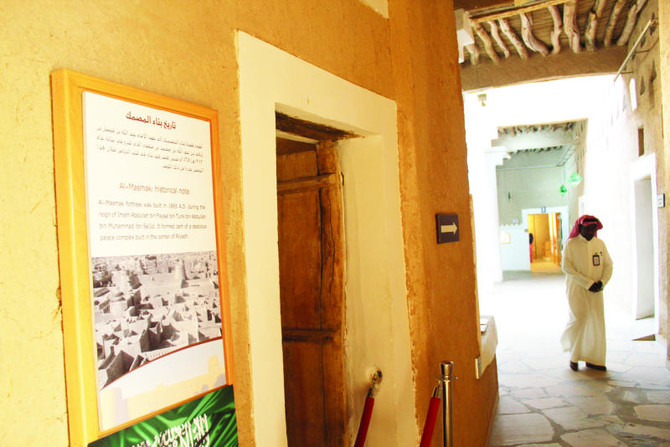
The details of this event are illustrated through a picture at the entrance of the museum today. The Masmak Fort primarily served as a military post and an ammunition storehouse until it was acknowledged as a patrimonial symbol of the establishment of Saudi Arabia. The museum lives up to expectations and lures one and all. It shows mementos of the Kingdom’s historic past, including some 20 pictures of palaces found in various parts of the Kingdom.
Apart from the museum, there are other attractions in the area. This includes the Riyadh governor’s office, whose size and architecture is something to behold. Visitors go to the governor’s office for various reasons. The Masmak Fort, the governor’s office, the mosque, and the buildings of the religious police form a circle that is popular with tourists, besides being the seat of the local Riyadh governorate.
At its center is a wide concrete space where the children play at sunset. During Haj holidays recently, more than 25,000 people visited the area, according to Naseer Al-Oraifi, the Masmak museum’s director. Visitors include diplomats from different countries, expatriates and Saudi families.
It is important to mention here that Masmak Fort today is considered one of the most important historical landmarks in the Kingdom. The word ‘Masmak’ means a high, strong and thick building. It has been built in Mohamed Bin Rasheed’s era in 1289 AD. In the beginning of the Saudi state, this building was used as an armory until it was made into an archaeological attraction and a museum.
In 1902, during Abdul Aziz Al-Saud’s drive from Kuwait to capture the Najd, the fort was taken by Al-Saud and marked the passage of the city of Riyadh — then only a small village — into the hands of the Al-Sauds. It was a watershed moment for the establishment of Saudi power, which eventually paved the grounds for the late King Abdul Aziz to establish a modern Saudi nation.
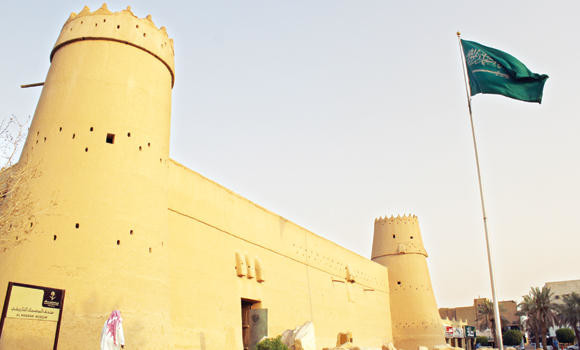
The fort is built in traditional Najdi style, with round conical towers and thick, red-brick walls showing sparse, geometric designs. It is open to the public. In 1995, King Salman, the then Riyadh governor, opened the Masmak Historical Museum. Today, it is a rich museum. The museum contains photographs, maps, models, display cabinets, some old weapons, traditional objects, exhibition and audio-visual halls. The museum receives visitors from 8 a.m. to 12 p.m. noon and in the evening from 4 p.m. to 9 p.m. daily. Mondays and Wednesdays are reserved for families. It is closed on Friday mornings.
—
Email: [email protected]


![]()
![]()
![]()
![]()
![]()
![]()
![]()
![]()
Masmak Fort: The birthplace of modern Saudi nation


Masmak Fort: The birthplace of modern Saudi nation
Latest updates


© 2026 SAUDI RESEARCH & PUBLISHING COMPANY, All Rights Reserved And subject to Terms of Use Agreement.