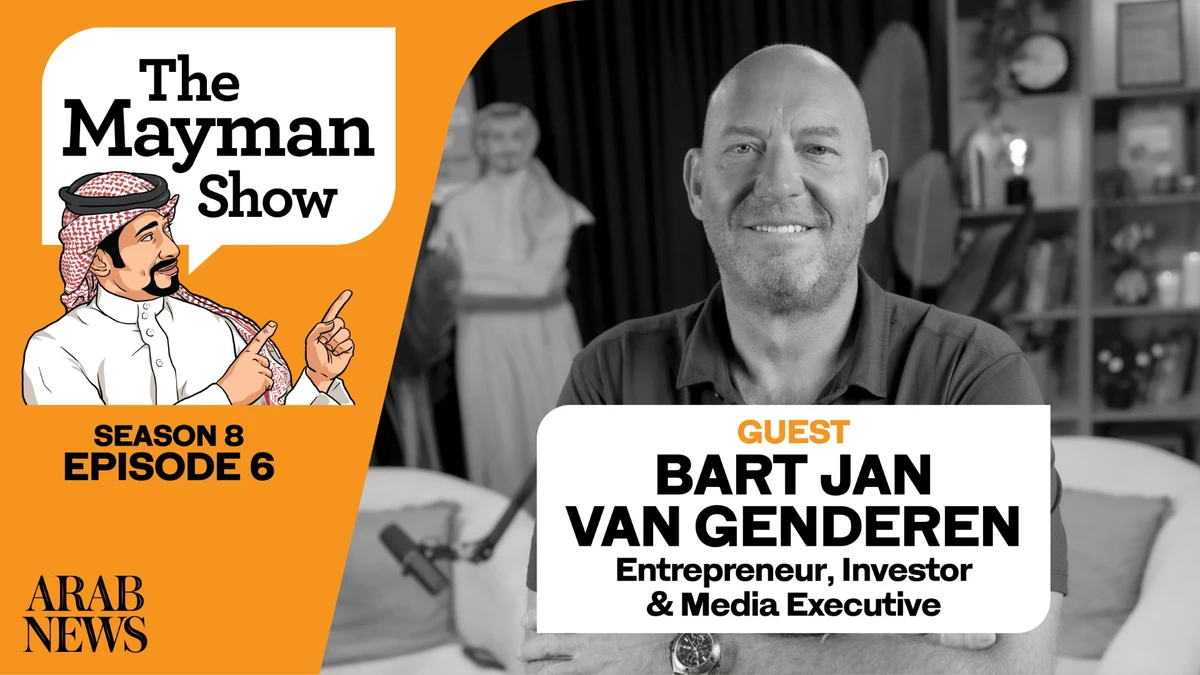
RIYADH: Great television does not begin when the cameras start rolling — it begins with people who know how to recognize an idea, nurture talent and bring stories to life.
Bart-Jan van Genderen has spent decades doing just that. From helping build the production infrastructure behind some of the world’s most successful television formats to investing in the next generation of entrepreneurs, his career has been driven by one question: How do you turn potential into global success?
Van Genderen’s journey took him from life as a cameraman to the creation and growth of Consolidated Media Industries. “In the beginning of my career, I specialized quite quickly as a cameraman in war environments,” he said. “So, I did that for eight years. I had a lot of time traveling, sitting on planes and thinking how I could grow a company because that was a wish from when I was a small kid.”
He finally found the courage to build a company of his own: “I started out as a cameraman and renting out camera crews and I thought, OK, what else is there in this industry?”
When van Genderen started to explore other skills necessary for production and learned about the editing process, he says: “Then I fell in love with multicam, and that’s how my company evolved. I wanted to become a full-service media production facilitator. So, I had everything ... sound, light, editing — everything you basically need to create a TV program. And through acquisitions in the years, I became the biggest in the Netherlands.”
As someone who has worked on international successes such as “The Voice” and “Big Brother,” van Genderen explains that experimentation and ingenuity are key for success.
“I think that’s a bit of luck,” he said. “We’re a small country with small budgets, and where you have small budgets, people become really creative to still deliver the highest standards in the most efficient way. So, I think we’re brought up to do everything hugely efficiently.”
He added that Dutch media tycoon and television producer John del Mol, widely recognized as the mastermind behind some of the most successful and influential reality television and game show formats, completely reshaped global entertainment.
Because the Netherlands is a small country, added van Genderen, television stations are more willing to trial new concepts
“They needed airtime to prove their success,” he explained. “I mean, ‘Big Brother’ was hugely controversial when it started, because basically it’s a viewing show, and it took a tremendous amount of persuasion (by) the producer, John de Mol, to the TV station to actually air. It took him years … I mean, if you look at the culture we’re in now, it’s even unthinkable, this concept, but in actual fact, that TV program, it did a lot more than become a success — I think it changed television forever.”
The show then gave other reality-based shows, such as “The Voice” and “Idols” a space in which to exist.
“‘The Voice’ has a very big twist. It’s basically inviting people who are already good at something to excel and give them a podium, whereas ‘Idols,’ you could stand on the spot. I mean, the first few shows are about laughing,” said van Genderen, adding that timing was everything.
With “The Voice,” he (John del Mol) ended up doing it at the right time and with ‘Idols’ it was also the right time. People were less into laughing at people but wanted to see real talent excel,” he said.
Both shows have sustained a cult following that over-shadowed other successful reality shows.
“There are a lot of shows like ‘Fear Factor’ that were also very successful that nobody ever heard about,” van Genderen said.
Setting up technical production for a show like “Big Brother” was far from simple, he explained.
“It was especially interesting, because, technically, it was an impossibility. I mean, huge amounts of cameras. People hidden in rooms. We didn’t have the technology you have today. So, cameras weren’t small. You had alleys built. It was a huge challenge.”
After a career spent recognizing talent in the entertainment industry, van Genderen can now identify qualities before anyone else sees their potential. To him, Saudi Vision 2030 provides a plethora of opportunities.
“If you look at Vision 2030, everybody in this country (Saudi Arabia) knows about it, knows where it’s going, and it gives a tremendous amount of energy. And when all these people decide that something is going to happen — yeah, it excels speed. Things that take five years in any other country, here might take a year,” he said, saying the vibe it created was addictive.
“What I really like, and I was missing in my life in Europe, is that here, everyone’s building. You know, everyone wants to create. I think in the Western world we’re more about optimization, and it’s a different feeling. And I’ve come to the conclusion that I’m a builder, you know, so — I want to build,” he said.