JEDDAH: More than 50 Saudi artists and craftspeople came together to reinterpret the Kingdom’s heritage through the historic art of miniature painting, transforming local stories, traditions and memories into contemporary works.
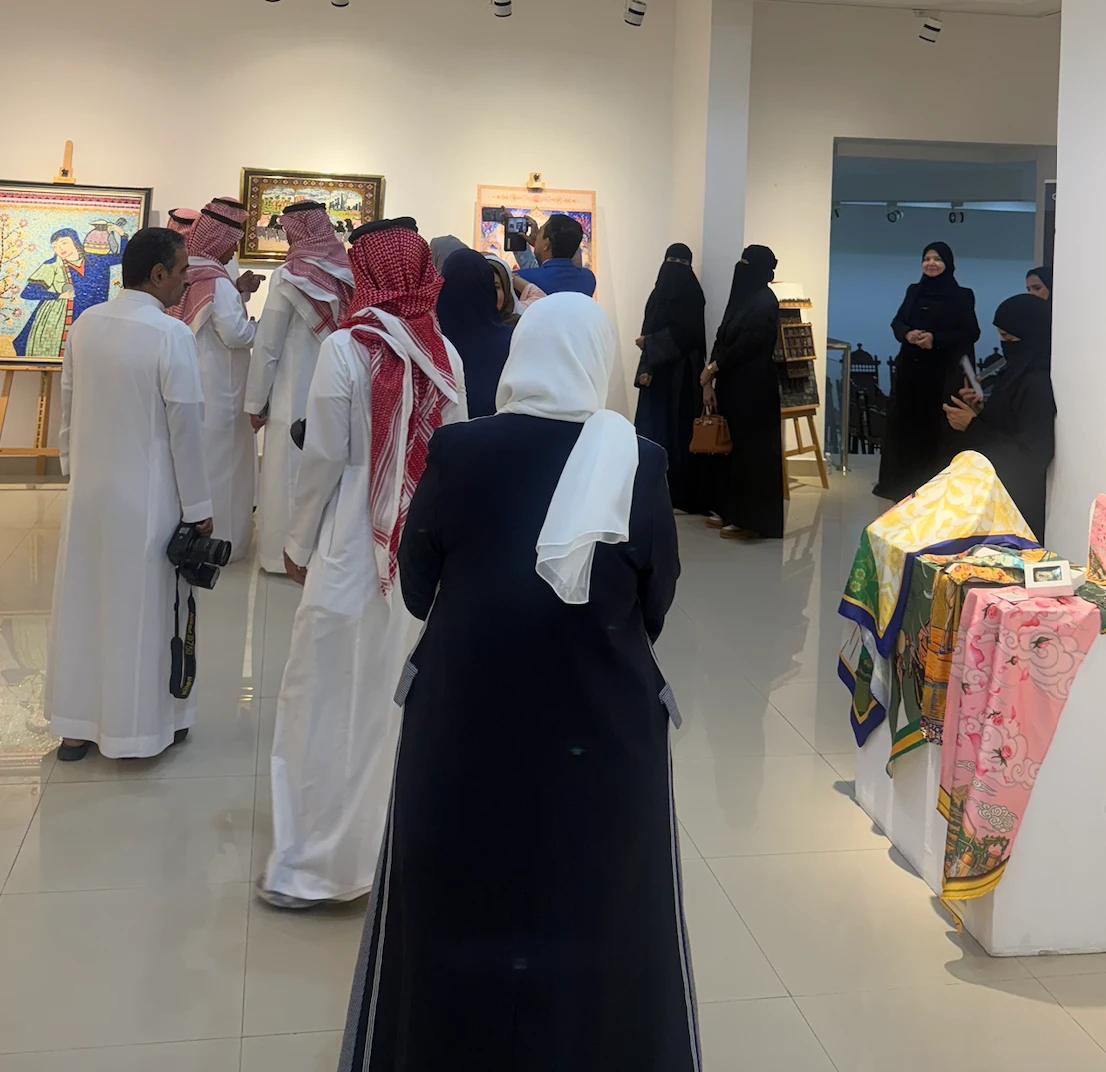
Held on Monday at the Saudi Center for Fine Arts in Jeddah, the exhibition showcased works created as part of the “Saudi Miniatures” initiative, organized by Wasl Cultural Center and sponsored by Bank Aljazira through its Sustainability and Social Responsibility Group.
The initiative explored how an ancient Islamic art form can provide a contemporary visual language for documenting Saudi identity and its diverse cultural heritage. “We launched the program because miniatures are an ancient Islamic art form that we chose for their authenticity. It is not an imported art form, and its visual language despite its age has the capacity to accommodate contemporary subjects,” said Jawaher Al-Zahrani, executive director of Wasl Cultural Center, and Ghada Bafalah, partnerships director at the center.
“Our aim was not to reproduce the miniature in its historical form, but rather to draw inspiration from its principles of compression, storytelling and attention to detail, and then give the artist space to reinterpret it from within their own Saudi environment and memory,” the organizers said.
Artists were encouraged to draw from architecture, clothing, crafts, dances, stories, social practices, daily life and natural environments across the Kingdom.
“From the beginning, we did not want Saudi Arabia to be a decorative addition to the miniature. Rather, we wanted it to be the source of the story itself,” Al-Zahrani said, adding, “We did not restrict them to a particular region, because one of the most beautiful elements of Saudi identity is the immense diversity between the Kingdom’s regions. In the works, visitors will find references to the Hejaz, Najd, Asir, Jazan and other regions, and details from architecture, textiles, ornamentation, clothing, customs and local stories.”
“Thus, we are not looking for one Saudi form of the miniature, but for multiple miniatures reflecting the diversity of Saudi stories themselves.”
The exhibition took the art form beyond paper, with works spanning sculpture, textiles, embroidery, crystal, jewelry and three-dimensional pieces, as well as unconventional materials such as ostrich eggs and furniture. Among them are a gypsum-carved depiction of a Saudi dance, a textile piece inspired by a folk tale, crystal works, an ostrich egg artwork evoking an aspect of Quran preservation rituals, a chair carrying a series of interconnected stories, and miniature models recreating Saudi cities and environments.
The artists were chosen for their openness to experimentation and their ability to approach heritage as material for research rather than something to reproduce. “What mattered to us was an artist who could view heritage as material for research and reinterpretation, rather than as a ready-made model to be repeated,” Bafalah added.
Participating artist Ishraq Al-Oyouni said, “I focused on Saudi and Gulf heritage and identity, drawing inspiration from the local environment, customs, clothing, crafts and architecture. Through my practice, I established an artistic direction that I called ‘Gulf Miniatures,’ which uses the techniques and spirit of miniature art to express our stories and local identity through a distinctive visual style.”
She has taken the form beyond paper, working with ceramics, woven palm fronds and wood, while focusing particularly on the heritage of the Eastern Province and Qatif.
“Through miniatures, I seek to transform these details and memories into visual stories that preserve our identity and pass it on to future generations,” she said.
Her approach has also shaped her understanding of the possibilities of the art form.
“I maintained the precision of detail, ornamentation and spirit of traditional miniature art, while developing a contemporary style that carries my identity and Gulf environment. Throughout my practice, I discovered that Saudi heritage is extremely rich in details and stories that can be visually reinterpreted, and that miniatures can be a contemporary language for documenting this heritage,” Al-Oyouni added.
Another artist, Nada Al-Omawi presented ‘In the Presence of Makkah,’ which focused on the spiritual, social and cultural memory of Makkah and its surroundings through contrasting day and night scenes.
The daytime composition features the Grand Mosque, Jabal Al-Nour and the Cave of Hira, pilgrims’ tents, sacrificial animals, Makkans and a man from Bani Shaiba carrying the key to the Kaaba.
The nighttime scene depicts Al-Ta’sheer, traditional Makkawi gatherings and games including conquián and carrom, along with Al-Kharrar waterfall in Wadi Numan, the Shuaiba coast, the Hijazi groom’s procession and old Makkawi houses.
Al-Omawi moved the work beyond paper, using an old chair as its foundation and combining acrylic paint, gold leaf, fabric and wood. “During the process of creating the work, I discovered that the Makkah and Hijaz environment is endlessly rich in visual stories that can be brought back to life. The fine details of facial features, traditional clothing, popular lighting such as the ‘atreek,’ and rituals of celebration and daily gatherings represent a gold mine of inspiration,” she said adding, “It proved to me that the miniature, through its flexibility, can accommodate the details of our local identity and convey them to future generations in a contemporary form.”
For the organizers, that ability to reinterpret heritage is central to keeping it relevant.
Commenting on it Al-Zahrani said, “I believe heritage is preserved when it remains capable of producing new meaning. If we simply display a craft or heritage element as it has been passed down to us, we preserve it, and that is important. But when we allow a young artist to understand it, explore it and then reinterpret it in their own language, we give it another opportunity to live.”
“That is why we want Saudi Miniatures to contribute to moving the relationship with heritage from observation to practice, and from reception to production. We hope Saudi visual and craft heritage will become, for young artists, a continuous source of innovation rather than material associated only with the past.” they said.
Saudi Miniatures reimagines heritage through contemporary art