- Elshahed is also the founder of Makhtut Studio, which integrates design with artistic experimentation,
RIYADH: Saudi artist and calligrapher Abdelrahman Elshahed brought historical poetry and Arabic calligraphy to life using raw, natural inks during an immersive and educational evening of cultural celebration on Tuesday.
“Calligraphers in the past used to make their inks themselves; they would get them from natural materials, such as some flowers … in our case, for example, the coffee — we grind it and then mix it with natural materials,” he said during the event, held at Diriyah’s Bab Samhan Hotel.
“Natural materials, for example like [Arabic] gum, also like honey, like vinegar … are mixed together so that they give us an ink that lasts for hundreds of years. The brown color is inspired by Saudi coffee ink,”
Elshahed, who is also the founder of Makhtut Studio, which integrates design with artistic experimentation, led an evening of live calligraphy and an educational workshop that featured the Kingdom’s historical works and how natural ingredients were used to leave a lasting impact.
Originally from Makkah, Elshahed trained in Arabic calligraphy at the Grand Mosque, drawing inspiration from the holy city. He has shown his art at major venues including UNESCO in Paris, the Prince Mohammed bin Salman Global Center for Arabic Calligraphy, and the Canadian Museum of Nature.
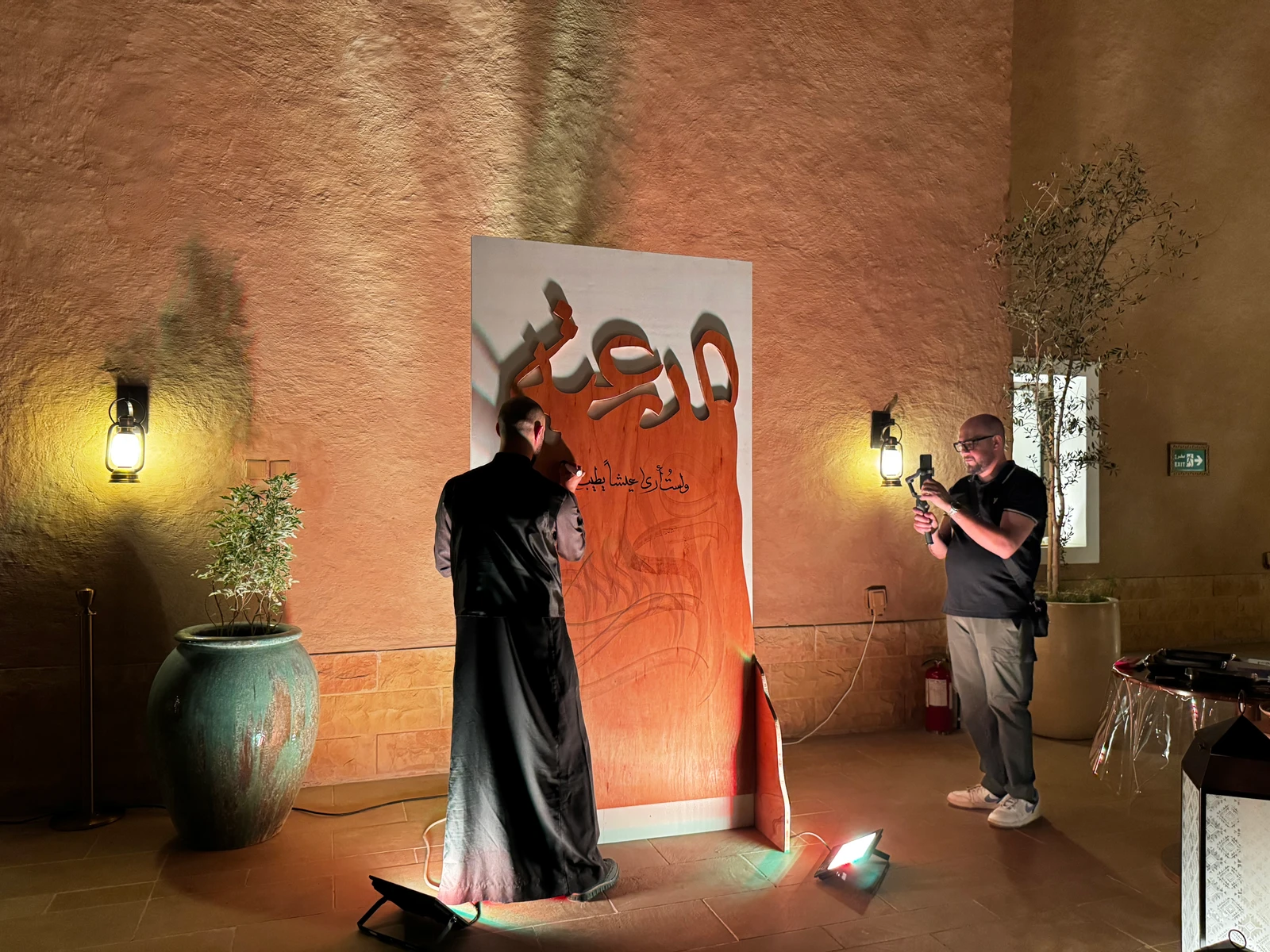
Before the workshop began, in a live performance, Elshahed completed and finalized his latest artwork using coffee ink, recreating the 1,300-year-old-plus poem by Banu Hanifah tribe member ,Yahya bin Talib Al-Hanafi.
“This artwork is a line of poetry over a thousand years old by a poet from Wadi Hanifa named Ibn Talib, who wrote a poem speaking about his love for this place,” the artist said. “The work has very great depth and wonderful philosophy.”
An early classical Arab poet known for his work expressing deep longing, nostalgia and love for his homeland, Yahya bin Talib Al-Hanafi wrote: “And I see no life as pleasant while dealing with separation (al-nawa); yet it used to be pleasant in Al-ʿArḍ.”
In the poem, “al-nawa” refers to distance or separation, while “Al-ʿArḍ” refers to Al-ʿArḍ Al-Yamamah, the historical valley in the Najd region known today as Wadi Hanifa and Diriyah. The line celebrates the natural landscape of Wadi Hanifa, from the greenery to the deep brown soils and palm oases.
Elshahed explained: “Most of the poems of this poet describe his longing and nostalgia for Wadi Hanifa and the places adjacent to it. Like today, we are in Diriyah and Bab Samhan; today, it overlooks Wadi Hanifa; therefore, we chose this verse of poetry: ‘And I do not see a life that is pleasant with separation, but on the land, it was pleasant,’ meaning we can say that Al-Ard is approximately currently Diriyah or the places around Wadi Hanifa.”
By utilizing raw materials found in nature, the performance demonstrated how natural inks, unlike manufactured or synthetic alternatives, create an enduring mark that celebrates thousands of years of poetic heritage.
“And also, the connection mentioned in this work is that today this work traveled more than a thousand kilometers, because its production started from historic Jeddah and its place in my private studio … and today we complete it here in Diriyah,” added Elshahed.
After the live performance, the artist led a workshop where each guest experimented with natural inks to create their own work of art.