JEDDAH: The Jeddah-based Pakistan Repatriation Council (PRC) hosted the 76th anniversary of Pakistan’s Lahore resolution of March 23, 1940.
Ali Al-Ghamdi, former diplomat, presided over the function and guests included Maqboolur Rahman Abbasi, Tayyab Mosani, Shamsuddin Altaf, Mohammad Akram Agha, Zubair Ahmed, Mohammed Akram, Syed Naseeruddin, Mohammed Khaled Jawaid, Syed Wasi Imam, Owais Akram, Naushad Usman and Mohammed Ashfaq Badayuni.
In his presidential address, Al-Ghamdi said on March 23, 1940, thousands of Muslims and their leaders, headed by Quaid-e-Azam Mohammed Ali Jinnah, gathered at Lahore in which Fazlul Haque’s resolution for creation of a separate country for Indian Muslims was unanimously approved.
He praised the role of Allama Iqbal and other leaders for the success of the movement for a separate state. “We always pray for its success, integrity and solidarity, since it gives strength to Ummah,” he said.
Al-Ghamdi said he studied in Karachi, Pakistan, in the late 1970s. “That was the best part of my life.” He said it is the primary responsibility of Pakistan to arrange for the repatriation of those stranded in Bangladesh and settle them in Pakistan.
Shamsuddin Altaf, speaking in Arabic, suggested that government should establish a commission to organize the repatriation and rehabilitation of Pakistanis stranded in Bangladesh.
Maqbool Abbassi said the Lahore resolution was in fact the result of Indian Muslim shoura (consensus) and that resulted in the establishment of Pakistan under the leadership of Mohammed Ali Jinnah. He urged Prime Minister Nawaz Sharif to issue passports to Pakistanis stranded in Bangladesh.
Mohammad Akram Agha praised the leadership of Quaid-e-Azam and hoped the country would get a similar leader to bring Pakistan on the track of his mission.
Mohammad Tayyab Mosani paid rich tributes to Jinnah and said: “We failed to achieve his mission for Pakistan.”
Mohammad Ashfaque Badaoyuni said: “Pakistan is our motherland and we should not abuse it.”
PRC convener Syed Ehsanul Haque said Pakistan was created on the basis of two-nation theory, so Muslims from India migrated to East Pakistan and not to Bangladesh. He said on that basis Kashmir should be part of Pakistan and stranded Pakistanis in Bangladesh should be brought to Pakistan.
The function began with the recitation of the Holy Qur’an by Qari Abdul Majeedi. Poet Syed Mohsin Alavi and Zamurrad Khan Saifi presented poems on the struggle of Pakistan.
Sher Afzal rendered the national song of Pakistan. Saifi conducted the proceedings.


![]()
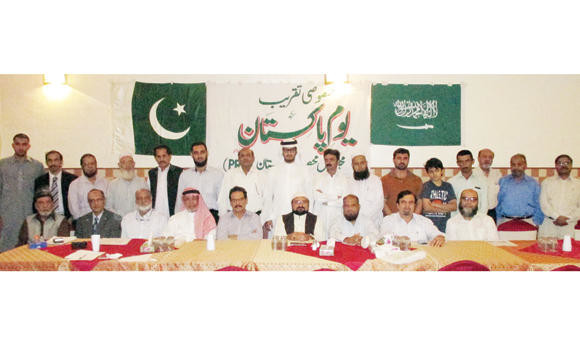
PRC event marks Pakistan National Day
PRC event marks Pakistan National Day
Latest updates






© 2026 SAUDI RESEARCH & PUBLISHING COMPANY, All Rights Reserved And subject to Terms of Use Agreement.