RIYADH: The Saudi government is strongly supporting the development of organic farming and institutional capacity building as part of an ambitious plan to expand the Kingdom’s shift toward organic agriculture, which will be good for the country’s nutritional needs, public health and environment. Plans are afoot to establish more than 20 organic farms within a year from now.
This was disclosed by Ibrahim M. Al-Shahwan, vice chairman of the Saudi Organic Farming Association (SOFA), on Friday. He said that “the government’s incentives for promoting organic farming and the general awareness about he benefits of organic products have led to the establishment of about 145 organic farms so far across different regions of the Kingdom.”
The SOFA deputy chief explained the trends of organic farming in Saudi Arabia, and said that organic agriculture is sustainable and profitable. “Moreover, organic farming cuts down dependence on water by 30 percent, which is indeed better for a harsh environment like Saudi Arabia,” he added.
To this end, he noted that Saudi Arabia also does not allow any genetically modified products like seeds for organic farming. “It is a matter of protection, as changing genetics in organisms can harm human beings,” explained the SOFA deputy chief. He pointed out that SOFA has an in-house farmers’ assistance department to help start-ups and farmers across the country.
Asked about the progress made by the Kingdom in the domain of organic farming, he said that “there were only two farms some 10 years back, and currently the total number of organic farms exceeds 145 in total.”
“Some farms are producing cereals, some are producing vegetables,” said Al-Shahwan, whose own farm grows about 42 diverse products.
The Saudi government supports organic farmers by paying fees for certification, extending support to improve the quality of farming and rendering technical advice. He said that the Kingdom has had a conducive climate to promote organic agriculture.
Organic farming typically refers to the production of fruits, vegetables, grains, and other food products as well as cereals without the use of antibiotics, pesticides, or other items.
On the question of self-sufficiency achieved by the country, Al-Shahwan said that “the Kingdom is self-reliant in the production of eggs, cucumber, tomato, dairy products, and a few other products.” He, however, asserted that the government does not allow these products to be exported outside the Kingdom mainly to save water resources.
Only dairy products including milk are allowed by the Saudi government to be exported. “It will be the better option for a water-starved country like the Kingdom, if we can produce enough for our own consumption, keeping in view the depleting water resources, which cannot be used to grow fruits and vegetables for exports,” he added.
About innovative research being conducted by the Kingdom, especially in the agriculture and organic farming sector, he said that a number of studies and research projects have been undertaken by government agencies and universities in the country. To this end, he pointed out that a research study has suggested neem products to protect date palm trees.


![]()
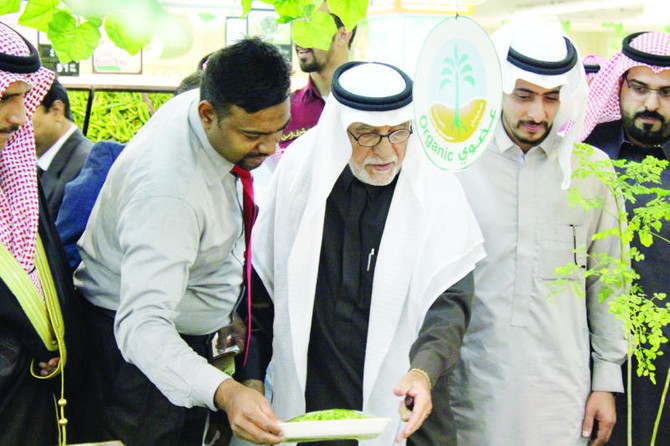
Organic farming becoming more popular with Saudis
Organic farming becoming more popular with Saudis
Latest updates


© 2026 SAUDI RESEARCH & PUBLISHING COMPANY, All Rights Reserved And subject to Terms of Use Agreement.